

Most people land on this question standing between two shopping carts. One holds a wood burning fire pit for around $150. The other holds a propane fire table for three or four times that, and the sales copy is doing everything it can to make wood sound like a chore. The honest answer is that wood burning fire pits have three real advantages over gas, all of them worth having, and every one of them only shows up if you buy the right kind of wood pit. The $80 mesh bowl from the seasonal aisle delivers almost none of them.
Here is what wood actually buys you, what it costs you, and which pit to get for each situation.
The one thing wood gives you that gas cannot
Heat. Not ambiance, not the smell, not nostalgia. Raw usable warmth on a 45 degree evening in October when the whole point of sitting outside is that you are still outside.
Look at the spec sheets and the gap is obvious. Manufacturers rate most propane fire tables somewhere between 40,000 and 60,000 BTU, and that rating is measured at the burner, not at your knees. Gas fire tables also spread that output across a long linear burner sitting under a wide layer of lava rock or fire glass, which looks beautiful and radiates poorly. A full load of seasoned hardwood in a 22 inch steel pit throws heat you can feel from six or eight feet back, and it keeps throwing it from the coal bed for an hour after the flames drop.
This is the practical test. On a gas fire table, people pull their chairs in close and still reach for a blanket. On a wood fire, people push their chairs back. If you are buying a fire feature mainly to extend your patio season into spring and fall, wood wins and it is not close.
The catch is that heat output tracks with fire size, and fire size tracks with pit diameter and wall construction. A 15 inch camping bowl will not warm four people. Look for at least 19 inches of internal diameter if you want a fire that heats a seating circle, and closer to 27 inches if you regularly have six or more people around it.
Cooking over the fire is the second real benefit
You cannot cook over a gas fire table. The manuals say so, the lava rock is not food safe once drippings hit it, and the flame pattern is wrong anyway. Wood gives you a coal bed, and a coal bed is a cooking surface.
The mistake people make is assuming any wood pit can do this. Most cannot, at least not without buying a grate separately, and the accessory grates for the popular double wall pits often cost more than a basic charcoal grill. If cooking is part of why you want wood, buy that capability up front instead of discovering it later.
The BioLite FirePit Plus is the clearest example of a pit built for both jobs. The fuel rack sits low for a normal fire, then raises to bring food within a few inches of the coals, and the grill grate is included rather than sold as an add-on. It also runs a battery powered fan that pushes air through the burn, which is how it gets a cooking bed going in a few minutes instead of the twenty or so a natural draft fire needs. It handles up to four cordwood logs, so it is a small pit. Do not buy it as your primary heat source for a large patio. Buy it if the fire is going to double as dinner.
For a larger pit where cooking is occasional rather than the point, plan on a hinged cooking grate or a swing arm grill that clamps to the rim, and check the fit against your pit diameter before ordering. Rim thickness varies a lot between brands and a grate that does not seat properly is a genuine hazard over a live fire.
Wood is only cheaper if you have a wood source
The “wood is free” argument gets repeated constantly and it is true for maybe a third of the people who read it. If you have trees on your property, a neighbor who drops limbs, or access to a cord of seasoned hardwood at local delivery prices, then yes, your per evening fuel cost is close to nothing and a wood pit is far cheaper to run than a propane table burning through a 20 pound tank every several evenings.
If your wood comes from a bundle rack outside the grocery store, the math flips hard. Those bundles are typically less than a cubic foot of kiln dried wood, they run a few dollars each, and one evening fire eats two or three of them. That is the most expensive way to buy heat in a backyard, and it is worse than propane on a cost per hour basis.
So the question to answer before you buy is not whether wood is cheap. It is where your next 20 fires are coming from and where you are going to keep that wood dry. Wood stacked on the ground under a tarp reabsorbs moisture, and wet wood is the actual cause of most of the smoke people blame on wood pits in general.
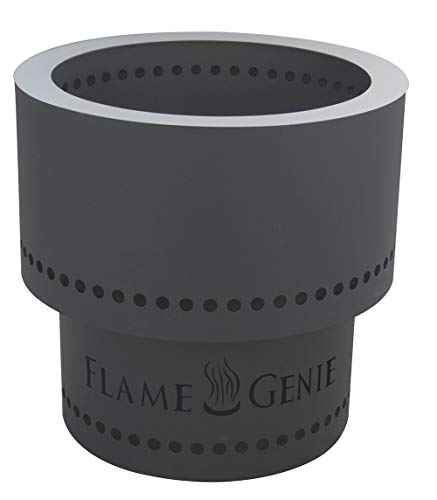
If you have no place to store split logs, which covers a lot of townhouse and small lot owners, the pellet burning route solves it. The Flame Genie runs on standard hardwood heating pellets, the same bags sold for pellet stoves and pellet grills, and a 40 pound bag stacks in a corner of the garage. Pellets are already dried to a low moisture content, so the burn is cleaner and more consistent than whatever bundle wood you happen to find. The tradeoff is that the fire is smaller and more contained, and you will not be stacking logs in it. For a small patio where storage is the binding constraint, that tradeoff is usually worth it.
The smoke problem is now something you buy your way out of
Smoke is the single biggest reason people talk themselves out of wood, and most of the advice about it is a decade out of date. The standard open steel bowl does smoke, it does chase you around the circle, and it does put the smell in your hair. That is a design problem, not a wood problem.
Double wall pits fix most of it through secondary combustion. Air enters vents at the base, travels up the cavity between the inner and outer wall, gets heated on the way, and exits through a ring of holes at the top as preheated oxygen. That hot oxygen hits the smoke as it rises and burns a large share of it before it leaves the pit. Manufacturers describe this as smokeless. It is not. It is a big reduction, not an elimination, and you will still get smoke during the first several minutes before the walls come up to temperature, and any time you load damp wood.

The Solo Stove Bonfire is the reference point for this category for a reason. It is 304 stainless rather than the powder coated mild steel used on cheap pits, which matters because the inner wall of a double wall pit lives at a temperature that destroys coated steel within a couple of seasons. At 19.5 inches and about 20 pounds it is small enough that one person can carry it off the patio and into a shed, and the lifetime warranty is a real signal about how the company expects the steel to hold up.

If the price of the name brand is the sticking point, Blue Sky’s The Peak uses the same double wall secondary burn principle at a lower price and a wider mouth, which makes log stacking easier and gets you a bigger fire for the same effort. It is a heavier, more utilitarian piece of hardware and it looks it. For a fire pit that lives on a gravel pad rather than a designed patio, that is not a real drawback. We compare these and the rest of the category in our guide to the best smokeless fire pits.
One more thing about smoke that nobody selling fire pits will tell you. Pit placement beats pit engineering. A pit tucked against a fence or a house wall creates a dead air pocket that pushes smoke sideways into the seating area no matter how well the pit is designed. Ten feet of clearance in every direction fixes more smoke complaints than an upgrade does.
Wood on a deck, in a small yard, or under HOA rules
This is where a lot of wood pit purchases go wrong, and the constraints are worth checking before the box arrives.
- Wood decks and composite decking. A wood pit on a deck needs a stand that lifts the base off the surface plus a heat shield underneath, and even then some pit models are explicitly not rated for it. Composite decking is the worse case because it softens and scars at temperatures well below what wood boards tolerate. We walk through the specifics in our guide on whether a fire pit can be put on a deck.
- Small yards and close neighbors. If you cannot get 10 feet of clearance from structures and overhanging branches, go smaller rather than skipping the clearance. A 19 inch pit placed correctly is a better outcome than a 27 inch pit crowded against a fence.
- Renters. Every wood pit worth owning is portable, which is the quiet advantage over a gas fire table plumbed to a line. Choose one you can lift alone and check your lease language on open flame before buying.
- HOA rules and burn bans. Wood burning is the fuel type most likely to be restricted, and seasonal burn bans in dry regions apply to wood while leaving propane alone. A spark screen is often the specific thing that makes a wood pit compliant. Check what applies where you live in our breakdown of whether backyard fire pits are legal.
- Kids and dogs. A double wall pit runs hot on the outer wall, not just at the opening, and that surprises people who expect the outside to stay touchable. A surround or a set ring of seating at a fixed distance does more for safety here than any lid.
What a wood fire actually costs you in time
The benefits are real. So is the labor, and the honest version of it is more than “wood needs a little more effort.”
Budget 15 to 20 minutes from striking a match to a fire that is actually warm, and roughly the same at the end, because you cannot walk away from a wood fire the way you can turn a knob and go inside. Coals hold enough heat to reignite dry material for hours. Then there is ash. A regularly used pit generates ash that needs to come out every few burns, and it goes in a metal container, not a plastic trash bin, because ash that looks cold can still hold live embers for days.
Add a cover to the purchase, not later. Water pooling in an uncovered pit is what rusts through the floor of budget models and what clogs the secondary combustion holes on the good ones.
When to skip wood and buy gas instead
There are situations where the wood advantages simply do not apply, and pretending otherwise wastes money.
If your fire is a 30 minute thing after dinner on a weeknight, the startup and shutdown time is most of the evening and a gas unit is the better product. If someone in the house has asthma or a smoke sensitivity, reduced smoke is not the same as no smoke and you should not gamble on it. If you are on a balcony, a rooftop, or anywhere with a hard no on solid fuel, propane is often permitted where wood is not. And if you camp or tailgate with it, a portable propane unit lights in seconds and travels without a fuel supply problem. Our roundup of the best portable propane fire pits covers that side of the decision.
The bottom line on wood burning fire pits
Buy a double wall wood pit of at least 19 inches, in stainless rather than coated mild steel, with a cover, and put it at least 10 feet from anything that can catch. That single specification captures the heat advantage, cuts the smoke objection down to a few minutes at startup, and lasts long enough that the cost per season stops mattering. Everything else in this decision is a detail. If you want the fire to cook as well as heat, buy a pit with the grate included instead of adding one later, and if you have nowhere to stack logs, go with pellets and stop worrying about wood storage entirely.
Last update on 2026-10-07 / Affiliate links / Images from Amazon Product Advertising API
This post contains affiliate links, which means I may receive a small commission, at no extra cost to you, if you make a purchase using these links.


