

A backyard ice rink kit is one of the few purchases in this niche where the weather decides whether the money was well spent before a single skate touches the ice. Prices run from about $50 for a plain liner you drape over packed snow, up to $1,500 or more for a full boarded system with real hockey-height walls. What actually separates a good kit from a wasted winter has less to do with price and everything to do with matching the wall system, the size, and the setup labor to your yard and your climate.
Search for one and the listings all promise the same thing, a smooth sheet of backyard ice by the weekend. Almost none of them explain that a liner-only setup, a steel bracket kit, and an inflatable no-board wall solve genuinely different problems, or that the size you pick changes what the rink is actually good for almost as much as the price does.
That is the gap this guide fills. We compared eight backyard ice rink kits by wall system, size, and what ships in the box, from a bare liner for anyone working with existing snowbanks to a full hockey-length pro kit, so the rink you order actually fits the yard, the climate, and how much setup work you want to do.
Our Quick Picks
- Best overall, NiceRink Rink-in-a-Box 16×28. A complete bracket-and-liner starter kit from the brand most backyard rink builders already trust.
- Best for small yards and tight budgets, Iron Sleek Skating Rink Kit 20×20. A compact bracket system sized for a starter rink without a full-yard commitment.
- Best liner-free system, Rink Wizard Dreamscape Series. Reusable panel boards that skip the liner entirely and leave the grass underneath alone.
- Best for real hockey use, Rink Wizard Warrior Series. The same liner-free panel system in a 16 inch board height built for shooting and checking, not just casual skating.
- Best no-boards-to-build setup, Ice N’Go EZ Rink 2.0 Kit. An inflatable wall system that skips the plywood and brackets other kits ask you to source yourself.
- Best budget DIY option, Iron Sleek White Plastic Ice Rink Liner. A standalone liner for anyone building walls out of snowbanks or leftover lumber instead of buying a full kit.
How the Eight Backyard Ice Rink Kits Compare at a Glance
| Kit | Size | Wall system | What’s included | Best for |
|---|---|---|---|---|
| NiceRink Rink-in-a-Box 16×28 | 16 x 28 ft | Brackets plus liner, boards sold separately | Brackets, liner, patch tape, glue, logo puck | First-time builders wanting a complete starter system |
| NiceRink Rink-in-a-Box 20×40 | 20 x 40 ft | Brackets plus liner, boards sold separately | Brackets, liner, patch tape, glue, logo puck | Bigger families and multi-kid households |
| Iron Sleek Skating Rink Kit 20×20 | 20 x 20 ft | Steel brackets plus liner, boards sold separately | Liner, brackets, corner bracing, hardware | Small yards and first-time builders |
| Iron Sleek Skating Rink Kit 30×45 | 30 x 45 ft | Steel brackets plus liner, boards sold separately | Liner, brackets, corner bracing, hardware | Larger yards wanting real skating room |
| Rink Wizard Dreamscape Series | 12 x 16 ft per kit, stackable | Liner-free interlocking panel boards, 8 inch height | Panel boards, ground spikes | Protecting grass, casual and figure skating |
| Rink Wizard Warrior Series | 12 x 16 ft per kit, stackable | Liner-free interlocking panel boards, 16 inch height | Panel boards, ground spikes | Hockey and puck containment |
| Ice N’Go EZ Rink 2.0 Kit | 23 x 34 ft | Inflatable tube wall plus liner | Liner, inflatable wall system, inflation pump | Avoiding plywood boards and bracket assembly |
| Ice N’Go Pro Rink Kit | 16 x 40 ft | Inflatable tube wall plus liner | Liner, inflatable wall system, inflation pump | Hockey-length rinks for serious training |
| Iron Sleek White Plastic Ice Rink Liner | 25 x 25 ft | Liner only, no wall hardware | 6 mil plastic liner | DIY builders using snowbanks or their own lumber |
The Wall System Decides How Much Weekend This Project Actually Costs You
Every backyard ice rink starts from the same basic idea, a flat, level, contained area that holds a few inches of water long enough to freeze solid. What changes from one kit to the next is how that containment actually happens, and that single choice affects the budget, the setup time, and how much of the yard survives the winter underneath it.
A bracket-and-liner kit, the style NiceRink and Iron Sleek both sell, is the traditional approach. Steel or plastic brackets hold plywood or dimensional lumber boards upright around the perimeter, and a heavy vinyl liner drapes over the boards and the ground to hold the water. It is the cheapest system per square foot, but it also asks the buyer to source and cut the boards separately, usually three to six sheets of plywood depending on wall height, which is real money and real time the kit price does not include.
A liner-free panel system, like the Rink Wizard kits, flips that tradeoff. The boards themselves are the product, reusable panels that interlock and stake into the ground without any liner underneath at all. Water sits directly on frozen ground or a snow base, which means no plywood to buy and no liner to patch, but also means the panels alone cost more up front than a bracket kit’s hardware. An inflatable tube system, the approach Ice N’Go and EZ ICE built their businesses around, splits the difference again, skipping both the plywood boards and the multi-piece bracket assembly in exchange for a wall that has to be inflated and deflated with the seasons.
Size Should Match What You Are Actually Going to Do on the Ice
A 16 by 28 foot rink, the smaller NiceRink size, comfortably holds two or three kids skating in loops or a parent teaching a toddler to stand up on skates for the first time. It is not big enough for anything resembling a real hockey game, and it was never meant to be. Step up to 20 by 40 feet or the 23 by 34 foot Ice N’Go EZ Rink, and there is enough room for casual shooting drills and a genuine game of pickup with a handful of players.
The 16 by 40 foot Ice N’Go Pro Rink Kit and larger Iron Sleek configurations exist for a different buyer entirely, a family or a youth team serious enough about practice that a regulation-adjacent length actually matters for passing and skating drills. Bigger is not automatically better here. A rink sized for a full team in a yard that only ever sees two kids skating after school is more square footage to flood, level, and maintain than most households will use.
Your Climate Decides Whether Any of This Works Before Size Even Matters
This is the detail almost no listing mentions, and it matters more than wall material or brand. A backyard rink needs a sustained stretch of nights at or below roughly 25 degrees Fahrenheit to freeze a full flood of water into skateable ice, and it needs that cold to hold, not just touch freezing for a single night. A climate with reliable weeks of hard freeze in December and January makes any of these kits a straightforward seasonal project. A climate with a lot of freeze-thaw swings back and forth across 32 degrees turns the same project into a repeated cycle of flooding, partial melting, and refreezing that never quite produces a clean, smooth sheet.
None of that means a marginal climate rules out a backyard rink entirely, but it does mean the smaller, cheaper kits make more sense there than a large hockey-length build. A rink that only holds good ice for two or three weeks a year is a better fit for a modest 16 by 28 foot footprint than for a 40 foot pro-length investment.
Ground Prep Matters More Than the Kit You Buy
Every manufacturer in this category says the same thing for a reason, a rink is only as level as the ground underneath it. A slope of even a few inches across the footprint pools water unevenly, leaving thin, weak ice on the high side and a genuinely deep pool on the low side that takes far longer to freeze solid and skates unevenly once it does. Checking the site with a level, or a simple string and line level across stakes, before ordering a kit sized for that exact footprint saves a frustrating first flood.
Grass and lawn health is the other half of ground prep. A liner-based kit protects the grass underneath from the direct weight and cold of the ice, and most lawns recover fine once the rink comes down in spring. A liner-free panel system sitting directly on frozen ground, or a rink left up well past the point the ground would normally thaw, is harder on the lawn underneath and worth planning for if a pristine spring yard matters.
Our Reviews of the Eight Best Backyard Ice Rink Kits
The NiceRink Rink-in-a-Box 16×28 Is the Safest First Rink to Build

NiceRink built its name on backyard rinks specifically, and the Rink-in-a-Box starter kit shows it. The 16 by 28 foot package includes 26 patented brackets, a liner sized generously larger than the footprint itself, patch tape, underwater glue for repairs, and an instructional video and catalog that walks a first-time builder through the whole process.
The bracket system is the real reason this kit earns the top spot. It adapts to uneven ground better than a plain lumber-and-stake approach, holding boards upright without needing a perfectly graded site first. Buyers still need to source their own plywood or NiceRink’s plastic boards separately, generally three to six sheets of three quarter inch CDX plywood depending on how tall the walls go, so budget that in before comparing this price against a fully boarded kit.
At 16 by 28 feet, this is a family rink rather than a hockey rink, plenty of room for a couple of kids skating loops or learning to stand up, not a full game. A 20 by 40 foot version of the same kit exists for households that outgrow the smaller footprint.
Pros
- Bracket system adapts to uneven ground
- Generously sized liner with patch kit included
- Clear instructional video walks through setup
- Trusted, rink-specific brand with a long track record
Cons
- Plywood or plastic boards are a separate purchase
- 16x28 footprint is for family skating, not real hockey
- Assembly still takes a full weekend for a first build
The verdict: Buy it if this is your first backyard rink and you want a system that forgives an imperfect yard. Budget separately for boards before comparing the price against fully boarded kits.
The Iron Sleek Skating Rink Kit 20×20 Fits a Yard That Cannot Take a Full-Size Rink

Iron Sleek’s steel brackets are engineered, literally, by founders with an engineering background who designed the corner and side connections to stay rigid once frozen into the ground rather than cracking the way cheaper plastic brackets can in deep cold. The 20 by 20 foot kit ships with a white ice liner sized to the footprint, the bracket hardware, and corner bracing, with buyers supplying their own lumber for the actual boards.
A square 20 by 20 foot footprint is the practical floor for this category. Smaller than that and there is not enough room to skate a real loop. At this size, a side yard, a section of a fenced backyard, or a spot next to an existing patio can usually take the rink without swallowing the whole property, which is exactly the audience this size targets.
Iron Sleek sells more than fifty size configurations built around the same bracket system, so a buyer who outgrows this footprint can move up within the same brand and the same familiar hardware rather than starting over with an unfamiliar system.
Pros
- Steel brackets engineered to stay rigid in deep cold
- Compact 20x20 footprint fits smaller yards
- Same bracket system scales up across fifty-plus sizes
- Straightforward, no-frills kit at an accessible price
Cons
- Lumber for boards is a separate purchase and project
- 20x20 is the practical minimum for real skating room
- No pre-cut boards included despite the bracket precision
The verdict: Buy it for a small yard that still wants a real bracket-and-liner system instead of a scaled-down toy version. Size up within the same Iron Sleek lineup later if the footprint feels tight.
The Iron Sleek Skating Rink Kit 30×45 Is Built for a Yard That Can Actually Fit a Game
Same bracket system and the same engineered steel hardware as the smaller Iron Sleek kit, scaled up to a footprint that genuinely supports a pickup game rather than solo skating loops. At 30 by 45 feet, there is room for several players to pass, shoot, and actually skate at speed without constantly running into the boards.
The tradeoff scales with the size. More brackets means more assembly time, more liner to lay and seam correctly, and a meaningfully larger lumber order for boards than the 20 by 20 kit needs. Iron Sleek’s own sizing guidance is worth following here, order a kit slightly larger than the exact footprint desired, since a liner and bracket run that comes up just short at the corners is a frustrating problem to solve mid-build.
Pros
- Real game-sized footprint for multiple skaters
- Same trusted engineered bracket system as the smaller kit
- Scales cleanly with Iron Sleek's other size options
- Handles the flex and load of active hockey play
Cons
- Significantly more lumber and liner work than smaller kits
- Longer, multi-day assembly for most households
- Needs a genuinely level, open yard to make sense
The verdict: Buy it if the plan is real pickup games with more than one or two skaters. Make sure the yard has the open, level space to actually support it before ordering.
The Rink Wizard Dreamscape Series Skips the Liner and Protects the Grass
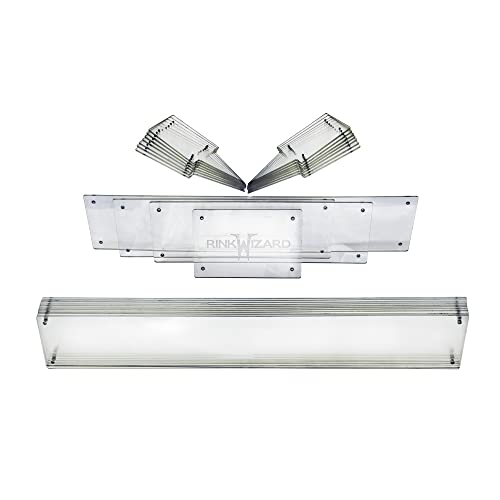
Every kit above relies on a liner sitting directly on the ground for the whole season. The Dreamscape Series takes a different approach entirely, interlocking panel boards made from a flexible, impact-resistant material that assemble into a full perimeter using ground spikes, no liner involved at all. At 8 inches tall, the boards are built for recreational skating and figure skating rather than hard puck contact.
Because there is no liner draped across the grass for weeks at a time, the lawn underneath fares noticeably better once the panels come down in spring, a real advantage for anyone who cares about how the yard looks in April. The panels store flat in the off-season and carry a 3 year warranty against breakage, and multiple base kits can combine to cover a larger footprint than the standard 12 by 16 foot size.
The base kit’s price sits above a comparable bracket-and-liner setup once boards are factored in, since the panels themselves are the premium part of the purchase. For a household that reuses the same panels winter after winter, that cost spreads out fast.
Pros
- No liner means real protection for the lawn underneath
- Panels store flat and reuse for years, backed by a 3 year warranty
- Multiple kits combine to scale up the footprint
- Faster teardown than a liner-and-lumber system
Cons
- 8 inch board height limits it to recreational skating
- Higher upfront cost than a basic bracket-and-liner kit
- Base 12x16 footprint needs multiple kits for a larger rink
The verdict: Buy it if a healthy lawn every spring matters as much as the rink itself, and recreational skating is the goal rather than hard hockey contact.
The Rink Wizard Warrior Series Is the Liner-Free Kit Built for Real Hockey
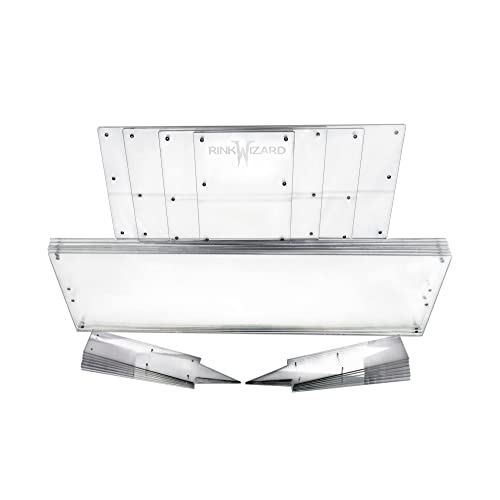
Same liner-free panel system as the Dreamscape Series, built to a 16 inch board height instead of 8 inches. That extra height is the entire point. It keeps pucks and shots inside the rink during actual hockey and ringette play, something the shorter recreational boards were never designed to contain.
The panels are described by the manufacturer as flexible and impact-resistant, built to take repeated puck and body contact across a season without cracking in the cold, and they carry the same 3 year breakage warranty as the shorter series. Setup follows the same ground-spike installation as the Dreamscape kit, and the same 12 by 16 foot base size scales up by combining multiple kits.
This is the priciest kit on the list at the single-kit level, and it earns that price through board height and durability rather than footprint. A household buying this for casual family skating is paying for hockey-grade containment it may never actually need.
Pros
- 16 inch boards actually contain shots and pucks
- Same liner-free lawn protection as the Dreamscape Series
- Impact-resistant panels built for real contact play
- 3 year warranty against breakage
Cons
- Highest price point on this list for a single base kit
- Taller boards are unnecessary if no one is shooting pucks
- Still needs multiple kits combined for a larger footprint
The verdict: Buy it if pucks and real hockey shots are actually going to hit these boards. Step down to the Dreamscape Series if the rink is mainly for skating, not shooting.
The Ice N’Go EZ Rink 2.0 Kit Removes the Boards From the Project Entirely
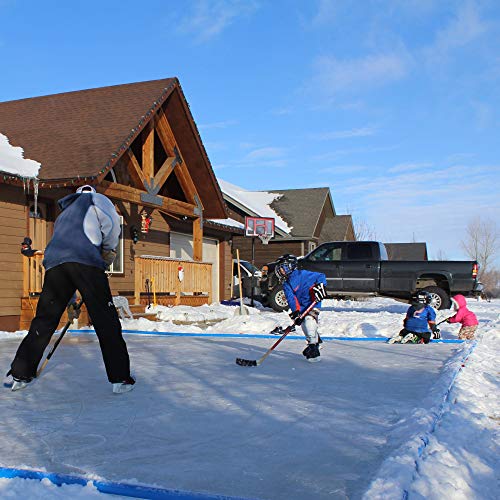
Every kit so far still asks the buyer to source lumber, assemble panels, or bolt together bracket hardware. Ice N’Go’s approach swaps rigid boards for an inflatable tube wall that pairs with a liner, so the entire perimeter setup comes down to inflating the wall and laying the liner rather than cutting, drilling, or bolting anything.
At 23 by 34 feet, the EZ Rink 2.0 sits in the same general size range as a mid-size Iron Sleek or NiceRink kit, enough room for a genuine group of skaters without reaching hockey-length dimensions. The inflatable wall trades some of the rigidity a plywood board provides for dramatically less setup labor, which matters most to buyers who want a rink up in an afternoon rather than a weekend project spread across several days.
The tradeoff is durability under hard use. An inflatable wall is a genuinely different proposition than a bolted plywood board when it comes to absorbing repeated hockey contact, so households planning serious puck play may still prefer a rigid-board system even with the extra setup work that comes with it.
Pros
- No plywood to source, cut, or install
- Fastest setup of any kit on this list
- Solid mid-size footprint for group skating
- Inflatable wall packs down small for off-season storage
Cons
- Less rigid under hard hockey contact than a plywood board
- Inflation pump and wall are one more thing that can leak or fail
- Not the choice for a household planning serious puck training
The verdict: Buy it if setup speed matters more than hockey-grade rigidity. This is the kit for a family that wants ice up fast, not a training rink for a travel team.
The Ice N’Go Pro Rink Kit Is the Hockey-Length Option for Serious Training
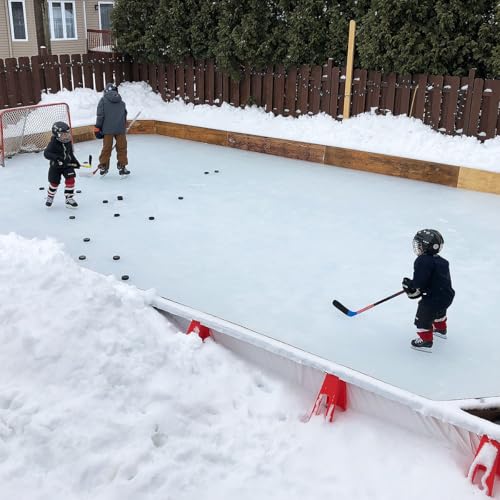
The same inflatable tube wall and liner system as the EZ Rink 2.0, scaled to a 16 by 40 foot footprint that pushes into genuine practice-rink territory. That length matters specifically for skating and passing drills, where a short, square footprint forces constant direction changes a real practice session does not want.
Families with a kid playing travel or competitive hockey are the clearest audience here, since a rink this length supports actual skill work, edges, crossovers, breakaway repetitions, rather than just casual loops. The inflatable wall keeps setup faster than a comparable bracket-and-board kit at this size would be, which matters more the larger the footprint gets.
A yard has to genuinely have the space for this, both the 16 by 40 foot footprint itself and enough clearance around it to walk the perimeter for flooding and maintenance. This is not a kit to buy on the hope that a smaller yard will somehow fit it.
Pros
- Hockey-length footprint genuinely supports skill training
- Fast inflatable setup even at a larger size
- Same trusted Ice N'Go wall system as the smaller EZ Rink
- Real value for a family committed to serious practice time
Cons
- Needs a genuinely large, open, level yard
- Highest total footprint means the most water and time to flood
- Same reduced rigidity tradeoff as the smaller Ice N'Go kit
The verdict: Buy it if a young player’s actual training time justifies a hockey-length rink. Confirm the yard has real room for it before ordering.
The Iron Sleek White Plastic Ice Rink Liner Is the Honest Budget Option

Not every yard needs a full kit. A property with natural snowbanks tall enough to hold water, or a household willing to build simple wood-stake walls without buying an engineered bracket system, only actually needs the liner itself. This 25 by 25 foot, 6 mil white plastic liner is exactly that, no brackets, no boards, no hardware, just the material that turns a contained footprint into a rink.
The white color is a real functional choice, not just an aesthetic one. It reflects sunlight better than a clear or dark liner, which slows daytime melting and helps the ice hold up longer during sunny cold snaps. At 6 mil thickness, it is durable enough for a season of use and abuse from skates, snow pushers, and general winter wear, though it is not the multi-year, heavy-duty grade some bracket kits pair with.
This is the lowest price point on the entire list by a wide margin, and it earns that price by asking the buyer to solve the wall problem some other way. Anyone without existing snowbanks or a DIY lumber plan should look at one of the full kits above instead.
Pros
- Lowest price on this entire list
- White surface reflects sun and slows daytime melt
- Works with existing snowbanks or a simple DIY wall
- Reputable Iron Sleek liner quality without the bracket cost
Cons
- No wall system included, buyer solves containment separately
- 6 mil thickness is a single-season, not multi-year, liner
- Not a real option without snowbanks or a DIY wall plan already in mind
The verdict: Buy it if snowbanks or a simple DIY wall already solve containment and a full kit’s boards and brackets would be money spent twice.
How to Choose the Right Backyard Ice Rink Kit
Once the wall system and rough size are settled, here is what actually separates the rest of the decision.
Start From Your Climate, Not the Kit You Like Best
A region with weeks of reliable hard freeze can support any kit on this list, including the larger hockey-length builds, since the ice will hold once it forms. A region with frequent freeze-thaw swings gets more value from a smaller, simpler kit that can be flooded and refrozen quickly on the nights that actually cooperate. Check a typical December through February low temperature history for the area before sizing up to a larger, pricier kit that needs weeks of unbroken cold to pay off.
Match the Wall System to How Much Labor You Actually Want
A bracket-and-liner kit is the cheapest path to a real rink, but it comes with a separate lumber run and a multi-day build. A liner-free panel system costs more upfront but skips the plywood entirely and protects the lawn underneath. An inflatable system trades some rigidity for the fastest setup of the three. None of this is universally right, the honest answer depends on whether the extra weekend of work or the extra money is the bigger obstacle for a given household.
Measure the Real Footprint and Check the Slope
Mark the exact rink dimensions on the ground with stakes and string before ordering, and run a level or a simple string level across the footprint while doing it. A kit ordered to match a footprint that turns out to slope more than expected leads to uneven ice and pooling water on the first flood, a problem that is far easier to catch with a level in hand than to fix after the liner is already down.
Budget for What Comes After the Kit
The kit price is rarely the finished project cost.
- Boards or lumber. Bracket-and-liner kits need plywood or dimensional lumber sourced and cut separately, usually three to six sheets depending on wall height.
- Underlayment. A layer of foam or an underlayment tarp between the ground and the liner protects the liner from sharp rocks or roots and helps insulate the ice from ground heat.
- A real snow pusher. A garden shovel tears at ice. A wide, flat snow pusher clears snow without gouging the surface underneath.
- Resurfacing gear. A hose for flooding, and ideally a simple homemade or purchased resurfacer, keeps the sheet smooth through a season of skate cuts.
- Lighting for evening skating. A rink that only gets used after dinner in January needs its own light source, since most yards were not built with rink-side lighting already in place.
- Patch supplies and off-season storage. Liners tear, panels need clean stacking, and a labeled storage plan saves real frustration setting the same kit back up next winter.
Frequently Asked Questions
How much does a backyard ice rink kit cost?
A standalone liner runs as little as $50 to $100. A complete bracket-and-liner starter kit like the smaller NiceRink or Iron Sleek options runs roughly $200 to $450. Liner-free panel systems and inflatable kits generally run $500 to $1,500 or more depending on size and board height, with lumber, underlayment, and maintenance gear adding to any bracket-based kit’s total cost.
How cold does it need to be to make a backyard ice rink?
A sustained stretch of nights at or below roughly 25 degrees Fahrenheit is generally needed to freeze a full flood into solid, skateable ice. A single cold night is rarely enough on its own, and repeated freeze-thaw swings back through 32 degrees make it harder to build up a clean, smooth sheet.
Do I need a liner for a backyard ice rink?
Most traditional kits do, since the liner is what actually holds the water in place over grass or dirt. Liner-free panel systems like the Rink Wizard kits are the exception, relying on interlocking boards and ground contact instead of a liner, which also means less risk to the lawn underneath.
How many years does a backyard ice rink kit last?
A basic 6 mil liner is generally treated as a single-season item, though careful storage can stretch it further. Bracket hardware, liner-free panels, and inflatable wall systems are all built for multi-year reuse, often five years or more, when stored properly in the off-season and kept out of direct sun and extreme temperature swings during summer.
Can I put a backyard ice rink on a sloped yard?
A small slope can sometimes be managed by building up the low side with extra lumber or panels, but any meaningful grade across the footprint causes uneven ice thickness and water pooling on the low end. Checking the site with a level before ordering a kit is the single easiest way to avoid a frustrating first flood.
How thick does backyard rink ice need to be before you can skate on it?
Most backyard rink guidance calls for at least 4 to 6 inches of solid ice before regular skating, with more thickness needed for any hockey contact or a group of skaters at once. Checking thickness with a tape measure through a small test hole, rather than guessing from the surface, is the safer approach.
Will a backyard ice rink kill my grass?
A liner-based rink generally protects the grass reasonably well through a normal winter season, and most lawns recover once the rink comes down and the ground thaws. Grass under a liner-free system, or under any rink left up well past the point the ground would normally thaw, tends to fare worse and is more likely to need reseeding in spring.
Our Final Recommendations
The NiceRink Rink-in-a-Box 16×28 is our pick. A bracket system that forgives an imperfect yard, a generously sized liner, and clear instructions make it the safest first rink for a household that has never built one before.
If the yard is small, the Iron Sleek Skating Rink Kit 20×20 delivers the same trusted engineered bracket system at a footprint that actually fits. If protecting the lawn matters as much as the rink itself, the Rink Wizard Dreamscape Series skips the liner entirely, and the Warrior Series steps that same system up to real hockey-grade board height. For anyone who wants ice up fast without a lumber run, the Ice N’Go EZ Rink 2.0 Kit and the hockey-length Ice N’Go Pro Rink Kit trade some rigidity for genuinely faster setup. And if snowbanks or a DIY wall already solve containment, the Iron Sleek White Plastic Liner is the honest, no-frills way to skip paying for hardware that is not actually needed.
Whichever kit you choose, do three things before the first flood. Check the site with a level, confirm your typical winter low temperatures actually support the size you are buying, and plan rink-side warmth and lighting before the first skate, not after. A patio heater or a contained fire pit nearby turns a quick skate into an evening people actually want to stick around for. And if the same slab or side yard doubles as an above-ground pool spot in summer, our guide to hardtop gazebos is worth a look for covering that same space year round, once the ice season ends.
Last update on 2026-11-10 / Affiliate links / Images from Amazon Product Advertising API
This post contains affiliate links, which means I may receive a small commission, at no extra cost to you, if you make a purchase using these links.


