So you want to connect wooden planks without ugly screws showing everywhere? Maybe you’re building a cabinet, a drawer, or even a full dining table. The challenge is that woodworking demands precision, and most people underestimate just how tricky it can be to line up two pieces of wood perfectly.

That’s where dowel jigs come in. These tools guide your drill bit so you get perfectly aligned holes for wooden dowel pins. When you glue those pins into matching holes on two boards, you end up with a joint that’s incredibly strong and completely invisible.

But here’s the real question: which dowel jig should you actually buy? There are dozens out there, and they range from $10 budget options to $300 professional-grade tools. This guide breaks it all down for you, from what features matter most to our top picks for every budget.


What Makes a Dowel Jig Worth Your Money

Before we get into specific products, you need to know what separates a good dowel jig from a bad one. Otherwise, you might end up with a tool that wobbles, wears out fast, or just doesn’t drill where you need it to.

The Size of Your Bushings Matters More Than You Think

Most projects call for 1/4″, 5/16″, or 3/8″ dowels. But how do you know which size to pick? A simple rule works well here. Your dowel diameter should be somewhere between one-third and one-half the thickness of your board. So if you’re working with standard 3/4″ lumber, 3/8″ dowels hit the sweet spot. A jig that supports multiple sizes gives you flexibility for different projects down the road.

Self-Centering Jigs vs Fixed Reference Jigs

This is a choice that trips up a lot of people. Self-centering jigs automatically position your holes in the middle of your board’s thickness. Sounds great, right? The problem is that if your boards vary even slightly in thickness, your holes won’t line up. Fixed reference jigs like the JessEm work differently. They reference from one face of the board, so even if your stock isn’t perfectly uniform, your joints still come together flush. Professionals tend to prefer this approach for that exact reason.

What Your Jig is Made Of

Cheap plastic jigs wear out fast and lose accuracy. You want hardened steel bushings because they hold up to repeated drilling. An aluminum or steel body won’t flex when you clamp it down tight. Skip the all-plastic models unless you’re only planning to use it once or twice.

How Thick Can Your Boards Be

Most standard jigs handle stock up to 2″ thick. That covers the majority of furniture projects. But if you work with thicker slabs or timbers, check the specs before you buy.

What Comes in the Box

Some kits include drill bits, depth stops, dowel center points, glue, and even the dowels themselves. Others give you just the jig. A complete kit gets you working right away without hunting down accessories.


Should You Buy a Dowel Jig or a Festool Domino

This debate comes up constantly in woodworking forums. Let’s break down the real differences.

The Festool Domino DF 500 runs about $1,359 these days. The larger XL DF 700 is closer to $1,600. A quality dowel jig from JessEm or Dowelmax costs between $150 and $300. Budget options from Milescraft or Wolfcraft run $15 to $60.

What about strength? Here’s something interesting. In independent tests, a Dowelmax joint with three dowels actually outperformed a single Domino. Multiple dowels can match or beat Domino strength when done right. But there’s a catch.

Speed is where the Domino wins. For production work where you’re making the same joint over and over, the Domino is significantly faster. A dowel jig needs more setup time for each joint.

Both can achieve excellent precision. Premium dowel jigs rival Domino accuracy when you take your time.

So what’s the verdict? If you run a professional shop and time is money, the Domino’s speed might justify its price tag. But if you’re a hobbyist, an occasional furniture maker, or someone who doesn’t want to spend over a thousand dollars, a quality dowel jig gives you comparable results. The dowels themselves cost almost nothing compared to Domino tenons too.


Our Top Recommended Dowel Jigs

Best Overall Pick for Most Woodworkers

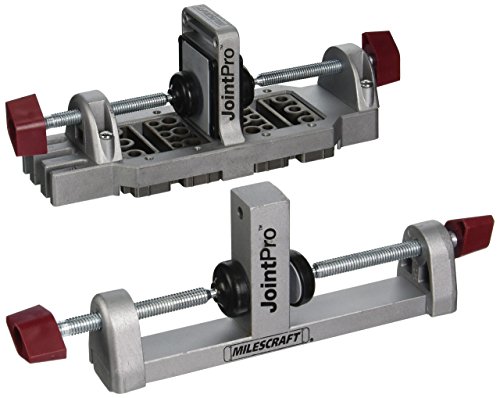
Milescraft 1334 JointMaster

The JointMaster sits right in that sweet spot where you get professional-grade construction without professional-grade prices. It’s built entirely from aluminum, so it won’t flex or bend even when you crank down on the clamp.

What makes this one stand out is the self-clamping design. You don’t need extra clamps to hold it in place. Just tighten the built-in mechanism and you’re ready to drill. It works with 1/4″, 5/16″, and 3/8″ dowel pins, which covers most projects you’ll tackle.

The thickness range is impressive too. Boards from 1/2″ all the way up to 3″ thick work fine with this jig. Built-in centering marks and spacer blocks for common board thicknesses take the guesswork out of setup. Two retractable edge stops help you get consistent alignment across multiple joints.

Why do we keep coming back to this one? It handles virtually any doweling task, sets up quickly, and the aluminum construction means it’ll last for years. If you can only buy one dowel jig, this is probably it.


Best Premium Choice for Serious Woodworkers

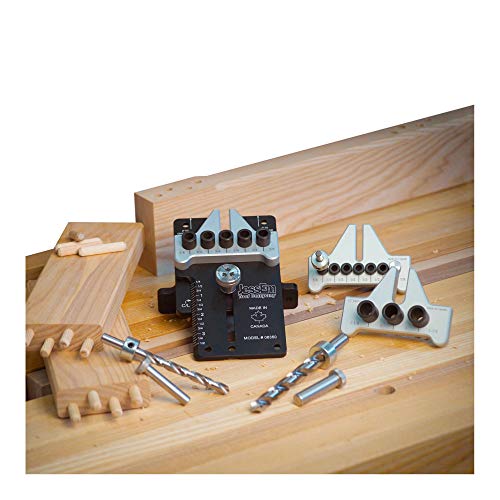
JessEm 08350 Dowelling Jig Master Kit

When precision matters more than anything else, the JessEm Master Kit delivers. This Canadian-made jig is what you’ll find in serious woodworking shops where “close enough” isn’t good enough.

The construction tells you a lot about the quality. Precision CNC-machined 6000-series aluminum forms the body. An anodized finish protects it from wear. Laser-engraved markings make setup fast and accurate.

You can create 1/4″, 3/8″, and 1/2″ dowel holes with this kit. Pre-set dowel locations in 1/8″ increments let you position holes exactly where you want them. A built-in alignment slot helps you match up holes that are spaced far apart. The maximum edge-to-center distance reaches 3-1/2″, which gives you plenty of flexibility.

The kit includes high-quality drill bits, stop collars, and stainless steel indexing pins. Those drill bits deserve special mention because they cut cleanly without tearout, which isn’t always the case with included accessories.

Here’s what sets it apart from cheaper self-centering jigs. The JessEm references from one face of your board instead of centering automatically. Why does that matter? If your boards vary even slightly in thickness, a self-centering jig will produce holes that don’t line up perfectly. The JessEm’s face-reference approach eliminates that problem. This is a lifetime tool that will probably outlast you.


Best Budget Option That Actually Works

Milescraft 1319 JointMate

Maybe you’re just getting started with dowel joinery. Or maybe you only need a jig for occasional repairs and small projects. The JointMate costs under $15 and does a surprisingly good job for the price.

Four alignment pegs provide the self-centering action. An adjustable fence lets you position dowels precisely. It works with 1/4″, 5/16″, and 3/8″ dowels on stock from 1/2″ to 1-1/2″ thick. Metal bushings mean accurate drilling even on a budget.

Is this as good as the JessEm? No. But for furniture repairs, learning dowel joinery, or projects where perfection isn’t critical, it gets the job done. At this price, you can try doweling without making a major investment. If you end up loving it, upgrade to something better later.


Best Classic Design That’s Stood the Test of Time

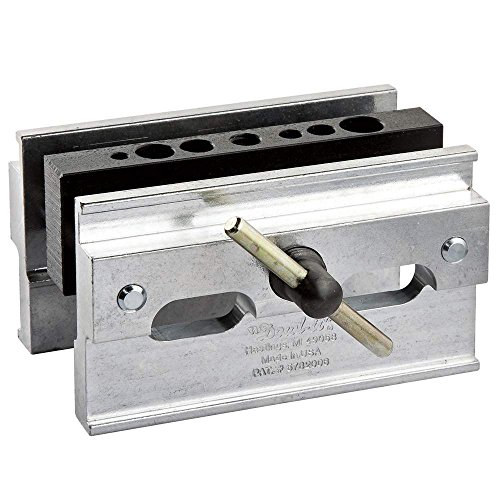
Dowl-It 1000 Self-Centering Doweling Jig

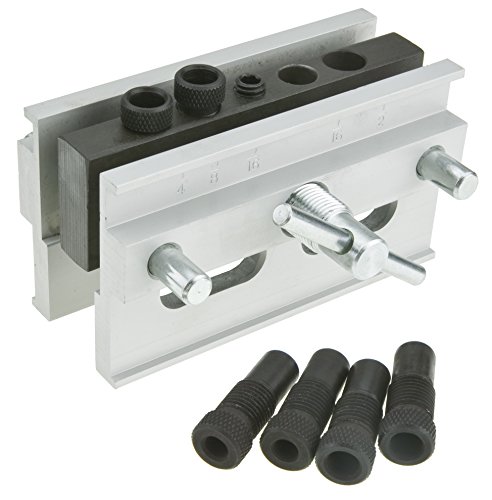
Since 1949, Dowl-It has been the jig that vocational schools and serious hobbyists reach for. There’s a reason this design has barely changed in over 70 years. It just works.

Six permanent drill hole sizes give you more options than most competitors. You get 3/16″, 1/4″, 5/16″, 3/8″, 7/16″, and 1/2″ all built into one tool. The self-centering action works on round or square stock, which opens up possibilities that other jigs can’t handle.

The center block is hardened steel, drilled and reamed to exact specifications for extreme accuracy. Aluminum sides clamp your workpiece securely. The 2″ maximum capacity handles most furniture-scale projects. And because there are no loose parts, you won’t lose pieces over time.

This jig is made in Michigan and it shows in the build quality. If you want a reliable workhorse that your grandkids might end up using someday, the Dowl-It 1000 is hard to beat.


Best Choice for Complete Beginners

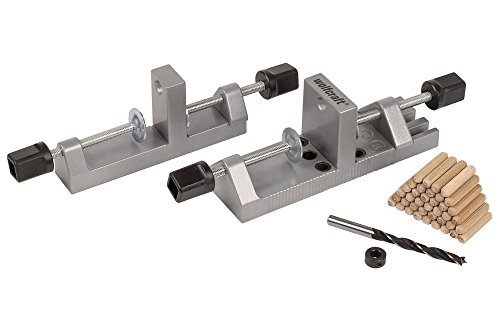
Wolfcraft 3751405 Dowel Pro Kit

What if you could drill both boards at the same time and guarantee your holes line up perfectly? That’s exactly what the Wolfcraft Dowel Pro does, and it makes doweling almost foolproof for beginners.

The cast aluminum body holds up well. Nine pre-aligned hole guides mean you don’t need to measure or mark anything. Hardened steel bushings in 1/4″, 5/16″, and 3/8″ sizes handle the most common dowel dimensions. Three steel depth stops come included.

The jig works with materials from 1/2″ to 1-1/4″ thick. A complete instruction manual walks you through edge-to-edge joints, T-joints, and corner joints step by step. Wolfcraft backs it with a 5-year warranty.

Why is this so good for beginners? The simultaneous drilling feature eliminates the biggest source of doweling mistakes: misaligned holes. When both boards get drilled at once through the same guides, alignment is automatic. You can start making quality joints on your first try.


Best Value When You Want Everything Included

POWERTEC 71397 Ultimate Doweling Jig Kit

Some people want a complete, ready-to-use system without buying accessories separately. The POWERTEC Ultimate Kit gives you exactly that at a price that won’t hurt.

You get three separate jigs for 1/4″, 3/8″, and 1/2″ dowels. Premium M35 cobalt drill bits come included for each size. Stop collars and hex wrenches round out the package. Clear hardened acrylic viewing plates with alignment marks make positioning easy. Hardened steel drill guides provide accuracy and durability.

Step-by-step instructions help if you’re new to this. A hard shell carrying case keeps everything organized and portable.

The cobalt drill bits deserve special mention. They stay sharp longer than standard bits and cut cleaner. Having three jig sizes means you can match your dowel to your stock thickness without compromise. For the money, this kit is tough to beat.


Best Option from a Trusted Brand Name

Kreg KHJD345 Dowel Jig Kit

Kreg made their name with the Pocket Hole Jig. Now they’ve brought that same user-friendly design philosophy to doweling. If you’ve used Kreg products before, you’ll feel right at home.

Five different alignment methods give you options for any setup. You can use reference lines, alignment pins, edge stops, dowel alignment grooves, or a combination. Removable 1/4″ and 3/8″ drill guide blocks come standard, with 1/2″ available as an upgrade.

The body is impact-resistant polymer with hardened steel guides. It’s designed to work with trigger-style clamps for stability. An onboard stop collar setting and measuring scale eliminate guesswork when setting drill depth. Kreg backs it with their 3-year warranty.

What Kreg did well here is making doweling as intuitive as their pocket hole system. Multiple alignment methods mean there’s always a fast way to position the jig. The depth scale built right into the jig is a nice touch that saves time.


Best See-Through Design for Easy Alignment

Rockler Complete Doweling Jig Kit

Rockler took a different approach with their jig design. Clear 3/16″ acrylic faces let you see exactly where you’re drilling. No more guessing whether your alignment marks line up.

The kit includes jigs for 1/4″, 3/8″, and 1/2″ holes. Hardened steel drill guides won’t wear out. Matching drill bits, stop collars, and wrenches come in the box. Dual edge stops provide consistent alignment and make repeating the same joint easy. A depth scale molded into the back helps set drill depth. A hard shell case keeps everything together.

Here’s how the transparent design changes your workflow. Set your two pieces together and strike a line across the joint. Then align the jig’s reference lines with your mark. You can see exactly when everything lines up. No measuring, no math, just visual confirmation that you’re in the right spot. It’s brilliant in its simplicity.


Best for Face Frames and Narrow Stock

Milescraft 1309 DowelJigKit

Face frames, narrow rails, and thin stock present challenges that not every jig handles well. Space is tight, and you need precision in a small footprint. This 82-piece kit from Milescraft was designed for exactly those situations.

The self-centering jig has an adjustable fence. Metal bushings in 1/4″, 5/16″, and 3/8″ sizes cover the most common needs. But what makes this a kit rather than just a jig are all the extras.

You get 62 dowel pins in three sizes. Brad point drill bits cut clean holes. Depth stops keep your drilling consistent. Six dowel centers let you transfer hole locations to mating pieces. Wood glue is included. A heavy-duty storage case holds everything.

The dowel centers are particularly useful. Insert them in your drilled holes, press the mating piece against them, and you get perfect matching marks without measuring. For production work on face frames or when you’re making multiple identical joints, this speeds things up considerably.


Best Heavy-Duty Option for Larger Projects

Grizzly G1874 Improved Dowel Jig

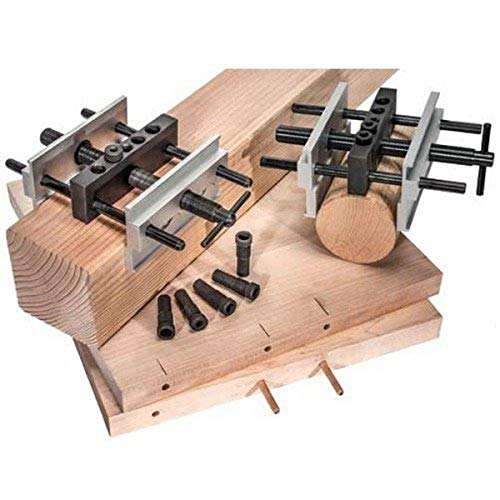
Not every project involves perfectly square, flat boards. Sometimes you need to drill into a turned leg, an angled apron, or a curved rail. Most jigs struggle with irregular shapes. The Grizzly doesn’t.

Self-centering action works on round, square, or irregular shapes. Hardened steel bushings come in five sizes: 1/4″, 5/16″, 3/8″, 7/16″, and 1/2″. The compact design clamps securely even on uneven surfaces. It handles stock up to 2″ wide.

A specialized alignment system provides stability that cheaper jigs can’t match. When you’re drilling into something that isn’t flat, that stability matters.

Furniture makers who work with legs, spindles, and curved components will appreciate what this jig can do. The ability to clamp onto irregular shapes without losing centering accuracy opens up possibilities that other jigs simply can’t offer.


Best Upgraded Classic with Four Bushings

Dowl-It 2500 Self-Centering Jig

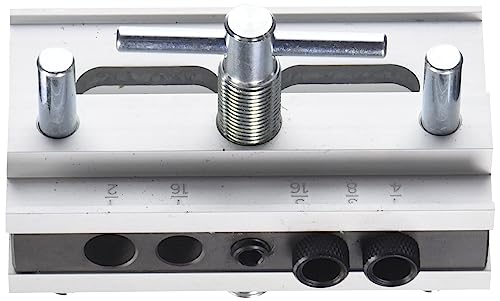
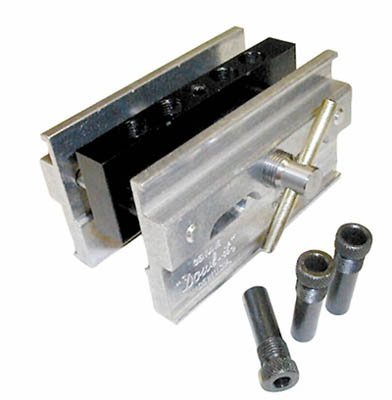
The Dowl-It 2500 takes everything good about the classic 1000 model and adds features that speed up production work. Four tapped holes accept replaceable bushings, which means you can drill multiple holes per setup.

Six removable bushings come included. The center block and bushings are hardened steel for accuracy that lasts. Reinforced aluminum clamping sides grip your workpiece without flex. The self-centering design handles stock up to 2″ wide.

Why does four holes matter? On face frames and larger joints, you often need several dowels. With a single-hole jig, you drill one hole, reposition, drill another, reposition again. With the 2500, you can drill two or more holes before moving the jig. That cuts your time significantly on repetitive work.

The replaceable bushings also extend the jig’s useful life. When a guide wears out, you swap in a new one instead of replacing the whole tool.


Best Budget Self-Centering Metric Option

Self-Centering Doweling Jig (6/8/10mm)

If you work with metric hardware or European-style cabinets, imperial jigs create headaches. This budget-friendly metric jig solves that problem without emptying your wallet.

The body is 6061 aluminum alloy with an anodized finish for durability. Three metric bushing sizes of 6mm, 8mm, and 10mm cover most needs. A built-in measuring scale helps with positioning. The self-centering design works on boards from 17mm to 50mm thick.

At under $25, this isn’t a premium tool. But for metric projects where you need affordable and functional, it delivers. The anodized finish holds up better than painted alternatives at similar prices.


A Quick Guide to Using Your Dowel Jig

Got your jig? Here’s how to put it to work.

Start by marking your joint. Line up your pieces exactly as they’ll be joined, then mark reference lines across both pieces where your dowels will go.

Pick the right dowel size. That one-third to one-half rule applies here. For 3/4″ stock, 3/8″ dowels work great.

Set your drill depth. Holes should be about half the dowel length plus a little extra room for glue. A sixteenth of an inch does it.

Align your jig. Center it on your marks or use whatever built-in alignment features your particular jig offers.

Clamp it securely. The jig cannot move while you drill. Any wobble ruins accuracy.

Drill your holes. A sharp brad-point bit gives you the cleanest results.

Repeat on the mating piece. Use the same jig settings and alignment references.

Do a dry fit before glue. Test the joint to make sure everything lines up. This is your last chance to make adjustments.

Apply glue and assemble. Put glue inside the holes and on the dowels, insert them, and clamp the joint for at least 30 minutes. Hardwoods need longer.

A few tips from experience. Always use a depth stop because drilling too deep weakens the joint. Chamfer dowel ends slightly for easier insertion. Fluted dowels distribute glue better than smooth ones. Put glue inside holes, not just on the dowels. Don’t rush the clamp time.


Mistakes That Ruin Dowel Joints

You’ve got your jig and you’re ready to go. But watch out for these common problems.

Misaligned holes happen when you don’t reference from the same face on both pieces. Self-centering jigs can actually cause this problem if your stock varies in thickness. Pick a reference face and stick with it.

Wrong dowel size causes problems on both ends. Too small and your joint is weak. Too large and you risk splitting the wood. Match your dowel to your stock thickness.

Insufficient depth creates weak joints. Your dowels need enough depth in both pieces, plus room for excess glue to go somewhere.

Rushing the glue-up leads to failure. Dowel joints need proper clamping time. Don’t stress the joint until the glue fully cures.

Skipping the dry fit is asking for trouble. Test your joint without glue first. Once glue is applied, adjustments are almost impossible.


Common Questions About Dowel Jigs

Do you really need a doweling jig?

If you want hidden joints that are actually strong, yes. You could try to drill freehand, but your holes won’t line up and your joints will be weak. For simple repairs or rare use, you might get away without one. But anyone doing furniture work regularly will appreciate the precision a jig provides.

What size dowels should you use?

Take your thinnest board’s thickness. Pick a dowel diameter that’s between one-third and one-half of that measurement. So for 3/4″ stock, 3/8″ dowels are ideal. For 1/2″ stock, go with 1/4″ dowels.

Are dowels stronger than biscuits?

Yes, and it’s not even close for mechanical strength. Biscuits mainly help with alignment during glue-up. They add minimal structural strength. Dowels add both alignment and real joint strength.

How many dowels do you need per joint?

For edge joints where you’re joining boards side by side, space your dowels 4 to 6 inches apart. For corner joints or T-joints, use at least two dowels per joint. That prevents the pieces from rotating.

Can you make your own dowels?

You can, with a dowel plate or lathe. But commercial fluted dowels work better because the flutes distribute glue more evenly. And they cost almost nothing.

Are dowels stronger than screws?

Usually, yes. A properly made dowel joint is stronger because the glue bonds to more surface area. The load distributes across the entire joint instead of concentrating at fastener points. Screws can also loosen over time, while a glued dowel joint won’t.


Final Thoughts

The right dowel jig depends on your budget, your skill level, and how often you’ll use it.

For most woodworkers, the Milescraft JointMaster offers the best balance. Professional aluminum construction, excellent versatility, self-clamping convenience, and a price that doesn’t sting. It handles almost anything you’ll throw at it.

For those who demand the best and don’t mind paying for it, the JessEm Master Kit is the tool of choice. Face-reference design for perfect alignment, lifetime-quality construction, and precision that professionals rely on.

For beginners watching their budget, the Wolfcraft Dowel Pro or Milescraft JointMate get you started without a big investment. Learn the technique first, then upgrade when you know what features matter most to you.

A dowel jig pays for itself fast. Every project goes smoother when your joints line up perfectly on the first try.

Last update on 2026-02-12 / Affiliate links / Images from Amazon Product Advertising API

This post contains affiliate links, which means I may receive a small commission, at no extra cost to you, if you make a purchase using these links.