

A backyard sauna build almost always gets planned in the wrong order. The cabin gets chosen first, the benches get argued about, and the heater ends up as the last line on the list, picked by matching a kilowatt number to a room size chart. That is the part worth slowing down for, because the heater is the only component in the whole project that decides how the sauna actually feels to sit in.
Here is the thing that makes this category confusing. Two heaters both stamped 6 kW can sit roughly $180 and roughly $1,550 apart on the same search results page. Same nominal output, same room size range printed on the listing. What separates them is stone mass, where the controls live, and whether the unit carries a real safety listing under UL 875, the standard written specifically for electric dry bath heaters, now being superseded by UL 60335-2-53. None of those three things show up in the kilowatt number, and all three change what you get.
We pulled together eight heaters that cover the real spread of backyard sauna builds, from a wood fired stove that needs no electrician at all to a 9 kW electric unit with the controller mounted outside the hot room. Amazon prices in this category move around a lot, so treat every figure below as directional rather than exact.
Our Quick Picks for a Backyard Sauna Heater
- Best overall for a two to four person cabin, Harvia The Wall SWS60, 6 kW, UL listed with a 44 lb stone load and built in dial controls.
- Best value name brand electric, Harvia KIP 6 kW, the same Finnish build quality in a plainer triple wall stainless body.
- Best stone mass per dollar, Harvia TopClass KV-60, 45 lb of rock and side mounted digital controls you can hang left or right.
- Best for a large hot room, TOULE NTSC90 at 9 kW with a wall mounted digital controller that lives outside the heat.
- Best mid budget electric with real controls, ALEKO TOULE 6 kW, ETL certified wet and dry at roughly a third of the Harvia price.
- Best budget 6 kW, VEVOR 6 kW 240V, the honest entry point if the sauna is a shed conversion and not a permitted structure.
- Best plug in option, VEVOR 2 kW 120V, for a one person barrel or a tiny hot room where running 240V is not worth it.
- Best off grid and wood fired, Harvia M3, 16.5 kW of stove that needs a chimney instead of an electrician.
How These Eight Sauna Heaters Compare at a Glance
| Heater | Power | Room volume | Controls | Best for |
|---|---|---|---|---|
| Harvia The Wall SWS60 | 6 kW, 240V, 25 A | 170 to 300 cu ft | Built in dial, 1 hr timer, 8 hr delay | Standard 2 to 4 person cabin |
| Harvia KIP 6 kW | 6 kW, 240V, 25 A | 176 to 300 cu ft | Built in dials and thermostat | Same room, lower spend |
| Harvia TopClass KV-60 | 6 kW, 240V, 25 A | 175 to 300 cu ft | Side mounted digital, left or right | Buyers who want maximum rock |
| TOULE NTSC90 | 9 kW, 220 to 240V | Roughly 320 to 460 cu ft | NTS-300 wall panel, outside the room | Large or glass fronted rooms |
| ALEKO TOULE 6 kW | 6 kW, 220 to 240V | Roughly 175 to 320 cu ft | Digital controller, wet and dry | Mid budget builds |
| VEVOR 6 kW 240V | 6 kW, 240V | 176 to 318 cu ft | Internal controller on the body | Shed conversions and outbuildings |
| VEVOR 2 kW 120V | 2 kW, 120V | 53 to 106 cu ft | Internal controller on the body | One person barrels and tiny rooms |
| Harvia M3 | 16.5 kW wood fired | Barrel and cabin saunas | Damper and firebox, no electricity | Off grid and no electrician |
Harvia The Wall SWS60 Is the Heater We Would Put in a Standard Backyard Cabin
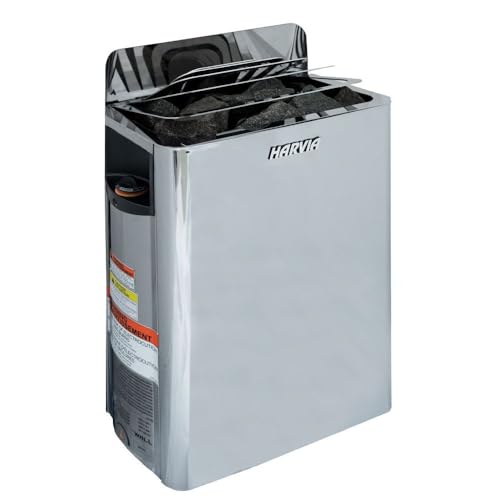
This is the heater that fits the sauna most people actually build. A 6 by 7 foot hot room with a 7 foot ceiling lands right around 290 cubic feet, and The Wall covers 170 to 300 cubic feet on a 240 volt single phase circuit drawing 25 amps through 10 gauge copper. That places a typical backyard cabin near the top of the range rather than the bottom, which is where you want to be if the door gets opened often or the build has any glass in it.
The spec worth paying for here is the stone load. One box of AC3000 olivine diabase, 20 kg or roughly 44 lb, sits in the cavity. Stone mass is thermal mass, and thermal mass is what turns a ladle of water into a proper burst of steam instead of a hiss and a shrug. It is also what stops the room temperature from sawing up and down every time the element cycles.
Controls are a built in dial with a one hour run timer and an eight hour preset delay, so you can set it in the morning and have the room ready when you get home. It is UL listed and carries a two year residential warranty. The trade off is that the dial lives inside the hot room, at heater height, which is a real annoyance in a room that runs near 190 degrees. Available in stainless or black steel.
Pros
- 44 lb stone load for genuine steam and stable temperature
- Covers 170 to 300 cu ft, which fits most 2 to 4 person cabins
- UL listed with a 2 year residential warranty
- Built in 8 hour delay timer means the room is ready when you are
- Wall mount design saves bench floor space
Cons
- Controls sit inside the hot room at heater height
- Needs a dedicated 240V circuit and a licensed electrician
- Among the most expensive units here
- Stones are a single box, so a larger load means buying more
The verdict: buy it if you are building a normal two to four person cabin and want the thing to still be working in ten years. This is the default answer in this roundup, and the reason to look elsewhere is a specific one, not a general one.
Harvia KIP 6 kW Gets You the Same Finnish Engineering for Less Money

The KIP is the plainer sibling. Same 6 kW, same 240 volt single phase supply at 25 amps, and a nearly identical 176 to 300 adjusted cubic feet coverage band. It runs wet or dry, so you can ladle water on the rocks without worrying about the element. Body is corrosion resistant stainless with triple wall construction and a stone guard, and it is UL certified.
Controls are dials at the base of the heater, giving a 60 minute timer, a thermostat, and up to eight hours of startup delay. At 37.5 lb and 11 by 16 by 24 inches, it is a compact unit that will not eat a corner of a small room.
Two honest caveats. The listing does not publish a stone capacity, which matters because stone mass is the single biggest driver of how a sauna feels, and we would want that number confirmed before ordering. The warranty is also one year rather than the two years on The Wall and the TopClass. For a spare bedroom conversion or a garage sauna that gets used twice a week, neither is a dealbreaker. For a heavily used backyard cabin, they are worth the price gap.
Pros
- Roughly $300 to $350 less than The Wall for near identical coverage
- Wet and dry rated, so water on the rocks is fine
- Triple wall stainless with a stone guard
- UL certified
- Compact 11 by 16 by 24 in footprint at 37.5 lb
Cons
- Stone capacity is not published anywhere we could find
- 1 year limited warranty rather than 2
- Dial controls again sit inside the hot room
- Still needs the same 240V, 25 amp circuit as the pricier models
The verdict: buy it if you want a Harvia and the difference between a one and two year warranty does not keep you up at night. It is the best way to get into name brand Finnish heaters without paying the flagship price.
Harvia TopClass KV-60 Carries the Biggest Stone Load Among the 6 kW Units Here
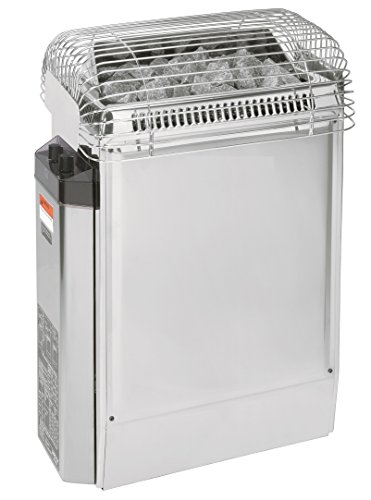
Same 6 kW class, same 240 volt single phase circuit at 25 amps, same 175 to 300 adjusted cubic feet. What separates the TopClass is 45 lb of stone capacity and a heavier build, 50 lb for the heater itself and about 95 lb shipped once the rocks are in the box. That extra mass is not marketing. It is the difference between a room that recovers quickly after someone throws water and a room that takes a few minutes to get back.
The controls are digital and mounted on the side of the heater near the top, and you can install the panel on either the right or the left, which matters more than it sounds when the heater has to sit in a specific corner. Same 60 minute timer and eight hour delay as the rest of the Harvia line. Stainless outer casing, stainless stone chamber, rock guard included, UL listed, two year warranty.
At roughly 17 inches wide by 11 deep by 24 tall it takes the same floor space as the KIP but weighs a good bit more, so check that the wall framing behind it can take the load if you are hanging it rather than floor mounting.
Pros
- 45 lb stone capacity, the highest of the electric units here
- Control panel mounts on either side to suit a corner install
- UL listed with a 2 year warranty
- Stainless casing and stainless stone chamber, not painted steel
- Rock guard included rather than sold separately
Cons
- 50 lb bare weight means the framing behind it needs to be sound
- Controls still sit inside the hot room
- Priced close to the flagship without wall mount styling
- Same 25 amp 240V circuit requirement
The verdict: buy it if you care more about how the steam feels than how the heater looks. If you are the kind of person who is going to throw water every few minutes, the extra rock is worth more than the styling on The Wall.
TOULE NTSC90 at 9 kW Is the Answer for a Big Room or a Glass Front
Once a hot room passes about 320 cubic feet, or once a barrel sauna has a full glass front, a 6 kW heater is fighting a losing battle. This is the unit for that situation. Nine kilowatts on 220 to 240 volts at 60 Hz, sized by the manufacturer for three to six person rooms, in a stainless body with splash proof construction that keeps water off the live parts.
The feature that actually justifies choosing this over a cheaper 9 kW is the NTS-300 wall controller. It mounts outside the hot room. You set temperature and time standing in the changing area at normal room temperature instead of crouching next to a 190 degree stainless box. Once you have used a sauna with external controls, going back to a dial inside the room feels like a mistake.
It is CE and ETL certified and approved for permanent installation. Be straight with yourself about the electrical side though. A 9 kW heater at 240 volts pulls close to 38 amps, which means a 50 amp circuit and heavy conductor all the way from the panel. If the sauna is detached and sitting 60 feet down the yard, that wire run can cost more than the heater.
Pros
- Wall mounted NTS-300 controller sits outside the heat
- 9 kW handles rooms other units here cannot
- ETL certified and approved for permanent installation
- Splash proof construction protects the conducting parts
- Stainless body at a fraction of premium brand pricing
Cons
- Needs roughly a 50 amp 240V circuit, the most demanding install here
- Room volume and stone capacity are not published on the listing
- ALEKO sells NTSA and NTSC variants that differ in controller placement
- No published warranty term we could confirm
The verdict: buy it if your hot room is genuinely large, or if it has a glass door and window that the sizing math has to pay for. Do not buy it for a small room just because more power sounds safer, because an oversized heater short cycles and the room ends up hot at the ceiling and cold at the feet.
ALEKO TOULE 6 kW Is the Middle Ground Most Backyard Builds Should Look At
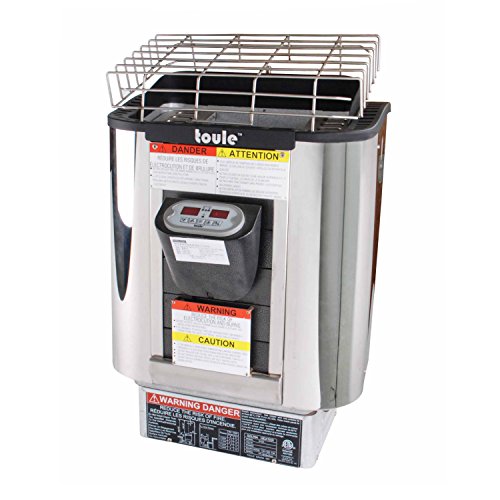
There is a wide gap in this category between roughly $180 and roughly $1,200, and this unit sits in it. Six kilowatts on 220 to 240 volts, stainless body, ETL certified for wet and dry use, and a digital controller rather than a rotary dial. Coverage for a 6 kW in this line works out to roughly 175 to 320 cubic feet, which is the same band as the Harvia units.
What you give up against a Harvia is published stone capacity, a documented warranty term, and the long service history that comes with a brand that has been building sauna stoves in Finland for decades. What you get back is several hundred dollars, which for a first sauna is a fair trade. If the build turns out to be something the household uses four times a week for years, the upgrade path is obvious and the old heater becomes a spare.
One thing to sort out before ordering. ALEKO sells this platform under both NTSA and NTSC model codes, and the difference is where the controller lives, on the heater body or on the wall outside the room. Listing titles and model codes do not always agree with each other, so confirm which version you are getting, because that is the single feature most likely to change how the sauna feels to use day to day.
Pros
- Roughly a third of the price of a comparable Harvia
- ETL certified for wet and dry operation
- Digital controller rather than a basic dial
- Stainless body
- Covers the same room volume band as the premium 6 kW units
Cons
- Stone capacity is not published
- Warranty term is unclear on most listings
- NTSA and NTSC model codes are easy to confuse at checkout
- Shorter brand track record than the Finnish makers
The verdict: buy it for a first sauna where the budget has to cover the cabin, the benches, the stones and the electrician all at once. It is the pick that leaves money for the rest of the project without dropping to the no name tier.
VEVOR 6 kW Is the Honest Budget Choice for a Shed Conversion
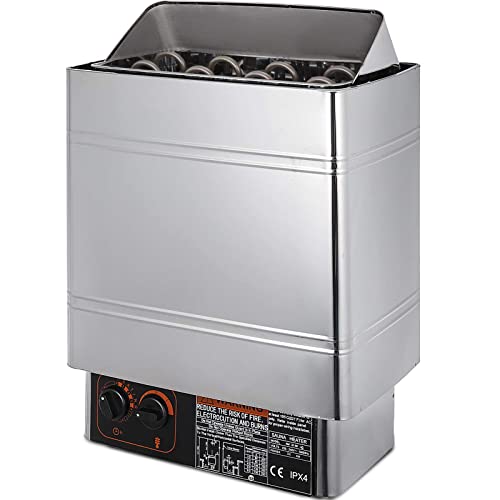
Six kilowatts, 240 volts, an internal controller on the body, and a published coverage range of roughly 176 to 318 cubic feet. On paper it matches the Harvia. On price it does not come close, typically landing under $200. That gap is the most interesting fact in this whole roundup, and it is worth being clear about where the money goes.
The listing does not publish a stone capacity, and it does not state a UL listing under UL 875 or the newer UL 60335-2-53. VEVOR references FCC compliance on some models, which is an electromagnetic interference matter and not a heater safety listing. That distinction is not academic. If the sauna is going into a permitted structure, or if you want the homeowner insurance conversation to be simple, an unlisted heater is the wrong purchase regardless of how well it heats.
For a shed conversion, a garage corner, or a build that is never going to be inspected, it is a reasonable way to find out whether you actually use a sauna before committing four figures. VEVOR also sells 4.5 kW and 9 kW versions of the same platform, so the coverage band can be matched to the room.
Pros
- Typically under $200 for a full 6 kW unit
- Published coverage of roughly 176 to 318 cu ft matches premium 6 kW heaters
- Internal controller keeps the install simple
- Available in 4.5 kW and 9 kW versions of the same design
- Low risk way to test whether the household will actually use a sauna
Cons
- No UL 875 or UL 60335-2-53 listing stated on the listing
- Stone capacity is not published
- Controller sits on the body inside the hot room
- Support and warranty are weaker than the established brands
- Wrong choice for a permitted or inspected structure
The verdict: buy it only for an uninspected build where the budget is genuinely tight and you are testing the idea. For anything permanent, permitted or shared with guests, spend the extra and get the safety listing.
VEVOR 2 kW at 120 Volts Is the Only Unit Here That Skips the 240 Volt Circuit
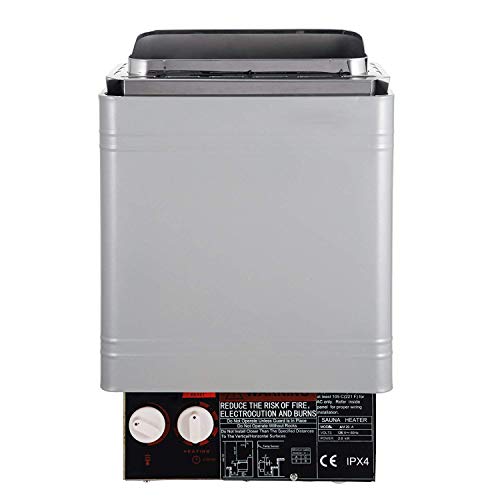
Every other electric heater in this roundup needs 240 volts, which means a licensed electrician, a new breaker, and a conductor run. This one runs on ordinary 120 volt household power and covers roughly 53 to 106 cubic feet, which is a genuinely small hot room, something like a one person barrel or a 4 by 4 foot closet conversion with a normal ceiling.
Do the arithmetic before you get excited about the plug though. Two kilowatts at 120 volts is about 16.7 amps, which eats nearly all of a 20 amp circuit and more than a standard 15 amp circuit can carry continuously. So it still wants a dedicated circuit. What it does not want is a 240 volt feed, which is the expensive part on most detached builds.
Expect a slower heat up than the bigger units and expect the room to cool faster after the door opens. That is physics rather than a defect. In a room this small the temperature swing is less punishing than it would be in a larger cabin, which is exactly why the small heater and the small room belong together.
Pros
- Runs on 120V, avoiding the 240V circuit that dominates most sauna budgets
- Right size for one person barrels and closet conversions
- Internal controller keeps installation straightforward
- Lowest total install cost of anything in this roundup
- VEVOR also offers a newer 2 kW listing with a pre drilled mounting bracket
Cons
- Still draws about 16.7 amps, so a dedicated 20 amp circuit is needed
- 53 to 106 cu ft is a very small room, do not stretch it
- Slow to heat and quick to lose temperature after the door opens
- No published stone capacity or UL heater listing
The verdict: buy it if the hot room is genuinely tiny and the alternative is not building a sauna at all because of what the electrical work would cost. For anything larger than about 106 cubic feet, it is the wrong tool and no amount of patience fixes that.
Harvia M3 Is the Wood Fired Stove That Makes the Electrician Optional

Every problem described so far, the circuit, the conductor run, the panel capacity, disappears the moment the heat comes from firewood instead of a breaker. The M3 puts out 16.5 kW, which is well beyond anything electric here, and it is the stove that turns up in a large share of barrel saunas for a specific reason. Its clearances to combustible surfaces are unusually tight without a shield, 250 mm at the rear and 300 mm at the sides and top, which is what lets it fit inside a curved barrel wall.
It takes logs up to 6 inches in diameter and 13.75 inches long, has a glass door so you can watch the fire, and connects to a standard 115 mm, about 4.5 inch, chimney. Legs adjust across a 0 to 30 mm range for a floor that is not quite level. Made in Finland with a two year warranty.
The honest costs are different rather than absent. You need a proper chimney kit and roof penetration, which is a real expense and a real fire safety detail, and you need somewhere dry to keep split wood. Heat up takes longer and involves tending. The payoff is a sauna that works during a power cut, on a property with no service at the sauna site, and with a quality of heat that a lot of people prefer once they have had both.
Pros
- No electrician, no breaker, no conductor run to the sauna
- 16.5 kW easily heats a barrel or a full cabin
- Tight clearances make it fit inside barrel saunas where other stoves cannot
- Glass door and adjustable legs for uneven floors
- Made in Finland with a 2 year warranty
Cons
- Chimney kit and roof penetration are a separate and significant cost
- Needs dry split wood storage and hands on tending
- Longer heat up than an electric heater
- Stone capacity is not published on the listing we checked
- The M3SL side feed variant is a different product at a higher price
The verdict: buy it if the sauna sits away from the house, if the panel is already full, or if you want the sauna to work when the power does not. If your build has an easy 240 volt run available, an electric heater is less work for a similar result.
How to Size a Sauna Heater Without Guessing
Start with cubic feet, not with the number of people
Ignore any listing that sizes a heater by how many people fit on the benches. Two adults lying down and four adults sitting upright occupy wildly different rooms. Measure length by width by height in feet and multiply. A 6 by 5 room with a 7 foot ceiling is 210 cubic feet. A 7 by 7 room with an 8 foot ceiling is 392, nearly double, and that is the difference between a 6 kW heater and a 9 kW one.
Harvia’s own guidance is the cleanest version of the rule. About 1 kW of heater power per cubic meter of sauna volume, which works out to roughly 1 kW for every 35 cubic feet. They also say plainly that the recommended figure is a minimum rather than a target, and that you should aim near the midpoint of a heater’s stated range rather than scraping along at the bottom of it.
The glass and stone penalty is the step almost everyone skips
This is the part that quietly wrecks backyard sauna builds, and it explains most of the complaints about a heater that never quite gets the room hot enough. Any surface inside the hot room that is not insulated wood behaves like extra volume, because it dumps heat straight out.
Harvia puts numbers on it. One square meter of glass, stone or similar uninsulated surface raises the power requirement as much as adding 1.2 cubic meters of room volume. If the interior walls are uninsulated logs, the factor is 1.5 per square meter. Translated into the units most people are working in, every 10.8 square feet of glass adds roughly 42 cubic feet of imaginary room.
Work an example. A barrel sauna with a full glass front door and a small window might have 20 square feet of glass. That is about 1.9 square meters, which adds roughly 2.2 cubic meters or about 78 cubic feet of effective volume. A 210 cubic foot room just became a 288 cubic foot room, which is the top of the 6 kW range instead of comfortably inside it. Add an uninsulated log wall and the 9 kW is the right answer.
Stone mass is what makes the steam feel right
Kilowatts get the room hot. Stones decide what happens when you ladle water on. A heater with 44 or 45 lb of rock in the cavity stores enough energy to turn a full ladle into a proper wave of steam and then keep the room stable while the element catches up. A thin stone tray hisses, drops temperature, and leaves the room feeling flat.
This is also the spec most often missing from budget listings, and its absence is informative. The Harvia units in this roundup publish 44 and 45 lb figures. Most of the cheaper units publish nothing at all. If a listing will not tell you, assume the load is small and plan to add stones if the cavity allows it.
Decide where the controls live before you decide anything else
Built in controls sit on the heater, inside the room, usually near the bottom. Cheap, simple, and slightly miserable to use, because adjusting temperature means kneeling next to the hottest object in the building. External wall controllers mount outside the hot room in the changing area, so you set the schedule and the temperature in comfort.
Most sauna owners who have used both prefer external controls by a wide margin, and it is the reason to pay attention to model codes when ordering, since several brands sell the identical heater in both configurations under confusingly similar part numbers.
Budget for the circuit, not just the heater
This is where sauna projects go over budget. A 6 kW heater at 240 volts draws 25 amps and wants 10 gauge copper on a 30 amp breaker. A 9 kW unit is closer to 38 amps, which means a 50 amp circuit and heavier conductor. If the sauna is a detached structure at the back of the yard, that run may need a subpanel, a trench, and conduit, and it can easily cost more than the heater itself.
Get a number from an electrician before you order anything. Two things change the answer completely. If the panel is full, you are looking at a service upgrade. If the sauna can sit against the house instead of 70 feet away, the wire run shrinks and so does the bill. That single siting decision is worth more than any feature comparison in this article.
A wood fired stove sidesteps all of that and swaps it for a chimney kit, a roof or wall penetration, and firewood storage. It is not free, but the costs are more predictable and do not depend on how far the sauna is from the panel. If your yard already has a hardtop gazebo or a similar structure with a solid roof, siting a wood fired sauna near it keeps the whole wellness corner in one place.
Match the heater to the way you actually use heat
If the sauna is going in next to a hot tub, the two get used in the same session and the heater choice should follow that. Contrast bathing, hot room then cold water, means the sauna needs to come back to temperature quickly after repeated door openings, which argues for more stone mass and a heater sized nearer the top of its range. Households already handling hot tub filter cartridge replacements and regular water chemistry are usually the same people who will use a sauna several times a week, and that usage pattern justifies the better heater.
If it is a once a week wind down for one or two people, a smaller heater in a smaller room is a better build. Heating 400 cubic feet for a single person is an expensive habit, and the delay timer becomes the feature you use most.
What a safety listing actually buys you
UL 875 is the standard for electric dry bath heaters, and UL 60335-2-53 is the newer standard set to replace it. A heater carrying a UL or ETL listing has been tested against a written safety standard by an accredited lab. One that has not, has not, no matter how solid the stainless looks in the photos.
This matters in three practical places. An inspector on a permitted build will look for the listing mark. A homeowner insurance claim after a fire will look for it too. And a heater bolted to a wooden wall inside a small sealed room, running unattended on a delay timer, is not the place to save $900. Every unit in this roundup except the two VEVOR heaters carries a UL or ETL mark, and that is the single clearest line separating the price tiers.
Stones, guards and the parts nobody mentions
Check whether stones are included. Some listings ship them, some do not, and a proper load of olivine diabase is a real line item. Check whether a rock guard comes in the box, because a heater in a small room with benches nearby needs one and buying it separately is annoying. And plan to restack the stones once a year or so, since they crack and settle over time, which chokes airflow through the cavity and makes a good heater behave like a bad one.
Sauna Heater Questions We Get Asked Most Often
What size sauna heater do I need for a 6 by 8 foot sauna?
A 6 by 8 room with a 7 foot ceiling is 336 cubic feet. At roughly 1 kW per 35 cubic feet that points to about 9.6 kW, so a 9 kW heater is the sensible pick and a 6 kW would be undersized. Add any glass door or window into the calculation before deciding, because uninsulated surfaces raise the requirement further.
Can I run a sauna heater on a normal household outlet?
Only the smallest units. A 2 kW 120 volt heater draws about 16.7 amps, which needs a dedicated 20 amp circuit and covers a room of roughly 53 to 106 cubic feet. Everything from 4.5 kW upward runs on 240 volts and requires a dedicated circuit installed by a licensed electrician.
Is a wood fired sauna stove better than an electric heater?
Neither is better in general, they solve different problems. A wood stove removes the electrical work entirely, which is the biggest cost on a detached backyard build, and it keeps working during a power cut. An electric heater is faster to start, needs no tending, and works on a delay timer. Choose based on how far the sauna sits from your electrical panel and whether you want to manage firewood.
How many pounds of stones does a sauna heater need?
It depends on the model, and the number is worth checking before buying. The Harvia units here hold 44 to 45 lb. Many budget heaters do not publish a figure at all, which usually means a small tray. More stone gives better steam and a more stable room temperature, so treat a missing stone spec as a reason to look closer.
Do I need a UL listed sauna heater?
For a permitted structure, effectively yes, because an inspector will look for the mark. UL 875 is the standard covering electric dry bath heaters, with UL 60335-2-53 replacing it. Even outside a permit, a listed heater is the safer choice for a device that runs unattended on a timer inside a small wooden room.
Should I put the controls inside or outside the sauna?
Outside, if the budget allows. A wall mounted controller in the changing area lets you set temperature and schedule without kneeling next to a heater running near 190 degrees. Several brands sell the same heater in both configurations under similar part numbers, so check the model code carefully at checkout.
How long does a sauna heater take to heat a room?
A correctly sized electric heater typically brings a well insulated room up to temperature in roughly 30 to 45 minutes, which is why the eight hour delay timer on most units is genuinely useful. A wood fired stove usually takes longer and needs tending. An undersized heater may never reach temperature at all in a cold climate, which is the most common complaint in this category.
Can I add more stones than the heater specifies?
No. Overfilling the cavity restricts airflow around the elements, which makes the heater run hotter internally and shortens element life. Fill to the level the manufacturer states, stack the stones loosely rather than packing them, and restack them once a year as they crack and settle.
What We Would Actually Buy
For the sauna most people are building in a backyard, a two to four person insulated cabin somewhere between 200 and 300 cubic feet with a glass door, buy the Harvia The Wall SWS60. The 44 lb stone load and the UL listing are what you are paying for, and both show up every time you use the room rather than only on the spec sheet. If the room is bigger than about 320 cubic feet, or the front of the build is mostly glass, step up to the TOULE NTSC90 and take the external wall controller as a bonus rather than an upgrade. And if the sauna is going somewhere the electrical panel will not reach without a trench and a subpanel, stop comparing kilowatts and buy the Harvia M3, because the chimney will cost less than the wire.
Last update on 2026-11-10 / Affiliate links / Images from Amazon Product Advertising API
This post contains affiliate links, which means I may receive a small commission, at no extra cost to you, if you make a purchase using these links.


