

Yes, you can roast marshmallows over a propane fire pit, and the flame itself is not the problem. Propane burns to carbon dioxide and water vapor, it is the same fuel under most gas grills, and it leaves nothing on the marshmallow. The real question is what happens to your fire pit. A gas fire pit is not a campfire. Under that bed of lava rock or fire glass sits a stainless burner with drilled ports, and one dropped marshmallow can put molten sugar exactly where you do not want it. That is the part almost nobody warns you about before the first bag of jumbo mallows comes out.
So the honest answer is yes, with one condition. Protect the media and the burner, and the rest takes care of itself.
What actually goes wrong when you roast over a gas fire pit
Open the manual that came with your fire pit and you will almost certainly find a line saying the unit is intended for decorative or ambiance use and is not a cooking appliance. That wording is not there because propane flame is unsafe for food. It is there because manufacturers do not want food debris in the burner, and most warranties exclude damage caused by it.
Here is the chain of events they are worried about. A marshmallow slides off the skewer. It lands on hot fire glass or lava rock and immediately liquefies into caramel. That caramel runs down between the pieces of media, reaches the burner tube, and hardens over one or more of the gas ports as it cools. Blocked ports do not just look bad. They make the flame pattern uneven, push the burner toward a richer, sootier burn, and leave you with dark tips and black staining on the glass every time you light it after that.
Compare that to a wood fire, where a dropped marshmallow burns off into ash and nobody thinks about it again. That difference is the whole story, and it is why the technique for a gas pit is not the same technique you used at summer camp.
Fire glass or lava rock, which one forgives a dropped marshmallow
This matters more than most buyers realize, and it is worth knowing before you host a s’mores night.
- Lava rock is the forgiving one. It is dark, so soot barely shows. It is cheap enough to replace by the bag if a piece gets ruined. Sugar does soak into the pores and that specific rock is basically finished, but you pull out three or four rocks and move on. Nobody notices.
- Fire glass is the unforgiving one. Melted sugar welds itself to a smooth glass surface and cools into a hard amber crust. Sometimes a long soak in warm water lifts it. Often it does not, and the piece stays cloudy. Fire glass also runs several times the price of lava rock, so replacing a scorched handful stings.
If you already have a fire glass table and s’mores are going to be a regular thing, the cheapest fix is to buy a small bag of black lava rock and swap it in for the nights the kids are roasting. Swap the glass back for dinner parties. That sounds fussy, but it takes about four minutes and it saves a media bed that can cost well over a hundred dollars to replace.
The foil trick that solves the whole problem
Before you light the pit, lay a doubled sheet of heavy duty aluminum foil directly on top of the media on the side where people will be roasting, covering roughly a quarter of the bed. Press it down so it sits flat against the rock or glass and does not blow around. You are not covering the burner ports or the whole surface, just building a landing pad.
Every drip and every dropped marshmallow now lands on foil instead of media. When the pit is cold, you peel the foil off, ball it up, and the cleanup is done. Two dollars of foil protects a burner and a media bed, and it is the single most useful thing in this article.
One caution. Do not wrap or tent the burner itself, and do not lay foil across the entire surface. A gas burner needs unrestricted airflow to burn cleanly, and choking it is how you push a clean blue and yellow flame toward incomplete combustion. Cover a section, never the whole bed, and always leave the majority of the media open.
Why the campfire technique does not transfer
A wood fire gives you a tall, ragged flame column with a hot zone you can hold a marshmallow beside. A propane fire pit gives you something completely different. The flame is short, wide, and spread evenly across the media, usually eight to twelve inches tall on high. There is no tall column to work beside. The heat sits low and flat, right above a surface that is hot enough to scorch a marshmallow the moment it touches down.
Three adjustments handle it.
- Turn the burner down. Most people leave the valve wide open because it looks better. Roasting works far better at roughly half throttle. The flame gets shorter and steadier, and you get the slow browning that makes a good marshmallow instead of a torch.
- Work above the flame tips, not inside them. Hold the marshmallow two to three inches above the highest tips and rotate slowly. It takes around two minutes. That is normal. Sugar browns through caramelization, and caramelization needs time at moderate heat, not a few seconds at high heat.
- Use a longer skewer than you think you need. A gas fire table is usually wider than a wood fire ring, and a lot of them sit at coffee table height with a surround you have to reach across. A short 22 inch stick puts your knuckles right over the heat. Something in the 32 to 45 inch range keeps your hands out of it.
And skip the old trick of dunking the marshmallow into the flame for a few seconds to set it on fire. On a wood fire that just makes a torch. On a gas pit, the melted outer layer is at its most liquid right at that moment, which is exactly when it drips, and it drips onto your burner.
The gear worth owning for this
You do not need much, but the wrong skewer genuinely makes this harder than it should be.
Long telescoping skewers. The feature that matters on a gas fire table is reach, and the second feature that matters is a rotating handle.
The MalloMe 45 inch set collapses down for storage and extends past the width of most fire tables, which is what lets you stand back from a wide burner instead of leaning across it. If you want the rotating fork specifically, the bbqstyle 45 inch set has a handle that spins the fork in place, and even browning is entirely a function of steady rotation. Both are stainless, both hold two marshmallows per fork, and both matter more on gas than on wood because the low flat flame punishes a marshmallow that sits still.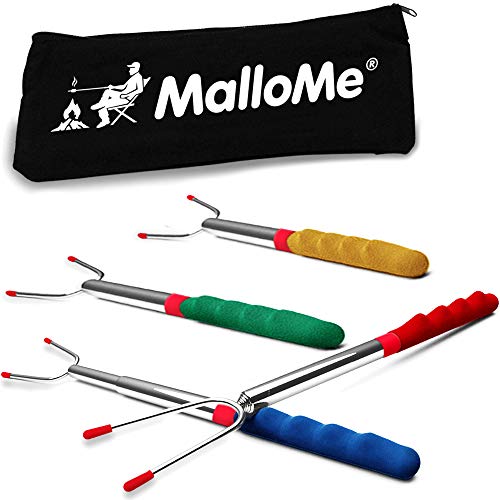
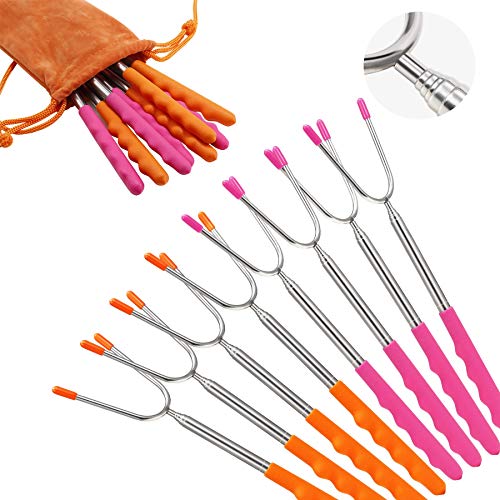
A separate s’mores burner for young kids. If the roasting is mostly for children under about eight, taking them off the fire pit entirely is the better call.
The Sterno S’mores Maker Jr runs on a canned gel fuel and includes a wire roasting screen over the flame, so the marshmallow rests on the screen instead of being held in the air over an open fire pit burner. It sits on a table, the flame is tiny, and a dropped marshmallow lands on a metal tray you can wash. Kids get the ritual, and your fire pit media never sees sugar.
The right fire pit, if you are still shopping. For roasting specifically, a lava rock bowl beats a fire glass table, and an adjustable regulator beats a fixed one.
The Outland Firebowl 893 Deluxe checks both. It ships with lava rock instead of glass, it has a proper adjustable valve so you can drop the flame down for roasting, and it is CSA certified, which is the specific detail that lets it be used in a lot of places where an open wood fire is not allowed. If you want to compare it against the rest of the category, our guide to the best portable propane fire pits breaks down BTU output, tank setup and burn time across the models worth considering. If you would rather have real wood flame with far less smoke in your face, the best smokeless fire pits are the other side of that decision, and they take dropped marshmallows without complaint.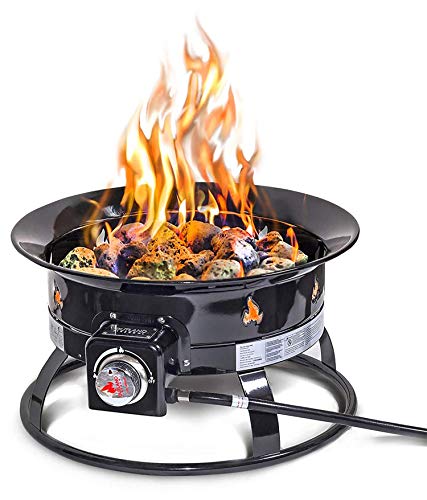
When propane is the only fire you are allowed to have
A lot of people searching this question are not choosing propane because they prefer it. They are on propane because wood is off the table, and they want to know whether they still get to do s’mores. Usually the answer is yes.
- Burn bans and drought restrictions. Many seasonal bans on open burning carve out an exception for a self contained gas appliance with a shutoff valve, because you can kill the flame instantly. Certification markings on the unit are what fire officials look for. This varies by jurisdiction and by how severe the current restriction is, so confirm with your local fire department before assuming it applies to you.
- HOA rules. Plenty of associations ban wood burning outright over smoke complaints and ember risk while permitting gas. If your HOA document only says no open burning, ask specifically about a gas appliance rather than guessing.
- Apartment and condo balconies. Be careful here. Widely adopted fire code language restricts open flame devices on balconies of multi unit buildings, and that restriction often covers gas as well as charcoal. Your lease may repeat it. Check both before you put a fire bowl on a balcony.
- Decks and patios. A propane bowl on a wood deck needs a heat barrier under it and clearance around it. We walk through what actually damages a deck and how to prevent it in our guide on whether a fire pit can go on a deck.
If you are unsure where you stand generally, our overview of backyard fire pit laws covers the rules that most often catch people out.
Roasting with kids around a gas pit
Gas fire pits have one specific hazard that wood fires do not, which is that they look off when they are on. There is no glowing bed of coals, no crackle, no visible heat signature once the flame is low. A child can walk up and put a hand on a steel rim that has been running for an hour and is still hot enough to burn. Wood fires broadcast danger. Gas fire tables do not.
- Set one roasting position and have kids take turns from that spot rather than circling the pit.
- Keep the control knob on the far side from where children stand, so nobody bumps it up.
- Tell them plainly that the rim stays hot for a long time after the flame is out. This is not obvious to a kid.
- Blow out a flaming marshmallow away from the pit. Blowing across a burner is how you send burning sugar into the media.
You dropped one, now what
Do not go in after it with the burner running, and do not spray water on hot media. Fire glass and lava rock can both fracture when hit with cold water while hot, and hot glass fragments are worth avoiding.
- Turn the valve off at the pit and close the valve on the tank. Let everything cool completely. That means an hour or more for fire glass, which holds heat longer than most people expect.
- Put on gloves and lift out the affected pieces of media by hand. You are pulling out the pieces with sugar on them, not the whole bed.
- Soak those pieces in hot water for twenty to thirty minutes. Caramelized sugar is water soluble and mostly comes off given time. Add a squeeze of dish soap if there is grease with it.
- Scrub with a stiff nylon brush, rinse, and set the pieces out until they are bone dry. Any trapped moisture can crack media the next time it heats up.
- Check the burner ports before relighting. If you see a hardened glaze over any of the holes, pick it out with a wooden skewer or a soft brush. Never a metal pick, which can widen a port and change the flame pattern permanently.
Lava rock that has soaked up sugar deep into its pores is not worth saving. Pull those pieces, throw them out, and top up the bed from a replacement bag. A bag of lava rock costs less than a pizza.
Common questions about roasting over propane
Does propane make the marshmallow taste like gas
No. The rotten egg smell you associate with propane comes from an odorant added at the tank so leaks are detectable, and it is consumed in the flame along with the fuel. Complete propane combustion produces carbon dioxide and water vapor, neither of which has a flavor. If anything, a marshmallow roasted over propane tastes cleaner than one roasted over wood, because there is no smoke and no resin to deposit on it. Some people miss that campfire note, which is a fair reason to prefer wood, but it is a preference and not a safety issue.
Is it safe to eat food cooked over a decorative fire pit
The flame is the same fuel used in gas grills, so the combustion itself is not the concern. What you should think about is what is sitting in the pit. Media that has been rained on, collected pollen and leaf litter, or gone months without a cleaning is not a surface you want dripping marshmallow onto and then eating. Brush the bed out before a s’mores night. That single step handles most of it.
Why does my flame go yellow when I roast
Decorative fire pit burners are tuned to produce a tall yellow flame on purpose, because that is what looks like a campfire. Yellow tips on a fire pit are normal and are not the warning sign they would be on a gas range. What is worth investigating is a flame that has gone lazy, uneven across the bed, or noticeably sootier than it used to be. That usually means blocked ports or restricted air, and after a season of s’mores, sugar is a likely culprit.
Can I cook anything else on a propane fire pit
Marshmallows work because they do not render fat. Anything that drips grease, hot dogs, burgers, bacon, sausages, belongs on a grill. Grease into a fire pit burner means flare ups, permanent staining on the media, and a smell that lingers for weeks. Some manufacturers sell a drop in grate accessory made for their specific model, and if yours does, that is the only version of fire pit cooking we would recommend. Otherwise, draw the line at marshmallows.
Should I just buy a wood fire pit instead
If s’mores are the main reason you want a fire at all, and wood is allowed where you live, wood is the better tool for the job. It gives you a real flame column to work beside, it does not care what you drop into it, and cleanup is a scoop of ash. Propane wins on convenience, on instant shutoff, and on being permitted in places wood is not. Both roast a marshmallow perfectly well.
The short version
Roast away, but do it deliberately. Lay a sheet of heavy duty foil over the section of media you will be working above, turn the burner down to about half, and use a skewer long enough that you are not reaching across the bed. Those three moves take under five minutes and they are the difference between a fire pit that still lights evenly in three years and one with sugar baked into the burner ports.
Last update on 2026-11-10 / Affiliate links / Images from Amazon Product Advertising API
This post contains affiliate links, which means I may receive a small commission, at no extra cost to you, if you make a purchase using these links.


