

Yes, patio heater reflectors work, but only in one specific situation, and that is why so many people buy one and feel like nothing changed. A reflector does not make your heater hotter. It takes the heat that is currently going somewhere nobody is sitting and sends it back toward the chairs. If your heater already sits in the middle of a circle of guests, there is nothing to redirect and the part is a waste of money. If it sits against a wall, a fence, or a deck railing, roughly half of what you are paying for in propane is heating brick and air right now, and a reflector is the cheapest fix on the market.
Two completely different products are both sold as a patio heater reflector shield
This is the single biggest reason people end up disappointed, and almost no one explains it before you click buy. Search the phrase on Amazon and you get two parts that share a name and do opposite jobs.
The replacement top dome. This is the big round hood that came on the heater from the factory, usually about 33 inches across, usually mounted with three bolts. It spreads heat down and out in a full 360 degree circle. People buy this one when the original blew off in a storm, rusted through, or got bent. It is a repair part. It will not focus your heat in any direction, because focusing was never its job.
The directional add on reflector. This is the curved half moon panel that clamps onto the back edge of the dome you already have. It blocks the rear half of the circle and pushes that heat forward. This is the part people mean when they ask whether reflectors “really work.” It is an accessory, not a repair part, and it is the one that changes how warm your patio feels.
If you order the 33 inch dome expecting your seating area to get warmer, nothing will happen. Check the listing photos. A repair dome looks like a full circle or a shallow cone. A directional reflector looks like a curved fence panel with clamps on the bottom edge.
What a reflector can and cannot do to your heat output
A 40,000 BTU heater puts out 40,000 BTU with a reflector and 40,000 BTU without one. Nothing about bolting aluminum to the hood changes the burner. What changes is the share of that output that lands on people.
A mushroom heater throws infrared out in a full circle. Push it against the side of the house, seat everyone in front of it, and you are heating your siding, your lawn, and the sky with the back half. Cut that circle to about 180 degrees and the front half roughly doubles in intensity. Manufacturers put numbers on this. Sweet Heat cites third party testing showing up to a 70 percent increase in heat range in the chosen direction, and several competing brands claim propane savings in the 40 to 60 percent range. Treat those as best case marketing figures measured under ideal conditions, not a promise for your deck. The direction of the effect is real even when the percentage is optimistic.
Here is the honest test, and it takes ten seconds. Stand where your guests actually sit. Now look at what is on the exact opposite side of the heater. If the answer is a wall, a fence, a railing, a hedge, or empty lawn, a reflector will pay for itself. If the answer is more chairs, skip it.
When a directional reflector is genuinely worth buying
- The heater lives against the house, a privacy fence, or a solid deck railing, which is where most people put it for stability and out of the walkway.
- You have a narrow balcony or a townhouse patio where the heater cannot go anywhere except a wall.
- Your seating is a straight line or an L shape rather than a ring, which describes most sectionals and most dining tables pushed to one side.
- Your vinyl siding or a nearby shrub is discoloring, drying out, or warping from the heater sitting too close.
- You are burning through a 20 pound tank faster than you would like and want to run on medium instead of high.
When a reflector will not fix a cold patio
Four situations where the money is better spent elsewhere.
Pyramid and glass tube heaters. The flame column on these runs nearly the full height of the unit. The small plate at the top is not doing much reflecting to begin with, so clamping a panel up there redirects a sliver of the output while the bottom two thirds of the column keeps radiating in every direction. Some sellers list their reflectors as pyramid compatible. Physically they attach. Practically they do very little.
Anything windier than a light breeze. Outdoor heaters lose most of their usefulness in real wind, and a reflector does not change that. Worse, a large flat panel bolted to the top of a tall heater is a sail. On an unweighted base, that is a tip over risk, which is exactly the failure mode you do not want with a live propane flame. Fill the base ring with sand or add a weight plate before you add surface area up top. A reflector angled into a light draft will help a little. In a gusty coastal evening it is a liability.
A heater that is simply too small for the space. A tabletop unit warms hands at a table. It was never going to warm a 20 foot patio, and concentrating its output into a half circle will not close that gap. If you are trying to heat a large open area, the answer is a second heat source or a different one, not an accessory.
Guests seated all the way around. Worth repeating because it is the most common mistake. A reflector on a centrally placed heater takes warmth away from half your party and gives it to the other half. Nobody wins.
What a reflector actually does to your propane bill
Run the numbers before you decide, because the payback is real but it is not dramatic. A 20 pound propane tank holds roughly 430,000 BTU. A common 40,000 BTU patio heater on full output drains that in about ten hours, and at typical refill or exchange pricing you are looking at somewhere near $1.50 to $2.00 per hour of use.
The saving does not come from the reflector. It comes from what the reflector lets you do next, which is turn the knob down. If concentrating the output means medium now feels the way high used to feel in the seats that matter, you stretch the same tank across noticeably more evenings. A reflector in the $30 to $60 range earns itself back over a season of regular use, not over a weekend. Anyone selling it as an instant halving of your gas bill is stretching.
Measure these three things before you order anything
Returns on this category are common and almost always come down to fitment. Get a tape measure out first.
- Dome diameter. Most full size mushroom heaters use a 33 inch hood, and most add on reflectors are cut for that. Measure yours. Compact and patio sized models run smaller and a large reflector will overhang badly.
- Mounting style. Clamp on reflectors squeeze the outer lip of the hood with thumb screws and need no drilling at all. Bolt on replacement domes typically use a three hole pattern with the holes about 6 7/8 inches apart. If you are replacing a dome, count and measure the holes on the old one.
- Lip thickness and rolled edge. Screw clamps need a lip they can actually grab. A heavily rolled or reinforced edge can stop a clamp from seating, which is the fitment problem that does not show up in any product photo.
The reflectors we would actually put on a heater
Three directional add ons cover almost every situation, and they differ in ways that matter more than the price gap suggests.
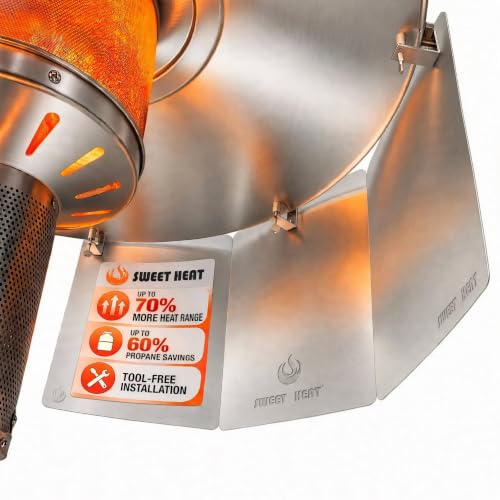
The Sweet Heat is the one to buy if your heater is a full size 33 inch mushroom that lives outside year round. It is solid aluminum rather than thin alloy, which matters because a thin panel warps over a couple of seasons of heat cycling and then stops sitting flush against the hood. It uses screw clamps, so installation takes about five minutes with no tools and no drilling, and it is the most expensive of the three. Pick it when the heater is permanently placed and gets used a lot.
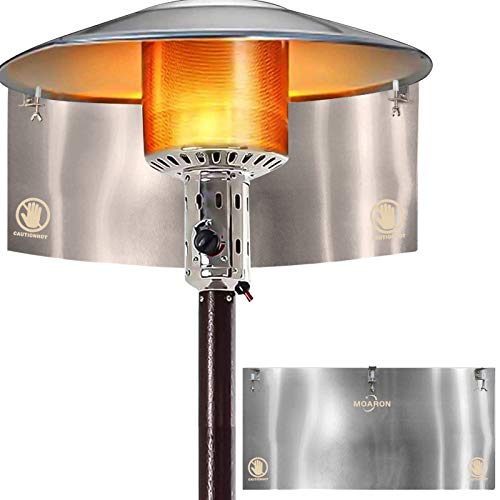
The MOARON is the value choice and does the same job with the same screw clamp attachment for roughly half the price. It is aluminum, it fits standard round propane and natural gas heaters, and for a heater you fire up a dozen evenings a year it is the sensible buy. Choose this one if you want to test whether a reflector helps your specific layout before committing more money.
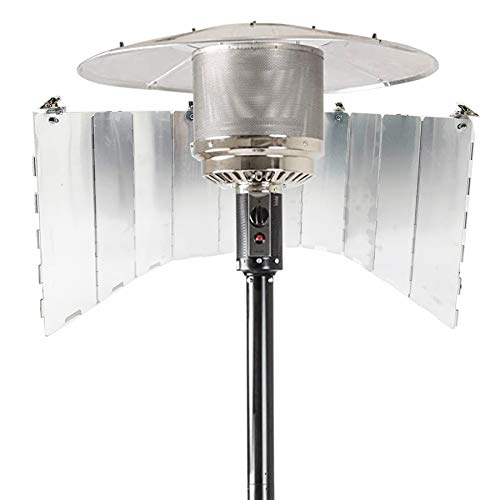
The Smokitcen is the one for renters, small patios, and anyone who puts the heater away in spring. Its paneled design folds down flat for storage instead of taking up a full curved panel of shed or closet space, and it clips on rather than clamping hard, so nothing about the heater is modified. The tradeoff is size. It sits shorter than the product images suggest, so some heat still escapes below the bottom edge. Accept that if storage and reversibility are what you need.
If your original hood is the thing that is missing or mangled, none of the above is what you want. Look for a universal 33 inch replacement dome with a three hole mount, which is sold as a repair part by several sellers and by heater brands directly. Fit that first, then decide separately whether you also want a directional panel on top of it.
What to do if you rent or cannot modify the heater
Every clamp on and clip on reflector in this category is fully reversible. No drilling, no permanent hardware, nothing that shows when you take it off. That covers most rental and HOA concerns about the heater itself. The rules people actually run into are about the heater, not the accessory, so check whether propane storage on a balcony is restricted before you worry about the reflector.
If a reflector is not an option, two cheaper moves do a surprising amount. Move the seating closer, because infrared drops off fast with distance and two feet makes more difference than most people expect. Then block the wind on the exposed side with a screen, a row of planters, or a folding privacy panel. Wind steals more warmth from a patio than poor heat direction does.
On a covered porch or a three sided space with a power outlet, an electric infrared heater is often the better answer than propane plus accessories, since it directs heat by design and has no tank to refill. We compare the two in detail in our guide to electric versus propane outdoor patio heaters. And if what you actually want is a warm place for people to gather rather than a heated zone, a fire pit does that job better for the money, which is where our roundup of the best smokeless fire pits is a more useful starting point than any reflector.
Using a reflector to protect siding, fences and plants
This benefit gets buried in most listings and it is often the better reason to buy. Vinyl siding softens and distorts well below the temperature people assume, and a tall heater parked a couple of feet from the wall night after night is a slow heat gun pointed at it. The same goes for a wood fence, a plastic downspout, or an evergreen you would rather not brown out on one side.
A directional reflector puts a solid aluminum barrier between the burner and that surface while sending the heat toward your chairs. You get the protection and the efficiency from the same $40 part. Keep following your heater manufacturer’s stated clearance distances anyway, because a reflector reduces radiant exposure but does not license you to shove the unit against the wall.
FAQ
Do patio heater reflectors actually save propane?
Indirectly, yes. The reflector does not reduce fuel use on its own, because the burner output is unchanged. It lets you run a lower setting and get the same felt warmth in the seats that matter, and that lower setting is what stretches the tank. Expect a meaningful difference over a season rather than a dramatic one in a single evening.
Will a reflector fit my patio heater?
Most add on reflectors are cut for the standard 33 inch mushroom hood and clamp onto its outer lip, so measure your dome diameter and check that the lip is not so heavily rolled that a clamp cannot seat. Pyramid and glass tube heaters accept them physically but gain very little.
Do I need tools to install one?
Usually not. Clamp on and clip on models tighten with thumb screws by hand and take about five minutes. A light nip with pliers on the thumb screws helps if grip strength is an issue, but it is not required.
Can I leave a reflector on the heater in winter?
Aluminum handles the weather fine, but the added surface area makes the heater more likely to catch wind and tip. If the heater stays out through the off season, weight the base properly and cover the unit, or take the reflector off and store it flat.
What is the difference between a reflector shield and a heat deflector?
Sellers use both terms loosely for both products, which is exactly where the confusion starts. Ignore the name and read the photos. A full round hood is a replacement dome for repairs. A curved half panel with clamps is the directional accessory that concentrates heat.
Our verdict on patio heater reflectors
Buy one if your heater backs onto a wall, a fence, or a railing, and skip it otherwise. That single detail decides whether this is one of the best value upgrades in the backyard or a curved sheet of aluminum that changes nothing. For a full size heater in a fixed spot, the Sweet Heat is the one we would fit and leave on.
Last update on 2026-11-17 / Affiliate links / Images from Amazon Product Advertising API
This post contains affiliate links, which means I may receive a small commission, at no extra cost to you, if you make a purchase using these links.


