

Most guides answer “how long to grill pork chops” with a single number, and that number is why so many backyard pork chops end up gray and rubbery. Grilling time depends on thickness, whether the bone is in, and how hot your specific grill runs, so a stopwatch alone will let you down. What actually decides whether a chop turns out right is internal temperature, and the biggest reason people overcook pork chops is old advice to cook until there is no pink left at all. That advice has been outdated since 2011.
Below is a time and temperature table you can actually use, an explanation of why the pink center you are afraid of is the safe outcome, and the two tools that make hitting the right temperature effortless instead of a guessing game. We also cover the situations the average recipe skips, frozen chops, tiny apartment grills, cooking a mixed batch for a crowd, and what to do if you do not own a thermometer yet.

Pork chop grilling times by cut and thickness
Use this as a starting point, then confirm with a thermometer. Pull chops 3 to 5 degrees before your target, since the internal temperature keeps climbing for a few minutes off the grill.
| Chop type | Heat method | Approx. total time | Pull temp |
|---|---|---|---|
| Boneless, 1/2 inch | Direct high heat | 6 to 8 minutes (3 to 4 per side) | 140°F |
| Boneless, 3/4 to 1 inch | Direct high heat | 8 to 10 minutes (4 to 5 per side) | 140°F |
| Bone-in, 1 to 1.25 inch | Sear direct, finish indirect | 10 to 14 minutes total | 140°F |
| Thick-cut, 1.5 to 2 inch | Reverse sear (indirect, then direct) | 20 to 30 minutes total | 135°F before the sear, 140°F after |
| Pre-cooked ham steak | Direct heat, just warming and marking | 5 to 7 minutes | 140°F (already cured) |
Pull everything at 140°F, not 145°F. A rested chop climbs another 3 to 5 degrees off the heat, so pulling at the final number almost guarantees you overshoot it. This is also why the time ranges you find online vary so much: a “medium-high” gas grill can mean anywhere from 400°F to 550°F at the grate depending on the model and how long it preheated, and a bone insulates the meat next to it, so a bone-in chop needs more time in the same spot than a boneless one of equal thickness. Time is a starting estimate. Temperature is the actual answer.
A pink center at 145°F is safe, not undercooked
The instinct to cook pork until it is uniformly white comes from a decades-old safety standard that no longer applies. The USDA lowered the recommended safe internal temperature for whole cuts of pork, including chops, from 160°F to 145°F in 2011, followed by a 3-minute rest. Modern U.S. pork is raised under conditions that have made trichinosis, the original reason for the 160°F rule, essentially a non-issue.
The pink color itself is not a doneness indicator either way. It comes from myoglobin in the muscle, and how much of it survives cooking depends on the chop’s pH and the exact temperature curve it went through, not on how “cooked” it is. A chop can look fully white at 130°F and unsafe, or keep a light pink blush at 145°F and be perfectly safe. Color is not a substitute for a thermometer in either direction. If you have been cooking chops to 160°F and wondering why they turn out dry, this is almost certainly why.
Get a real reading instead of guessing
Because the safe window for pork chops is narrow (a few degrees between “properly done” and “dry”), and because chops are thin enough that overcooking happens in under a minute, the single best upgrade for anyone who grills chops regularly is an instant-read thermometer. A full leave-in probe setup is overkill for something that cooks this fast. What you want is a fast, accurate spot check.
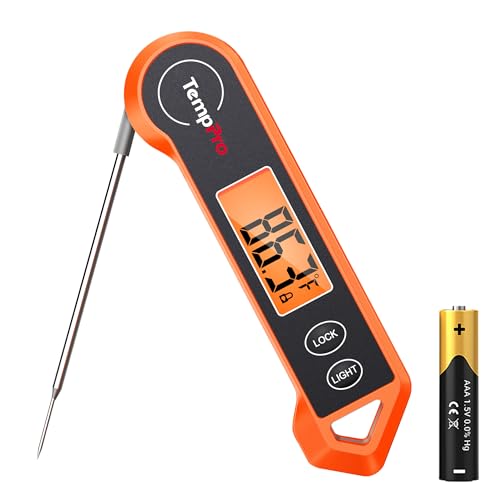
The ThermoPro TP19H reads in 3 to 4 seconds with plus or minus 0.9°F accuracy, which is tight enough to trust for a cut this thin. The auto-rotating backlit display matters more than it sounds for pork chops specifically, since you are usually checking multiple chops at once on a hot grate and need a fast, glare-free read before the next one overcooks.

The Alpha Grillers Instant Read is the budget pick if you are equipping a first grill setup or grilling after work when the light is already fading. Its backlight is noticeably brighter than most thermometers in this price range, and the lifetime warranty means a dropped probe on the patio does not end the tool’s life.
For a full comparison across every price point and use case, including wireless and leave-in options for longer cooks, see our guide to the best digital meat thermometers.

Reverse sear thick chops instead of babysitting the flame
A chop 1.5 inches or thicker will burn on the outside before the center catches up if you leave it over direct heat the whole time. Set up two zones instead. On a gas grill, light half the burners and leave the other half off. On a charcoal grill, bank the coals to one side. Start the chop on the cool, indirect side with the lid down until it reads about 135°F, then move it directly over the heat for 60 to 90 seconds per side just to build color and crust before pulling at 140°F.
If you are running charcoal for this, lump charcoal lights faster and burns hotter for the sear stage than briquettes, which matters when you only need a minute or two of direct heat at the end. Our lump charcoal picks cover which bags hold a steady indirect temperature long enough for the reverse sear without needing a second chimney.
Situations the general advice skips
Grilling chops straight from frozen
Do not grill pork chops straight from frozen. The outside will overcook long before the center clears 145°F, and there is no reliable timing chart for it because ice content varies too much chop to chop. Thaw in the refrigerator overnight, or if you are short on time, submerge the sealed chops in cold water for 30 to 45 minutes, changing the water every 15 minutes. A chop thawed this way is ready to season and grill on the same timeline as the table above.
Small grills, apartment balconies, and tabletop setups
A small two-burner or tabletop grill does not have enough surface area for a true two-zone setup with thick chops. The workaround is to sear first over direct heat for the full time on both sides, then kill one burner (or move the chops to the grate’s edge, furthest from the flame), close the lid, and let the chops finish coming up to temperature with indirect residual heat rather than open flame. Check with a thermometer earlier than you think you need to, since small grills swing in temperature faster than a full-size unit.
Bone-in versus boneless timing
Bone-in chops of the same thickness as a boneless chop generally need 1 to 3 extra minutes because bone conducts heat more slowly than muscle, so the meat right next to it lags behind. This is also why bone-in chops are harder to dry out. The bone is protecting that section of meat from overcooking even after the surrounding flesh is done, which gives you a slightly wider margin for error.
Cooking a mixed batch for a crowd
If you are grilling chops of different thicknesses at once, put the thickest ones down first and add thinner ones a few minutes later so everything finishes close together. Pull each chop individually by temperature rather than pulling the whole batch at once on a timer. A rimmed sheet pan tented loosely with foil next to the grill holds finished chops at a safe temperature for the 10 to 15 minutes it takes to finish the rest.
No thermometer on hand
If you genuinely have no thermometer, the closest low-tech check is cutting into the thickest chop near the bone and looking for the flesh to have gone from translucent pink-red to an opaque pale pink, with clear (not red) juices. This is far less reliable than a thermometer reading and it lets juices escape from the cut, so treat it as a one-time emergency workaround rather than your normal method. Given how cheap a basic instant-read thermometer is, and how easy pork chops are to overcook without one, it is worth picking one up before your next cookout.
If you already overcooked them
A pork chop that has gone past 150 to 155°F is not coming back to juicy on its own, but it is not wasted. Slice it thin against the grain, which shortens the muscle fibers and makes a dry chop noticeably easier to chew, then toss it into a sauce, a stir-fry, or a chopped salad where the dressing or sauce adds back moisture. For next time, brining for 30 minutes to 2 hours in a simple salt and sugar solution before grilling adds a buffer of extra moisture that forgives a slightly late pull.
Frequently asked questions
Is it safe to eat pink pork chops?
Yes. The USDA’s safe minimum internal temperature for pork chops is 145°F followed by a 3-minute rest, and a light pink center at that temperature is normal and expected, not a sign of undercooking. Color is determined by myoglobin and pH, not doneness, so check temperature with a thermometer instead of judging by how pink the center looks.
How long do you grill boneless pork chops per side?
For a 3/4 to 1 inch boneless chop over direct high heat, plan on 4 to 5 minutes per side, 8 to 10 minutes total, then confirm with a thermometer and pull at 140°F to allow for carryover cooking.
How long to grill 1 inch bone-in pork chops?
About 10 to 14 minutes total using a sear-then-finish method, searing 2 to 3 minutes per side over direct heat, then finishing over indirect heat until the center reads 140°F. Bone-in chops run a little slower than boneless chops of the same thickness because the bone slows heat transfer to the meat around it.
Can I grill pork chops from frozen?
It is not recommended. A frozen chop’s exterior will overcook well before the center reaches a safe temperature, and there is no reliable timing chart for it since ice content varies too much between chops. Thaw in the refrigerator overnight or in cold water for 30 to 45 minutes first.
What do I do if I do not own a meat thermometer?
Cut into the thickest part near the bone and check that the flesh is opaque pale pink with clear juices, not translucent red. This is a rough one-time workaround, not a reliable method, since it lets juices escape and is easy to misjudge. An inexpensive instant-read thermometer removes the guesswork entirely and pays for itself after the first chop it saves from overcooking.
Last update on 2026-10-07 / Affiliate links / Images from Amazon Product Advertising API
This post contains affiliate links, which means I may receive a small commission, at no extra cost to you, if you make a purchase using these links.


