

Buying is cheaper. In almost every real backyard, a prefab fire pit costs less on day one than anything you build, and the gap is wider than the national cost guides make it look once you price the parts a DIY build actually needs. Building wins on one measure only, which is cost per year of use, and only if you build it right the first time. That is the honest answer. What matters now is figuring out which of those two situations you are actually in, because people who regret this decision almost always chose based on the price of the pit and ignored the cost of the ground underneath it.
The comparison most people run in their head is the wrong one
The mental math usually goes like this. A steel bowl at the home center is $130. A stacked block pit looks like maybe $200 in materials. Building must be close, so why not build.
Those two things are not the same product. A bought fire pit is a container for a fire. A built fire pit is a permanent hardscape feature that happens to hold fire, and it prices like hardscape, which means base material, delivery or hauling, a heat barrier, and a weekend of your labor. Once you put both on the same line, the question stops being buy or build and becomes something more useful. Are you buying a fire, or are you buying a spot in the yard that will still be there in fifteen years.
What a bought fire pit really costs across five seasons
Sticker price is not the number that matters here. Lifespan is. Fire pits in the cheapest tier fail in a predictable way, and it is almost always the same failure.
- Under about $150. Thin rolled steel bowls with a painted finish. The paint burns off the interior in the first few fires, and after that the bowl is bare steel sitting in wet ash all winter. Two to four seasons is normal before the bottom seams rust through. Priced across five years, this tier is not the cheap option. It is two purchases.
- About $250 to $450. Double wall stainless smokeless pits. Stainless does not rust through the way painted carbon steel does, and the double wall burns off most of the smoke instead of pushing it at your neighbors. This is the tier where a bought pit starts to compete with a built one on lifespan.
- About $400 to $1,200. Propane fire tables. Add fuel to the running cost, because a 20 pound tank is real money every few weeks in heavy use, and add nothing for firewood, hauling, or ash disposal.
One line item changes this math more than any other, and it costs about $25 to $60. A cover. Water sitting in a pit full of ash is what kills cheap steel, not the fire. If you buy at the bottom of the range and never cover it, plan on replacing it. If you buy at the bottom of the range and cover it every time, you may get twice the life out of it.
If the reason you started pricing a custom build was smoke complaints from a close neighbor, buy your way out of that problem instead of building your way out of it. A double wall stainless pit like the Solo Stove Bonfire 2.0 pulls preheated air up through the inner wall and burns the smoke that a block ring simply releases at knee height.
A stacked stone pit cannot do that at any budget, because the smoke reduction comes from the airflow design and not the material. Our roundup of the best smokeless fire pits compares the sizes and the price tiers if that is the direction this is heading.
What a built fire pit really costs once you add the forgotten parts
Most DIY cost estimates count the blocks and stop. Here is the fuller list for a standard three course ring in the 36 to 44 inch range, using current big box retail pricing.
| Line item | Typical cost | Why people forget it |
|---|---|---|
| Retaining wall or trapezoidal fire pit block, 33 to 45 pieces | $100 to $180 | This is the only number most estimates include |
| Steel fire ring insert | $70 to $130 | Skipped on purpose to save money, which is the mistake below |
| Paver base or gravel for a level pad | $25 to $60 | The pit shifts and the top course cracks without it |
| Landscape block adhesive, 2 tubes | $16 to $24 | Only needed if you glue the cap course |
| Hauling, delivery, or a truck rental | $0 to $90 | 45 concrete blocks weigh several hundred pounds |
| Your weekend | 4 to 8 hours | Digging and leveling is most of it, not stacking |
Realistic all in range for a solid DIY block ring is about $200 to $350. That beats a mid tier prefab and loses badly to a $130 bowl. It also assumes you do the labor.
Pre-bagged masonry fire pit kits from the big box stores are a different animal entirely. The Pavestone RumbleStone kits and similar modular systems at Home Depot currently run from roughly $679 into the thousands depending on size and whether a steel insert is included. A kit is a fine product, but nobody should buy one believing it is the budget path. It is the convenience path.
The one part that decides whether your build is cheap or expensive
Skip the steel ring insert and you have not built a cheaper fire pit. You have built a fire pit with an expiration date.
Standard concrete retaining wall block is not rated for direct flame contact. A wood fire runs somewhere around 1,000 to 1,100 degrees Fahrenheit at the flame, and concrete starts to spall well below that. Spalling is the interior face flaking and cracking off in sheets as trapped moisture inside the block turns to steam and pushes outward. On a pit used most weekends, one to three seasons is a normal timeline for visible damage. A steel ring takes that abuse instead, and it is the difference between a pit you rebuild and a pit you inherit to the next owner of the house.
Sizing matters more than brand here. Measure the inside diameter you want the fire to be, then buy the ring first and lay the block to it, not the other way around. A 36 inch inner ring suits a three course pit meant for six to eight chairs.
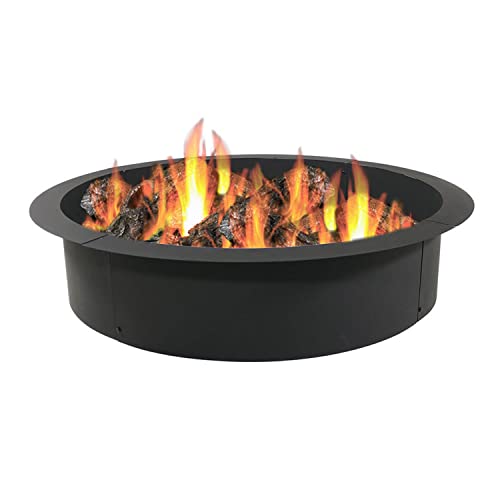
The heavy duty Sunnydaze ring in the 42 inch outer and 36 inch inner size is the common fit for a full size backyard ring, and the 2mm steel is the spec worth checking, because the thin stamped rings sold at the same price warp out of round after a season of hot fires. For a smaller patio, or a pit meant for four chairs, the 36 inch outer and 30 inch inner version keeps the whole footprint under a yard wide.
One safety note that has nothing to do with budget. Do not build with river rock, creek stone, or fieldstone you dug out of the yard, and do not fill the base with them. Those stones hold water inside, and water turns to steam at roughly 1,700 times its own volume. Saturated smooth stone in a hot fire can crack and throw fragments. Fire brick, lava rock, and fire rated pavers are the materials made for the inside of a pit. Save the pretty river rock for the border, well outside the heat.
The cheapest build almost nobody prices out
There is a third option that sits between buying and building, and it is usually the actual cost winner for anyone who wants a permanent fire.
Buy the steel ring insert. Set it on a leveled gravel pad. Stack one or two courses of block around it dry, with no adhesive and no kit. That is it. You are looking at roughly $180 to $280 depending on block price, you can do it in an afternoon, and because nothing is glued you can pull it apart and move it if the setback rules, the deck plan, or the next owner say so. It looks like a built pit and behaves like a bought one. Our full walkthrough on how to build a fire pit that lasts covers the base prep in detail, which is the part that actually determines whether it stays level.
When buying is clearly the cheaper choice for your situation
- You rent. Anything mortared or dug in is a deposit conversation. A portable pit leaves with you and costs nothing to un-install.
- You have an HOA or a strict local code. Many rules cap open wood fires, require a manufactured pit with a spark screen, or set a distance you may not be able to satisfy in a small yard. A built pit that violates a setback is a demolition bill. Check how far a fire pit has to be from the house before you dig anything.
- The only flat spot is a deck or a patio. Masonry on a wood deck is a bad idea for weight and heat reasons both, and a legged pit with a heat shield is the answer instead. We covered the specifics of putting a fire pit on a deck separately.
- Your yard is small. A 44 inch masonry ring plus a safe clearance circle eats a surprising amount of a small lot, and it eats it permanently. A pit you can push against the fence when the kids want the lawn is worth more than the savings.
- You want gas. Propane makes buying the obvious answer. Building a gas pit means a burner kit, a pan, a regulator, and either a tank enclosure or a run of gas line, which is a licensed trade job in most places. A finished propane unit skips all of it, and our guide to the best portable propane fire pits covers what the tank hides inside or beside.
When building is clearly the cheaper choice for your situation
- You want a big fire. Prefab bowls top out around 30 to 36 inches before prices climb steeply. A 44 inch block ring costs the same as a mid tier bowl and seats twice the people.
- You were already shopping above $400. That is the crossover. Below it, buying wins on price. Above it, your money buys more permanence in block than in sheet metal.
- The ground is already right. If you have a level gravel or bare dirt area with clearance, you skip the expensive half of the job. If you would need to build a patio pad first, add hundreds and reconsider.
- You are staying put. A built pit amortizes over ten or fifteen years. Over three years it does not.
What a contractor quote is actually buying you
Professionally installed fire pits commonly land in the $325 to $2,000 range, with roughly $850 being a typical middle figure, and quotes climb past that quickly once a seating wall, a paver surround, or a gas line joins the scope. Very little of that is the pit. You are paying for excavation, compacted base, and someone else carrying several hundred pounds of block. If a quote comes back over $1,500 and the design is a plain round ring, the price is in the surround and the labor, not the fire, and you can usually get most of the look for a fraction of it by doing the dry stacked version above and spending the difference on chairs.
Frequently asked questions about fire pit cost
What is the absolute cheapest way to have a legal fire in a backyard?
A steel fire ring insert set on a leveled gravel pad, with no block at all. That is roughly $70 to $130 and it satisfies most local rules that ask for a contained fire. Add a course of block later when you want it to look finished.
Do I really need a steel ring inside a block fire pit?
For anything you plan to use more than a few times a year, yes. Concrete block is not rated for direct flame, and the interior face spalls and cracks within one to three seasons of regular use. The ring costs less than replacing the block.
Is a fire pit kit from the home center a good deal?
It is a good product and a poor bargain. Modular kits at Home Depot and Lowe’s generally start around $679, which is well above a from scratch block build and above most prefab pits. Buy one for the finished look and the matching cap stones, not to save money.
How much does a built fire pit add to home value?
Nothing you should count on. Treat a fire pit as something you buy because you will use it, not as an improvement that pays back at sale. That is another argument for spending less rather than more.
Does a bigger fire pit cost more to run?
With wood, yes, and noticeably. A 44 inch ring burns roughly twice the wood per evening of a 30 inch one. If you buy firewood by the bundle rather than the cord, size the pit down and the savings show up every weekend.
If you are undecided and want one recommendation, buy a steel fire ring insert and dry stack a single course of block around it. It costs less than almost every prefab pit worth owning, it lasts longer than all of them, and nothing about it is permanent enough to become a problem when the rules, the yard, or the plans change.
Last update on 2026-11-17 / Affiliate links / Images from Amazon Product Advertising API
This post contains affiliate links, which means I may receive a small commission, at no extra cost to you, if you make a purchase using these links.


