

Most people asking this question have already spent an evening reading owner reviews that flatly contradict each other. One thread says Pit Boss is a steal and Traeger is overpriced for what you get. The next says Traeger is worth every extra dollar and Pit Boss feels cheap by the second season. That contradiction is not a coincidence. Pit Boss and Traeger are built around two different priorities, and which one is right for you depends on what you actually cook and how much you want to think about your grill after you buy it, not on which brand has louder fans online.
The One Feature That Actually Decides Most of These Purchases
Every comparison of these two brands eventually lands on price, hopper size, and app quality. Those matter, but they are not the detail that ends most debates. The real deciding factor is whether you can put a hard sear on a steak or burger.
Traeger’s entire 2026 lineup, the Woodridge, Woodridge Pro, and Woodridge Elite, tops out at 500°F and cooks over a fixed metal heat diffuser that sits between the fire and your food. That design is why Traeger holds temperature so evenly, but it also means the food never touches direct flame, so you get a warm crust at best, not a real char.
Many Pit Boss models solve this with a Flame Broiler, a lever that slides the heat diffuser open so the food sits directly over the fire pot. Open it and the grill can hit 1,000°F for a genuine sear, close it and it runs like a normal pellet smoker. If you grill steaks, burgers, or chicken thighs and care about a real crust, this single mechanical difference matters more than anything else in a spec sheet.
Pit Boss Pro Series II 850 vs Traeger Woodridge Pro, Head to Head
These two sit at similar price-to-capacity points and represent each brand’s best all-around 2026 model, so they make the fairest side-by-side comparison.
| Pit Boss Pro Series II 850 | Traeger Woodridge Pro | |
|---|---|---|
| Price | $549 | $1,149 |
| Cooking area | 850 sq in (two tiers) | 970 sq in |
| Temperature range | 180°F to 500°F, up to 1,000°F with Flame Broiler open | 180°F to 500°F, no direct flame option |
| Controller | PID digital control board | WiFIRE PID with Super Smoke mode |
| App and WiFi | Yes, WiFi and Bluetooth | Yes, WiFIRE app with guided cooks and recipes |
| Grates | Porcelain-coated cast iron | Porcelain-coated steel |
| Warranty | 5 years | 10 years |
| Direct-flame searing | Yes, Flame Broiler lever | No |
The Traeger costs roughly twice as much for less searing capability, but it wins on warranty length and the polish of its app, which includes guided cook programs and 24/7 support. The Pit Boss wins on price and on the one thing a lot of buyers actually want, a real sear, without spending on a second grill.
Our Picks for 2026
Three specific models cover almost every reason someone lands on this comparison. Two are the brands you came here to compare, and the third is worth knowing about even if you did not ask for it.
Pit Boss Pro Series II 850, best if searing matters and budget is tight

This is the model to buy if you want to retire your gas grill entirely. The Flame Broiler lever gets you a real crust on steaks and burgers, the PID controller holds steady through long overnight cooks, and 850 square inches across two tiers is enough for most households. At $549 it also undercuts the Traeger Woodridge Pro by roughly $600 for a similar footprint.
Pros
- Flame Broiler lever opens for direct flame up to 1,000°F
- 850 sq in across two tiers for under $600
- PID control holds steady through long cooks
- WiFi and Bluetooth app included, no longer a Traeger-only feature
Cons
- 500°F ceiling with the Flame Broiler closed
- 5-year warranty trails Traeger's 10 years
- App works but is less polished than Traeger's
The verdict: Buy it if a hard sear and a lower price matter more to you than the longest possible warranty.
Traeger Woodridge Pro, best if you want the smoothest app and the longest warranty
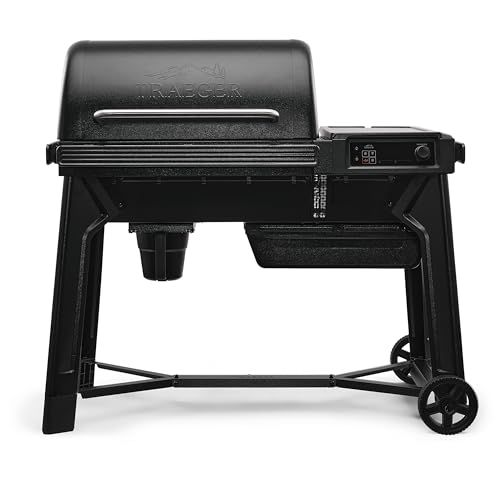
If you mostly smoke low and slow, rarely sear, and want a grill that is simple to trust for a decade, the Woodridge Pro earns its price. Super Smoke mode boosts smoke output below 225°F for a better bark, the WiFIRE app includes guided cook programs and a large recipe library, and the 10-year warranty is the longest in the category.
Pros
- WiFIRE app with guided cooks and a large recipe library
- Super Smoke mode for deeper flavor below 225°F
- 10-year limited warranty, the longest available
- 970 sq in cooking area
Cons
- 500°F ceiling with no direct-flame searing at all
- Costs roughly twice as much as the comparable Pit Boss
- Priced above competitors offering similar capacity
The verdict: Buy it if you rarely need a hard sear and app polish and warranty length outweigh price for you.
Weber Searwood 600, the option neither brand wants you to consider

Most Pit Boss versus Traeger comparisons stop at those two names, which means they never mention the grill that actually solves the tradeoff between them. The Searwood removes the heat diffuser most pellet grills use, so it smokes low and sears hot on the same grates, up to 600°F, without a lever or workaround. It sits between the two on price at $999, and it carries a 10-year warranty that matches Traeger’s.
Pros
- Direct flame searing up to 600°F with no diffuser blocking it
- 10-year warranty, matching Traeger
- Rapid React PID reaches cooking temperature in about 15 minutes
- Weber Connect app with a reliable track record
Cons
- 20 lb hopper is on the small side for unattended overnight cooks
- 648 sq in runs tight for large groups
- Costs more than the Pit Boss, though less than the comparable Traeger
The verdict: Buy it if you have been going back and forth between Pit Boss and Traeger because you want both smoke and sear from one grill, and the budget stretches to $999.
For the full lineup beyond these three, including budget options under $500 and large-capacity rigs built for crowds, our roundup of the best pellet smokers ranks 11 models side by side.
Match the Grill to Your Actual Situation
The three picks above cover most buyers, but a few specific situations change the right answer.
Cold climate. Neither the Pit Boss Pro Series II 850 nor the base or Pro Traeger Woodridge ship with an insulated body, only the Traeger Woodridge Elite does, at $1,799. Rather than paying for the Elite just for winter performance, an aftermarket insulating blanket sized for your specific model is the cheaper fix and works on either brand.
Renting, a small patio, or an HOA that restricts grills. Both brands sell compact tabletop and stand-alone portable versions that use far less footprint than the models compared above. Check your lease or HOA documents specifically for pellet or electric-ignition grills before assuming a rule applies. Many restrictions are written around “open flame” or “propane” and do not clearly address pellet grills, and enforcement varies by building, so a specific answer beats a guess. Our guide to the best portable pellet grills compares the compact options from both brands, plus a few third-party models, against weight and cooking area.
You already own a Traeger. Staying inside the Traeger ecosystem has a real practical benefit beyond brand loyalty. Every current Traeger model uses the same P.A.L. Pop-And-Lock accessory rail, so shelves, hooks, and add-ons carry over if you upgrade within the brand. If you are weighing whether to switch to Pit Boss or stay put, our roundup of the best Traeger accessories is worth a look before you decide, since losing rail compatibility is a real cost of switching brands that a spec sheet will not show you.
First pellet grill, no experience with either brand. Both companies ship models that arrive mostly pre-assembled with bolt-together legs and a shelf, and both apps walk a first-time owner through a startup burn-off and a first cook. Neither brand requires any special skill beyond what a normal gas grill takes to operate.
Torn between a horizontal barrel and a vertical cabinet, not just between these two brands. Everything compared on this page is a horizontal grill. A vertical cabinet smoker trades the searing lever for a much smaller footprint and more cooking racks in less patio space, at the cost of a lower temperature ceiling. Our vertical vs horizontal pellet smoker guide covers which shape actually fits a covered patio or a narrow side yard before you commit to either brand above.
Two Assumptions Worth Retiring Before You Buy
“Traeger has WiFi and Pit Boss does not.” This was true a few years ago and still shows up in older comparisons. It is no longer accurate. Pit Boss’s current mid-tier and higher models, including the Pro Series II 850, ship with WiFi and Bluetooth. The real gap left between the brands is not whether you get an app, it is how polished that app is and how long the warranty behind the grill lasts.
“Pit Boss is the cheap option and that means lower quality.” Price and quality are not the same axis here. Pit Boss’s lower price reflects thinner margins and a shorter warranty, not an inferior cooking mechanism. The Flame Broiler is a genuine engineering advantage Traeger’s entire lineup lacks, not a budget gimmick. Cheaper does not mean worse at the one thing, searing, that decides this comparison for a lot of buyers.
FAQ
Do Pit Boss and Traeger pellet grills work the same way?
Yes, mechanically. Both use an electric auger to feed hardwood pellets from a hopper into a firepot, and a digital controller manages the burn to hold a set temperature. The real differences are searing capability, app polish, and warranty length, not the core technology.
Can either brand actually sear a steak properly?
Only if the specific model gives food access to direct flame. No 2026 Traeger Woodridge model does this, they cap at 500°F through a fixed heat diffuser. Many Pit Boss models solve it with a Flame Broiler lever that slides the diffuser open for direct flame up to 1,000°F, so check for that feature by name rather than assuming every Pit Boss or every Traeger behaves the same way.
Is Pit Boss really lower quality than Traeger?
Not across the board anymore. Current Pit Boss models include PID controllers, WiFi, and Bluetooth, features that used to be Traeger-only advantages. The gap that remains and is worth weighing is warranty length, Traeger backs its grills for 10 years against Pit Boss’s 5.
Do I need to buy brand-specific pellets?
No. Both brands sell house-brand pellets, but any 100 percent hardwood pellet works in either grill. Confirm the bag says wood pellet rather than a heating pellet made for a pellet stove, that distinction matters more than which brand’s name is on it.
What happens if the power goes out mid-cook?
Both stop cooking immediately, since the auger, igniter, and fan all run on electricity. Neither brand is a good fit if you need a backup option during outages, a propane or charcoal grill covers that gap that a pellet grill cannot.
Can I put either brand on an apartment balcony?
Check your lease or HOA rules specifically for pellet or electric-ignition grills before assuming. Restrictions are often written around open flame or propane and do not always address pellet grills directly, and enforcement varies by building. A compact, portable model from either brand narrows the footprint if your building says yes.
Both brands make pellet grills that will last for years of normal backyard use. The choice comes down to whether direct-flame searing is worth more to you than a longer warranty and a more polished app, and now you have the specific numbers behind that tradeoff instead of a stack of contradictory owner opinions.
Last update on 2026-10-07 / Affiliate links / Images from Amazon Product Advertising API
This post contains affiliate links, which means I may receive a small commission, at no extra cost to you, if you make a purchase using these links.


