


Vertical smokers differ from horizontal pellet grills in appearance and design and how they cook meat, fish, vegetables, or whatever else you want to smoke.
So, to be clear, there is a significant difference between vertical and horizontal pellet smokers. A vertical pellet smoker is only for low and slow cooking, generally about 250 degrees; it cannot grill at 450 degrees or higher temperatures.
A horizontal pellet stove has the ability to both smoke and grill. However, grilling performance on certain horizontal pellet grills/smokers is subpar. Furthermore, a horizontal smoker’s smoking performance may not produce the same results as a vertical smoker, often the less expensive option.
As you can see, numerous factors must be considered before deciding between the two types of pellet cookers. So, let’s look at horizontal vs. vertical vs. offset smokers and when to use which.
Table of Contents
What is the difference between vertical and horizontal smokers?
Energy efficiency
Cooking meat in an oven consumes a lot of energy, which is inefficient because some meats must be cooked for extended periods before being consumed. Vertical and horizontal smokers, fortunately, use less energy.
We live in a world that necessitates the usage of energy and fuel. Fortunately, both the vertical and horizontal pellet smokers’ grills consume less energy and fuel than traditional offset smokers. As a result, buyers concerned about energy and the environment can choose any of the two options without hesitation.
However, in terms of the energy economy, the vertical smoker has a small design that allows it to run and operate with less fuel. It also warms up faster than a horizontal pellet grill, but you must manually monitor the fuel to get the desired temperature.

On the other hand, the horizontal pellet smoker grill employs Automated electric feed systems to burn the wood pellets, making temperature control easier. Furthermore, you would save more money and consume fewer wood pellets than you would with charcoal in most circumstances.
Ease of use
Although both types of smokers are easy to operate, the horizontal pellet smoker grill is more so. All you have to do with this smoker is turn on the hot rods and add the wood pellets. In addition, they have automatic temperature control. Thus there is no need for the user to make any adjustments.
In the case of the vertical smoker, you may need to manually check and adjust the temperature. However, it is still considerably easier to use than regular offset smokers.
Multipurpose function
The horizontal pellet smoker grill may be used for various purposes, including smoking, grilling, roasting, and even baking bread. Purchasing one of these pellet smoker grills eliminates purchasing a separate cooking gear.
On the other hand, a vertical smoker has only one function: smoke your meat. However, some users claim vertical smokers provide better tastes and tender meats than horizontal smokers. That may be because horizontal smokers use wood pellets.
On the other hand, vertical smokers do only one thing: smoke. Therefore, you cannot grill while using a vertical smoker. However, it produces more excellent smoked meat than the horizontal pellet smoker.
Cooking capacity
Even though the vertical smoker is smaller, it can smoke more meat than a horizontal smoker. In addition, because the vertical smoker is upright, it has three or more levels where you may arrange your meat.

Because there is just one grill on a horizontal pellet smoker, you can only cook a particular amount of meat at a time. You can buy larger horizontal smokers to fit more meat on the grill, but you’ll sacrifice space. A larger smoker is not the best option if you have a tiny outside space.
A vertical pellet smoker is ideal if you want to smoke a large amount of meat while saving space.
Durability
If you maintain your vertical smoker properly, it will last for many years. However, you must select a high-quality vertical smoker since lower-quality products will not last. In addition, a horizontal pellet smoker may not last as long since materials like wiring and mechanical parts wear out with time.
On the other hand, a horizontal pellet smoker grill has moving pieces and wires. If one of these components fails, you may not be able to use the smoker as a whole. As a result, the pellet smoker grill will remain inoperable until the damaged part is repaired. Consequently, buying a vertical smoker is the best option if you are concerned about your smoker breaking down soon.
Best-rated vertical smoker
Pit boss 5-series wood pellet vertical smoker – No. 1 bestseller
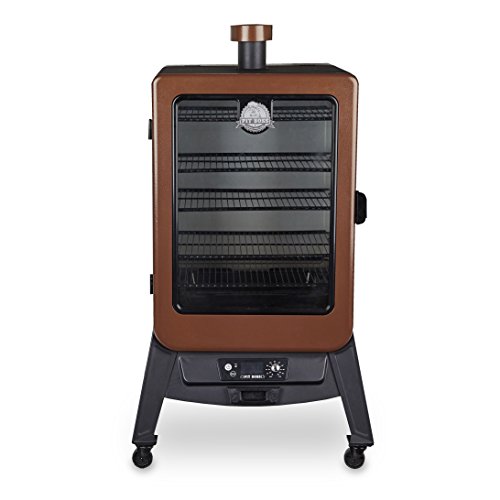
The Pit Boss 5 series vertical smoker includes double-walled insulation that allows you to smoke from 150°F to 450°F. The enormous 4.6 cu.m. ft. cooking chamber, with 1,716 total square inches of cooking surface on porcelain-coated cooking racks and a multi-position racking system, is easily visible through the big front window. It also has a 40-pound hopper that enables you to cook for up to 24 hours.
Locking caster wheels, an easy-to-read digital controller, and a gorgeous hammer tone copper finish are also included.
Four easy-to-maneuver wheels, 1,513 square inches of porcelain-coated cooking racks, and a large viewing glass are included. Temperatures are easily tracked thanks to the dial-in digital control board and stainless-steel meat probes.
Key features
- Digital PID control board
- Fan forced convection cooking
- 60-pound hopper capacity
- Temperature range of 150°F – 420°F
- 1,513 square inch cooking area
- Automatic Start-Up and Cool Down
- Ash control system with easy clean tray included
- Smoke duration up to 35 hours
- One meat probe
- High-temperature powder coat finish
- 5 porcelain-coated cast-iron cooking grids
- Fueled by 100% Hardwood Pellets
- Heavy-duty steel construction
- Best Horizontal Pellet Smokers
Traeger grills pro series 34 electric wood pellet grill and smoker
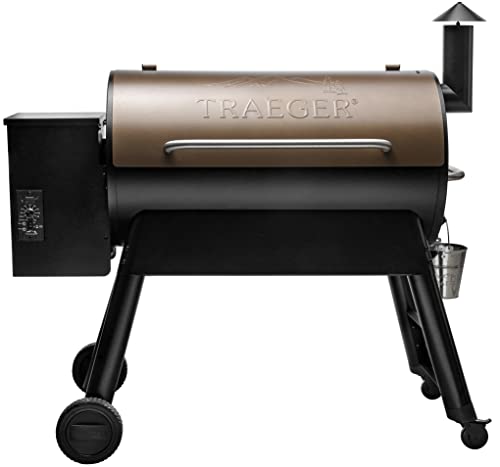
Traeger is the household name when it comes to pellet smokers. And one that, if you’re in the market for one, you must consider. Traeger’s success has been fueled by their superb build and spectacular results as the pioneers of pellet smoking.
The Pro Series 34 smoker, which features Traeger’s tried and trusted Digital Pro Controller with Advanced Grilling Logic, takes 60 temperature measurements per second to keep within +/- 15°F of your desired temperature.
Whether it’s low and slow or maxing out at 400 degrees, the LED display will help you to keep an eye on your cook with just a glance.
Key features
- Digital Pro Controller
- Large 884 square inches of cooking space, with the option of the smaller 22-inch version
- 18-pound hopper capacity
- Steel construction & durable powder-coated finish
- Two meat probes for internal meat temperature monitoring
- Hopper Clean Out
- Wood-Fired Flavor: Flavor from real hardwood pellets
- Epic Flavor Endless Possibilities: Smoke, Grill, Roast, Braise, Bake, and BBQ
- Set-it & Forget it
- Porcelain-Coated Grill Grates
- Easy-clean design
Advantages and disadvantages
The benefit of a vertical smoker is that it is compact and does not take up much room. In addition, it can cook more meat at once since it has more racks, and it saves power while cooking for longer.
The downside is that it can only smoke your meat and that you must constantly monitor the temperatures within the machine. Therefore, it might not be ideal for novices who want to smoke meat properly.
The benefits of horizontal smokers include cooking various foods on the grill and eliminating the need to check temperatures.
The downside of a horizontal smoker is that it is not small and requires power to work properly. As a result, if there is a power outage, you may be unable to use the grill’s ignition.
Faqs
Is it true that pellet smokers are superior to regular smokers?
They work best as smokers and fail to achieve the high heat necessary for searing. In addition, pellet smokers are bigger, heavier, and more costly than propane smokers.
What features should I look for in a pellet smoker?
Choose Your Pellet Smoker Class
- Made completely of high-quality stainless steel for long-lasting outdoor durability.
- They are available in freestanding and built-in configurations to fit the majority of outdoor kitchen appliances.
- The widest temperature range of any pellet grill, ideal for slow-smoking, searing, and anything in between.
What kind of meat pellets should I use?
Hickory is a fantastic meat pellet for a variety of reasons:
- Hickory pellets give smoked foods a dark color.
- Hickory pellets impart a robust Barbeque flavor.
- Third, it has a distinct smoky taste.
- Hickory wood is ideal for grilling and smoking.
Conclusion
There is no easy way to know which smoker grill is superior. They each have their own set of perks and downsides. However, now that you understand the differences between vertical and horizontal pellet smokers, you can pick the best one you believe will meet your needs.
Finally, it all comes down to how much money you’re prepared to put into these pieces of equipment. Consider how you will use it before purchasing, then review the features to ensure you haven’t overlooked anything. Of course, it also depends on the meat you’ll be cooking and how often you need to smoke it.
Last update on 2024-04-05 / Affiliate links / Images from Amazon Product Advertising API
This post contains affiliate links, which means I may receive a small commission, at no extra cost to you, if you make a purchase using these links.
