


Perhaps you want a wonderful trampoline for your kids and family but don’t have much space in your garden. You’re also concerned about falling from a considerable height while jumping on regular trampolines.
The best in-ground trampolines come into action to fix both problems like magic.
Because they are flat with the ground or slightly raised, in-ground trampolines take up less room than other trampolines. They don’t have any annoying huge legs that block your view, and you don’t have to climb on the jumping mat.
In-ground trampolines, on the other hand, will be a step up in your backyard.
Table of Contents
5 best in-ground trampoline reviews
Avyna Pro-Line In-Ground Trampoline-14-foot Diameter Round-Titanium Grey

The Avyna Pro-Line In-Ground Trampoline promises the highest quality at the lowest cost of installation. With its distinctive design and exceptional features, Avyna Pro has transformed backyard enjoyment. The jumpers have a sitting area on Avyna’s unrivaled in-ground trampoline
As a result, jumpers can either wait for their turn or simply relax after a thrilling jump. This in-ground trampoline will provide you with practically ground-level jumping experience, so there’s little risk of injury from falling from a great height.
As a result, you can let your kids jump on it confidently while remaining worry-free.
The weight restriction on the Avyna Pro-Line trampoline is 352 pounds. As a result, both children and adults can jump on it. The trampoline contains 96 galvanized high-quality steel springs.
Each spring is 8.5 inches long, and you’ll get a fantastic bounce practically every time you jump. The trampoline is shaped like a circle and will look fantastic in your backyard.
The frame is strong enough to support the trampoline and keep it in place. It is galvanized to prevent rust.
The jumping mat is composed of high-quality materials and will serve you well for a long time. A high-quality spring cover is used to protect the springs.
As a result, spring injuries won’t be a problem with this trampoline.
Installing an in-ground trampoline is considered difficult by some. Avyna Pro, on the other hand, is not like that. This trampoline comes with a nice video lesson on how to set it up.
You can quickly set up the trampoline if you follow these steps. Furthermore, the installation is simple because just 3 cubic yards of the earth must be removed.
However, if you require professional assistance, you can do so at an additional expense. This trampoline comes with excellent warranty support from Avyna.
The frame has a lifetime warranty, the springs have a 10-year warranty, and the mat and pad have a 3-year warranty. It may be your greatest option for in-ground trampolines in every way.
Pros
- Comes with a space to rest
- Springtime lasts longer
- Best rated in-ground trampoline with easy installation
- Ensures security
- Exceptional warranty term
Cons
- Expensive
Berg Trampoline Inground Champion Oval 17ft with Safety Enclosure Net Deluxe
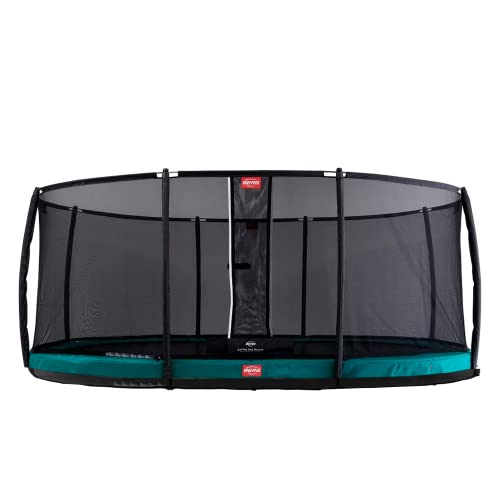
The Berg Trampoline Inground Champion was created with years of experience in mind to ensure quality and safety. You’ll enjoy a tremendous bounce and a safe jumping experience with this high-quality in-ground trampoline.
And having this oval trampoline in your backyard will make you proud. Higher jumps are required for excellent enjoyment.
And Berg has taken excellent care of this. Berg has created a unique airflow technique that virtually guarantees higher jumps every time you jump.
Its jumping mat allows 50% more air to pass through than traditional jumping mats.
You will confront less resistance and hence enjoy a better leaping experience with better airflow.
The Berg Champion In-Ground Trampoline features TwinSpring Gold springs and the innovative airflow leaping style. The springs are positioned in a V configuration, allowing for more jumping space than ordinary springs.
Because this trampoline is oval-shaped, you will be directed back to the appropriate jumping area if you jump outside.
A superb enclosing net is one of the unique features of this Berge in-ground trampoline. This net is pretty beautiful and taut, and the upper edge is strengthened.
The entrance that closes on its on is incredibly secure. The net poles are padded with thicker foam and are ergonomically constructed.
The net is linked to the poles and the padding outside the edge. As a result, this incredible in-ground trampoline provides the biggest jumping surface.
Pros
- Ensures a 50% increase in airflow
- It’s simple to put together and put in place
- A larger jumping area
- An enclosure net is included
- The best in-ground trampoline for the money
- Excellent jumping opportunity
Cons
- Digging properly may take some time.
In-Ground Trampolines Standard
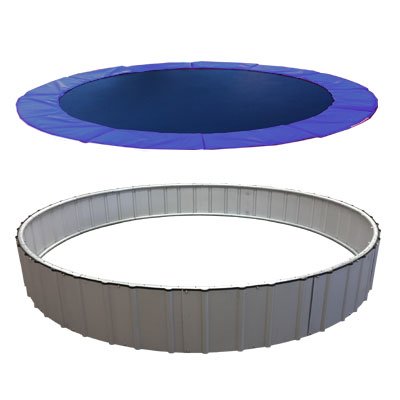
In-Ground Trampolines Standard comes in 12ft and 15ft lengths. This in-ground trampoline has a simple installation technique that requires very little digging and hauling away of earth.
This is not an above-ground trampoline that has been converted; rather, it has been built and engineered to fit properly inside the earth.
You will enjoy the real in-ground trampoline experience with this trampoline. This in-ground trampoline has an all-in-one design that addresses all your worries, including airflow, corrosion, and water collection in the pit.
Its all-new, ultra heavy-duty structure is made of 14-gauge steel tubing with 18-gauge steel wall panels for further stability. The frame is galvanized for maximum corrosion resistance over a lengthy period.
All of this steel is also held together by stainless steel hardware. A total of 96 8.5-inch long springs are included in this 12ft model.
For a high-performance bounce, the springs are pre-galvanized and tapered. The 15-foot model has 120 springs, which is more than the 10-foot model.
The spring is still the same length.
The usual jump surface on in-ground trampolines is a maximum airflow jump surface seen on other in-ground trampolines.
That means you’ll get an unrivaled bouncing experience. The 12ft model has a weight limit of 450 lbs. As a result, both children and adults are welcome to leap over it.
A next-level spring pad made of heavy-duty UV-resistant vinyl is included with this trampoline. It’s 18 inches wide and over a quarter-inch thick.
The frame tube segments, wall panels, and fasteners are covered by a 10-year warranty, the springs are covered by a 3-year warranty, and the jumping surface and other components are covered by a 2-year warranty.
Pros
- Frame made of heavy-gauge steel
- Improved airflow
- In-ground trampoline with the best features
- Spring pad that is wider and thicker
- Excellent warranty service
- Airflow is better than others
Cons
- More expensive than others
In-Ground Trampolines Stainless Steel Upgrade
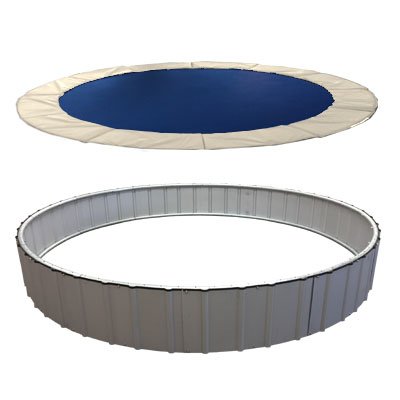
In-Ground Trampolines Stainless Steel are an updated version that provides greater quality and safety than earlier ones. If you’re searching for a compact in-ground trampoline, the 15 ft model is a good option. A stainless steel frame is included with both of them.
The frame is galvanized and secured with the appropriate steel fittings. You will obtain rust-resistant performance for a longer amount of time because of its high-quality galvanization.
The installation is not as difficult as it is with traditional in-ground trampolines. There is no need to excavate a large area.
The 14-gauge steel tubing that makes up the heavy-duty frame is complemented by 18-gauge steel wall panels. As a result, they’re designed to withstand the force of high jumps.
This trampoline may be used by both kids and adults. Because it has a 450-pound weight restriction. And the 96 8.5-inch springs are just right for a consistent bounce.
This trampoline has a 20-times better ventilation capacity than normal trampolines. In the pit, you’ll never have to worry about difficulties like ventilation, corrosion, or water collection. UV-resistant thick vinyl is used to make the heavy-duty spring pad.
Complete stainless steel springs and jump mat V rings are included in this enhanced variants. The frame has a 10-year warranty, the springs have a 3-year warranty, and the rest has a 2-year warranty.
Pros
- Improved airflow
- Top-of-the-line in-ground trampoline
- V rings and stainless springs
- Frame made of heavy-gauge steel
- Designed to last a long time
Cons
- It is more expensive than others
JUMP POWER In-ground Rectangular Trampoline with Patented Safety Net
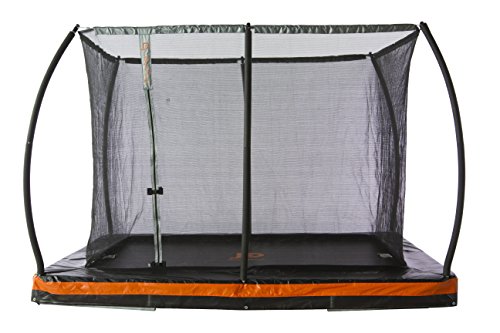
JUMP POWER In-ground Rectangular Trampoline are offered in two sizes. You can pick between the 10ft x 7.5 ft and the 12ft x 8ft sizes.
The weight limit on this in-ground trampoline is 220 pounds. It’s packaged in a high-quality enclosing net with a proprietary Top Ring Cable Wire Quick Release mechanism.
Gymnasts, cheerleaders, divers, and other advanced jumpers will enjoy the Jump Power rectangular in-ground trampoline. The trampoline will fit into any size or shape in the backyard due to its compact size.
The mat is constructed of high-quality polypropylene. The heavy-duty structure is constructed of solid 16-gauge steel.
It has a 1.75-inch thickness and is suitably galvanized. Because it is smaller and has a lower weight limit than previous versions, it has fewer springs.
This trampoline features a total of 58 6.5-inch long springs. They’re galvanized to keep them from rusting.
The trampoline poles are inclined to a certain degree so that jumpers are not injured if they fall incorrectly.
Furthermore, the poles are padded with high-density foam. The springs are covered and tightly secured with a thick, high-quality spring pad. Trampolines with enclosures are also available.
However, they are difficult to install and remove. However, this Jump Power in-ground trampoline has solved the problem with the poles. It’s simple to set up the enclosing net. If you’re searching for a great in-ground trampoline for your kids, this is the one.
Pros
- Size is small
- The frame tube is thicker
- Installation is simple
- An enclosure net is included
Cons
- Weight limit is reduced
- There are fewer springs
What are in-ground trampolines?
Trampolines that are sunk into the ground are known as in-ground trampolines. The trampoline’s whole body remains beneath, but the frame and jumping pad remain visible above the ground.
Installing them can be a bit of a pain, but we’ll get to that later.
These trampolines are far safer than traditional trampolines that are placed on the ground. Elevated platforms are inherently dangerous because there is a risk of falling off the trampoline and injuring oneself.
With an in-ground trampoline, however, these dangers are greatly reduced. With the frame and leaping pad at ground level, the odds of falling off are much reduced When you erect an enclosed net around an in-ground trampoline, the level of safety increases by a factor of a hundred. If you have children, this is the finest option.
How to find the best in-ground trampolines
Because of its design and installation system, in-ground trampolines are one-of-a-kind. They also have some advantages that no other trampoline can match.
Types of in-ground trampolines
In-ground trampolines are trampolines that are buried in the earth. It is a proven fact. However, you should be aware that there are two distinct varieties of in-ground trampolines.
- Flush to ground
In-ground trampolines of this type stay at the same level as the ground. You’ll need to build a retaining wall in the hole to install them.
This wall ensures the trampoline’s longevity and prevents it from collapsing due to excessive bouncing pressure.
- Raised from ground
Most of these in-ground trampolines remain under the ground, while the remainder is lifted from the ground. This is done to ensure that there is enough airflow.
Air pressure is created when you jump on an in-ground trampoline. You must ensure perfect ventilation to offset the pressure. The mat will bounce less or less if this is not done.
Shape
In-ground trampolines, like above-ground trampolines, come in a variety of shapes. In-ground trampolines come in various shapes, including round, rectangle, and oval.
Trampolines with a round shape are the most common and widely accessible. Jumpers are always directed to the middle area. As a result, jumpers rarely land on the cliff’s brink.
As a result, additional safety is ensured, such as with the fantastic JumpKing trampolines.
Rectangular trampolines have a consistent bounce and never direct jumpers to the center of the trampoline. In some circumstances, rectangular trampolines are more space-efficient than round trampolines. The size of your backyard will determine this.
Construction
The frame and springs must be composed of galvanized steel of high quality. The frame should be sufficiently thick.
An in-ground trampoline with more and longer springs is preferable. The higher the number of springs, the higher the bounce.
UV-treated and made of high-quality materials such as polypropylene, the jumping mat should be durable. Spring pads are required to bind the springs and eliminate potentially dangerous gaps.
A thick vinyl-made spring pad is standard on most high-quality in-ground trampolines.
Some in-ground trampolines are equipped with an enclosed net, while others are not. In the case of in-ground trampolines, the need for containment is less critical for round designs.
However, an enclosure net is recommended for rectangular trampolines. The poles should be thickly cushioned and angled to some degree. Jumpers will have more room this way.
Size of an in-ground trampoline
When it comes to the size of an in-ground trampoline, it’s not only about your preferred size; it’s also about the size of your yard or garden. There’s no going back once you’ve installed the unit.
When compared to other trampolines, installation needs a lot of effort, such as excavating, assembling, and installing.
As a result, be sure your garden has adequate room for the trampoline size you want. People should be able to walk about freely in the area surrounding the unit. If there is enough space, the largest trampolines are wonderful to have.
In terms of recommended size, you can keep to a common size unit for teenagers and children. However, if the adults in the house will be having fun and exercising on it, consider getting a larger one. A 15-foot trampoline can be easily accommodated in a bigger yard or garden.
Installation of in-ground trampoline
Again, compared to other trampoline types, this buying advice focuses on the factors that require more attention. Any trampoline installation necessitates your time and effort in terms of digging the soil, assembling the parts, and placing this enormous device on the ground.
You may need to dig the dirt up to 3 to 4 feet deep, depending on the model and the manufacturer’s instructions. It’s also crucial to build a retaining wall.
As a result, if you’d rather not pay specialists hundreds of dollars and handle all of the work yourself, be sure the item you’re about to buy is a little easier to install. When it comes to in-ground trampolines, there is no such thing as a simple installation.
As a result, when I say ‘simple to install,’ I’m referring to a less difficult installation. Learn how to dismantle trampolines safely for your own safety.
Water drainage
Because we’re working with a piece of equipment with a subterranean base, you’ll want to pay attention to the water drainage system as well. If the water cannot exit normally during rains, the trampoline’s base will be submerged, posing a threat to the trampoline’s components.
Quality water trampolines, on the other hand, are free of this problem. If you like, you can have those as well.
Furthermore, if it rains heavily, the jumping pad can submerge because it is only a few centimeters above the ground. Make no errors when constructing a proper drainage system.
If required, seek expert assistance. Spending money once rather than every season on trampoline replacement parts is better.
Bounce
This is the primary reason for trampoline purchases. As a result, if the bounce performance is harmed, your money will be wasted.
The good news is that all of the in-ground trampolines we looked at in this article deliver a satisfying bounce. Customers frequently compliment and admire how well these bounce.
Warranty and price
Choose a model that comes with a reasonable warranty period. It will come to your aid in times of adversity. A good investment is required for a high-quality product. So, if money isn’t an issue, take advantage of the greatest possibilities accessible to you.
Why you should choose in-ground trampolines
Every trampoline has a distinct purpose and specialty. Gymnastic trampolines, for example, are ideal for gymnasts, water trampolines are ideal for summer fun, and children’s trampolines benefit their development and health.
In the same way, in-ground trampolines offer some unrivaled benefits.
- Safety
In-ground trampolines are excellent for children’s safety. You don’t need a ladder to climb the jumping mat because it stays flush to the ground or is raised off it.
Giant legs are free on in-ground trampolines. You will not be as badly harmed if you fall to the ground because you’ve dropped below your regular height.
- Accessibility
You can easily access the jumping mat on in-ground trampolines because they are flat with the ground or a few steps above it. You don’t even need a ladder. As a result, the youngsters benefit much from this simple accessibility. It also lowers the risk of injury.
- Aesthetic
In-ground trampolines add to the aesthetic appeal of your backyard. On the ground, they appear appealing and exciting. You’ll always feel compelled to leap on them.
Above-ground huge trampolines, such as top-quality adult trampolines, on the other hand, take up a lot of area in the backyard and may not always look well. Large trampolines will also obstruct your backyard’s vision to some extent.
- Maintenance
If you live in a region where big storms or wind are common, the large trampolines will be challenging to maintain in place. You might consider utilizing wind stakes, although they aren’t always effective.
In this instance, trampolines are on the ground, so they won’t cause any problems during a storm. As a result, the amount of maintenance required for an in-ground trampoline is minimal.
In-ground trampoline installation
Many people believe that placing trampolines on the ground is difficult. We disagree with this premise and argue that installing them is difficult. You can easily set up your in-ground trampoline by following a few simple steps.
Making the trench
The first step is to dig a trench that is proportional to the size of your in-ground trampoline. You’ll have to dig and remove the soil meticulously. The trampoline’s specs, including the hole’s diameter and height, will be provided.
In most cases, you’ll need to dig one foot deeper than the trampoline’s diameter.
Retaining wall
After you’ve dug a beautiful trench, you’ll need to construct a robust retaining wall. Concrete, stone, or even bricks can construct the wall. Select the simplest option available.
When constructing this wall, take extreme caution. The retaining wall is essential for keeping the frame in place and protecting it from the elements.
Drainage
In-ground trampolines require a proper drainage system. Water will collect beneath the trampoline during the rainy season. If you don’t drain the water, your trampoline will become submerged.
As a result, consider how you’d like to drain the water. One option is to lay perforated pipes underneath and maintain them in place. So you can use them to drain water during the rainy season or whenever you need to.
Ventilation
The ideal bounce of in-ground trampolines is ensured by proper ventilation. Your trampoline will not bounce at all or will bounce extremely poorly if you do not process the airflow perfectly.
Air pressure builds up beneath the trampoline as bouncers jump on it. It’s time to get this air back to normal.
Simply leave a gap between the wall and the frame to do this. You can also accomplish it with pipes, but keeping a safe distance is the most straightforward solution.
me with the trampoline throughout the whole installation process.
Things to consider before buying in-ground trampolines
You should think about a few things before purchasing an in-ground trampoline.
- If you have enough space in your backyard for an in-ground trampoline, go for it. Check the size of the trampoline you want to buy and see if it fits in your garden.
- Choose a trampoline color that will mix in seamlessly with the rest of your yard. If not, it should, at the very least, not be bothersome.
- It’s difficult enough to dig the trench. So, if you’re unsure, don’t be afraid to seek professional assistance. You may incur additional costs, but you will finish up with an ideal configuration.
- In-ground trampolines are only for people who own a home or a place to live. If you don’t have a home, above-ground trampolines that are easy to move and set up are a good option.
In-ground trampoline pros and cons
An in-ground trampoline is a popular and effective way to have fun and exercise. There are some drawbacks to the benefits. We’ve discussed them in detail below.
Pros
- It’s a lot of fun
- Children can enter the jumping bed without the use of a ladder
- Trampolines that are safer than regular trampolines
- Gives the yard a nice appearance
- Keeps your pets secure
- Requires less maintenance
Cons
- The cost of installation is higher
- The price is higher than that of many other trampolines
- It is necessary to have proper ventilation and drainage
- Standing water is a potential hazard
Why are in-ground trampolines pricier than usual trampolines?
You might be curious as to how much an in-ground trampoline costs. The majority of in-ground trampolines cost between $800 and $3000.
You’ll also have to pay a hefty sum for trampoline installation on the ground. The reasons for the increased price of an in-ground trampoline are detailed in the next section.
There are two key in-ground trampoline prices to consider: purchase and installation.
The purchasing cost of an in-ground trampoline
Because an in-ground trampoline is buried, its structure and springs are built of extremely durable galvanized steel. These premium materials come at a higher price than standard trampolines.
You’ll also need to purchase additional supplies for the construction of reinforced walls.
Most in-ground trampolines have a length of more than 12 feet, which raises the price of aquatic trampolines. Although in-ground trampolines are a safe mode, a safety cage can be purchased to make it more jump-friendly.
Furthermore, if you require additional repairs and maintenance, you will have to pay a higher price.
In-ground trampoline installation cost
A basic in-ground trampoline installation costs between $500 and $1500, which is more expensive than other trampoline setups. The cost of installing a sunken trampoline involves additional materials, hole preparation, labor, and drain installation, among other things.
In-ground trampoline hole digging takes an average of about 5 hours per laborer. You’ll also have to pay around $30 each hour. On the other hand, you can do it by renting an excavator.
The concrete wall is the most expensive part of the installation. Then you’ll have to level the earth. All of these factors raise the expense of installing an in-ground trampoline.
Frequently asked questions
How much does an in-ground trampoline cost?
As you might expect, the cost of an in-ground trampoline is higher than that of a traditional trampoline due to the installation, so I would only recommend it to people who are handy and experienced with working on the ground, as well as those who have a large enough budget to hire a professional to install the ground level trampoline.
However, if you want to see if there are any cheaper built-in trampolines, go to websites like Amazon, Wayfair, or even Walmart, since they frequently have great deals on many things, including trampolines.
Also, if you’re lucky, you can come across a free delivery option, which means you won’t have to spend extra.
If you can achieve all of that, I urge you to read the subterranean trampoline reviews I’ve compiled for you. You exist in a variety of sizes, as I previously stated, and I’d like to show you the most popular, which are round in-ground trampoline models and one square underground trampoline.
Why are in-ground trampolines so expensive?
In-ground trampolines offer excellent quality and safety. The unusual design and particular installation fees, on the other hand, are more expensive than standard trampolines.
How do in-ground trampolines win over above-ground trampolines?
Both in-ground and above-ground trampolines have advantages and disadvantages. The finest sunken trampoline is a terrific way to have some fun in the backyard.
Less maintenance, safer than regular trampolines, simple access, no significant weather effect, and so on is some of the advantages of in-ground trampolines over traditional trampolines.
What is the weight limit of in-ground trampolines?
Weight limits for in-ground trampolines vary depending on their size. The weight restriction varies between 100 and 500 pounds in general.
Decide which weight rating is best for you before purchasing an in-ground trampoline.
Why are in-ground trampolines safer?
The jumping bed and the ground are on the same level in in-ground trampolines. As a result, jumpers don’t take as much of a beating if they fall to the ground, making this a safer option. This also keeps people from getting underneath the jumping bed.
What are the common misperceptions?
The safety of in-ground trampolines is a common misconception. A trampoline on the ground is widely believed to be safer than a trampoline above ground.
However, this may not be accurate. According to popular belief, a fall from an in-ground trampoline does not cause as much injury as a fall from an above-ground trampoline, you soar quite far in the air, and if you hit the ground from there, you can damage yourself.
People’s limbs can become trapped between where the trampoline finishes and the retaining wall begins, making this trampoline unsafe. Another common misunderstanding is that in-ground trampolines are more bouncy than standard trampolines.
This is also incorrect because the bounce of in-ground trampolines is entirely dependent on the airflow, which might be good or bad at any given time. As a result, in-ground trampolines do not bounce as well as above-ground trampolines.
In-ground trampolines are also thought to be incredibly simple to set up. It’s simply a matter of digging a hole and dropping it in. However, this is not the case.
An appropriate drainage system, soil erosion, and various other variables must all be considered.
Final words
Every trampoline fanatic would love to have the perfect in-ground trampoline to add to their backyard. Our list of the greatest in-ground trampolines will assist you in finding the right one for you.
You will be proud of it for the rest of your life if you purchase an excellent one.
Last update on 2024-04-05 / Affiliate links / Images from Amazon Product Advertising API
This post contains affiliate links, which means I may receive a small commission, at no extra cost to you, if you make a purchase using these links.
