

A good first telescope costs about $250 to $750 for most people. Below roughly $150 you are mostly buying wobbly tripods and inflated magnification claims. Around $250 you get a real instrument that shows Saturn’s rings and the Moon’s craters cleanly. Between $450 and $750 you reach the scopes most owners keep for years, and past $1,000 you are paying for computer control, portability or astrophotography rather than a better view.
That is the honest range, but the right number for you depends on three things: where you will observe, how much you can carry, and whether you want to find objects yourself or let a phone or motor do it. This guide breaks down what each budget buys, why prices climbed in the last couple of years, which costs people forget, and the three telescopes we would point you to at the price points that make sense.
What a Good Telescope Costs at Each Budget
Aperture, the width of the main lens or mirror, does most of the work in a telescope, so the table tracks how much of it each budget buys. Prices are typical street prices from major retailers and move with sales.
| Budget | What you typically get | Typical aperture | Our take |
|---|---|---|---|
| Under $150 | Small refractors on light tripods, toy-store kits | 50mm to 70mm | Usually frustrating, binoculars are often a better buy |
| $200 to $350 | Phone-guided 80mm refractors, tabletop Dobsonians | 80mm to 130mm | The real starting point for a good telescope |
| $400 to $600 | 130mm reflectors on tripods, 6-inch Dobsonians, entry smart telescopes | 130mm to 150mm | The sweet spot for a first scope that lasts |
| $600 to $1,000 | 8-inch Dobsonians, small go-to scopes, premium smart telescopes | 200mm (8 inches) | The point where most visual observers stop needing to upgrade |
| $1,000 to $2,000 | 8-inch go-to Schmidt-Cassegrains, 10 to 12-inch Dobsonians | 200mm to 300mm | Worth it for convenience or bigger aperture, not required |
| $2,000 and up | Imaging refractors, equatorial mounts, cameras, large go-to scopes | Varies | Astrophotography territory, where the mount often costs more than the optics |
The jump that matters most is the one from under $150 to the $250 range. Spending more after that buys you more light, more convenience or less weight. Spending less than that usually buys a closet ornament.
Why Telescopes Cost More Than They Did a Few Years Ago
If you remember a good 8-inch Dobsonian selling for under $400, you are not imagining things. Several changes stacked up and pushed prices higher across the whole market.
- Tariffs on imports from China. Most consumer telescopes are made in China, and US tariffs on Chinese goods climbed in steps through 2025, briefly reaching 145 percent in April 2025. Major brands paused shipments for a time, and list prices on many models rose afterward.
- Two big brands disappeared. Orion and Meade, long the default names in beginner guides, closed in 2024. Popular budget models such as the Orion SkyScanner and the Orion XT8 left the new market, which thinned out the cheapest decent options. If you still want one, our Orion SkyQuest XT8 review covers what to check on a used unit.
- Pandemic demand never fully reset. Sales surged when people looked for home hobbies, and prices that rose then mostly stayed up.
The practical result is easy to see in one model. The Celestron NexStar 8SE, a common upgrade scope, now carries a $1,699 list price at major astronomy retailers, where it sold for under $900 on sale in 2019. The Sky-Watcher 8-inch Classic Dobsonian now lists around $725. Budget a little more than older guides suggest, and watch for holiday sales, which are when the larger scopes see their best discounts.
What You Are Actually Paying For
Two telescopes with the same price can deliver very different nights outside. Four things drive the cost, and knowing them helps you spend on what you will notice.
Aperture Sets What You Can See
Light gathering grows with the area of the lens or mirror, so a 130mm telescope collects about 2.6 times the light of an 80mm one, and an 8-inch collects about 2.4 times the light of a 130mm. That extra light turns smudges into galaxies with shape and clusters into individual stars. It also raises the highest magnification the scope can really use, which works out to roughly 50x per inch of aperture, or 2x per millimeter.
That rule is why the “525x” printed on a cheap 60mm box is meaningless. A 60mm lens tops out near 120x on a steady night. Anything higher just makes a dim, blurry image bigger.
The Mount Decides Whether You Enjoy It
A shaky mount ruins good optics. Every touch of the focuser makes the view bounce, and tracking a planet across the field becomes a fight. Budget scopes save money here first, which is why so many under $150 end up unused. A Dobsonian base, the simple wooden rocker box that holds a reflector, is the cheapest way to get a rock-steady mount, and it is a big reason Dobsonians give the most telescope per dollar.
Optical Design Changes the Price per Inch
The three main designs reach the same aperture at very different prices.
| Design | How it works | Cost per inch of aperture | Best for |
|---|---|---|---|
| Refractor | Lens at the front, closed tube | Highest for quality glass, low for small beginner models | Moon, planets, daytime viewing, low maintenance |
| Reflector (Newtonian and Dobsonian) | Curved mirror at the back of an open tube | Lowest | Most aperture for the money, deep sky objects |
| Catadioptric (Schmidt-Cassegrain, Maksutov) | Mirror plus corrector lens in a short folded tube | Middle to high | Compact size, planets, go-to systems |
A small Maksutov can be had for a few hundred dollars, so compact catadioptric scopes are not only a high-end option. They simply cost more than a reflector of the same width.
Go-To and Smart Features Cost Extra
Motorized go-to mounts, phone-guided finders and fully automatic smart telescopes all add cost without adding light. For many beginners that trade is worth it, because finding objects is the hardest skill in the hobby. Just know that a $500 go-to scope usually has a smaller mirror than a $500 manual Dobsonian.
What Each Price Range Gets You in Practice
Here is what owning a telescope at each budget looks like once it is in your yard, along with the kind of buyer each tier suits.
Under $150 Is Mostly a Trap
Most telescopes at this price have 50mm to 70mm lenses, plastic focusers, small eyepieces and tripods that shake in a light breeze. They show the Moon, and with patience they show Jupiter’s moons and Saturn as a tiny ringed dot. Many owners give up before they get that far.
There are a few exceptions, and our guide to the best telescopes under $100 covers the ones we think hold up. For a child’s first look or a tight budget, a good pair of 10×50 binoculars is often the smarter spend. They show star clusters, the Milky Way and the Moon with almost no learning curve, and they stay useful after a telescope arrives.
$200 to $350 Is Where Good Telescopes Start
This is the first range where we would call a telescope good without qualifiers. Expect an 80mm refractor with a phone-guided finder, or a 130mm tabletop Dobsonian such as the Sky-Watcher Heritage 130 that sits on a sturdy table or stool. Saturn’s rings, Jupiter’s cloud bands, double stars and bright star clusters all look the way people hope they will.
Pick a refractor if you also want daytime use and no maintenance. Pick a tabletop reflector if you mainly want the night sky and more light for the money. Our list of the best telescopes under $200 sorts the options in the lower half of this range.
$400 to $600 Buys a Scope You Will Keep
At this budget you can get a 130mm reflector on a full-height tripod with a smartphone guidance system, a 6-inch Dobsonian, a small Wi-Fi go-to tabletop scope, or an entry smart telescope. Galaxies such as Andromeda and its companions, globular clusters and the brighter nebulae start to look like real objects rather than faint smears.
This is the range we steer most first-time buyers toward, especially families and anyone observing from a suburban backyard, because the scopes are light enough to carry outside on a weeknight.
$600 to $1,000 Gets You the Classic 8-Inch Dobsonian
An 8-inch Dobsonian is the telescope experienced observers recommend more than any other, and it sits right at the bottom of this range. It shows hundreds of galaxies and nebulae from a dark site, splits globular clusters into stars and handles high power on planets. The catch is size. The tube and base together weigh around 45 pounds, and the tube is about four feet long.
The same money also buys smaller go-to telescopes and the higher-end smart telescopes. Our guide to the best telescopes under $1,000 compares the full field.
Over $1,000 Is About Convenience, Size or Photography
Spending past $1,000 does not make the view dramatically better for a beginner. It buys go-to computer control on a compact 8-inch Schmidt-Cassegrain, a 10 or 12-inch Dobsonian that needs a car and a strong back, or the start of an astrophotography setup. Imaging is where costs climb fastest, since a tracking mount that can carry a camera and telescope often costs more than the telescope itself.
If push-button finding is the main reason you are tempted to spend more, our roundup of computerized telescopes covers the models worth the premium.
Where Smart Telescopes Fit in the Price Picture
Smart telescopes are a different kind of purchase. You do not look through an eyepiece. The telescope finds the target on its own, takes many short exposures, stacks them and shows a color image on your phone. They work surprisingly well from light-polluted yards, where nebulae that are invisible through an eyepiece show up in a few minutes.
ZWO’s Seestar S30 sits around $399, and the newer Seestar S50 Pro is around $999. Small apertures of 30mm to 50mm mean they will not match an eyepiece view of Saturn or Jupiter, so treat them as a camera that does astronomy rather than a replacement for a visual telescope.
Costs People Forget to Budget For
The telescope is rarely the last thing you buy. Plan for an extra $50 to $150 in the first year, depending on what came in the box.
- One or two better eyepieces. Included eyepieces are often basic. A good wide-field or planetary eyepiece runs about $30 to $60 each.
- Power for go-to and phone-guided scopes. A small rechargeable power bank keeps a phone or mount running through a long session.
- A collimation tool for reflectors. Mirrors need occasional alignment, and a simple collimation cap or Cheshire eyepiece costs little.
- A red flashlight and a sky chart or app. Both help you find targets without losing your night vision.
- A proper solar filter, only if you want to view the Sun. It must be a certified filter that covers the full front of the telescope. Never use a filter that screws into the eyepiece, since concentrated sunlight can crack it.
New, Used or From a Local Shop
A used telescope can stretch a budget a long way. Dobsonians are the safest used buy because they have few parts that wear out, and a used Orion XT8 or similar 8-inch often sells for well under the price of a new one. Check that the mirror is free of heavy scratches or peeling coating, that the base moves smoothly and that the focuser holds its position.
Local astronomy clubs are the best place to try before you buy. Many hold public star parties, and some lend telescopes to members. For new scopes, we like buying from Amazon or a dedicated astronomy retailer, both of which handle returns better than general marketplaces selling off-brand kits.
Our Three Picks at the Prices That Make Sense
These three cover the budgets we recommend most often. Each one answers a different situation, so start with the one that matches your yard and how much hands-on searching you want to do.
Best Around $250 for Beginners Who Want Daytime Use Too
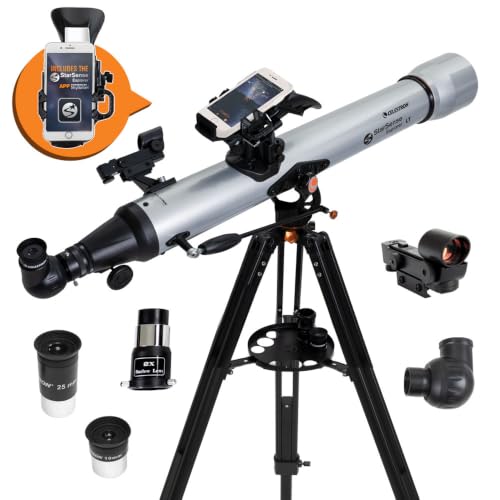
The Celestron StarSense Explorer LT 80AZ is an 80mm f/11 refractor with a 900mm focal length on a manual mount. Its main selling point is the StarSense system, a phone dock that reads the sky through your phone’s camera and shows arrows pointing you to each target. According to Celestron, it ships with 25mm and 10mm eyepieces plus a 2x Barlow, and the whole kit weighs about 9 pounds, light enough for a child to carry outside.
Pros
- Phone guidance takes the guesswork out of finding targets
- Closed refractor tube needs no maintenance
- Light enough for quick sessions and daytime nature viewing
Cons
- 80mm aperture limits faint galaxies and nebulae
- Tripod is adequate rather than sturdy at high power
- Phone app relies on a compatible smartphone
The verdict: buy it if you want the cheapest telescope we would call good, especially for a family or a beginner who wants to see results on night one.
Best Around $450 to $500 for Suburban Backyards
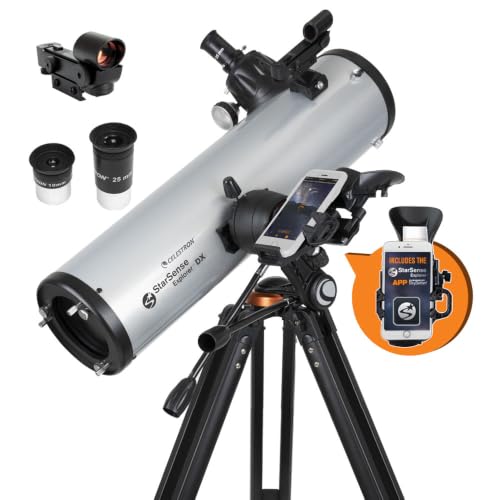
The Celestron StarSense Explorer DX 130AZ uses the same phone guidance with a 130mm f/5 reflector, which gathers about 2.6 times the light of the 80mm model. That is the difference between seeing Andromeda as a faint patch and seeing its bright core and companion galaxies. The tube weighs about 9 pounds and the tripod about 9 more, so it still moves outside in one trip.
Pros
- 130mm mirror is a big step up in light over 80mm scopes
- Phone guidance finds galaxies and clusters for beginners
- Full-height tripod means no table needed
Cons
- Reflector mirrors need occasional collimation
- Mount is less steady than a Dobsonian base
- Costs more than a manual scope with the same mirror
The verdict: buy it if you observe from the suburbs, want to see deep sky objects without learning star charts first and can spend around $500.
Best Around $700 for Observers Who Want the Most Telescope

The Sky-Watcher Classic 200 is a traditional 8-inch Dobsonian with a 203mm mirror, a 1200mm focal length and a 2-inch Crayford focuser. It has no electronics, so you aim it by hand. What you get in exchange is the most aperture at this price on a mount that does not shake. The tube weighs about 20 pounds and the base about 25, carried out in two trips.
Pros
- 8 inches of aperture shows far more deep sky detail than smaller scopes
- Simple rocker base is steady and fast to set up
- No batteries or alignment steps to fail
Cons
- About 45 pounds in two pieces needs storage space
- You find objects yourself with a chart or app
- Mirror needs periodic collimation
The verdict: buy it if you have a place to store it, can carry two 20-plus pound pieces and want a telescope you will not outgrow.
Telescope Cost Questions We Hear Most
These are the follow-up questions that come up most when people are setting a telescope budget.
Is a $100 telescope worth buying?
Usually not. Most telescopes near $100 have small lenses, weak tripods and misleading magnification claims, and they frustrate new owners. A few exceptions exist, but a good pair of 10×50 binoculars is often the better use of the same money.
How much should I spend on my first telescope?
Plan on about $250 to $500 for a first telescope that is easy to use and shows the planets and bright deep sky objects well. If you can store and carry a larger scope, an 8-inch Dobsonian at around $700 is the best long-term value.
Does a more expensive telescope mean higher magnification?
No. Usable magnification depends on aperture and sky conditions, roughly 50x per inch of aperture at most. A more expensive telescope gives a brighter, sharper image, not just a bigger one.
Are computerized telescopes worth the extra cost?
They are worth it if finding objects is what would make you quit. If you are happy learning the sky with a chart or app, a manual telescope gives you more aperture for the same money.
Are telescopes cheaper on Black Friday?
Often, yes. Larger scopes and go-to models tend to see their deepest discounts during holiday sales, so it pays to watch prices for a few weeks before buying.
Is a used telescope a good idea?
A used Dobsonian or refractor from a careful owner can be excellent value. Inspect the mirror or lens for damage, check that the mount moves smoothly and avoid used go-to scopes unless you can test the electronics.
How Much We Would Spend
If you are buying your first telescope, plan to spend about $450 to $750 and choose by where you live and what you can carry. From a bright suburban yard, or if you want the phone to show you where to point, get the StarSense Explorer DX 130AZ. If you have storage space, darker skies within a short drive and the patience to learn a few star patterns, stretch to the Sky-Watcher Classic 200. That 8-inch Dobsonian is the telescope most people never feel the need to replace.
Last update on 2026-11-17 / Affiliate links / Images from Amazon Product Advertising API
This post contains affiliate links, which means I may receive a small commission, at no extra cost to you, if you make a purchase using these links.


