

Grass grows fast enough in some months that a “mow it every week” rule leaves half of readers either scalping a lawn that grew six inches during a rainy stretch, or mowing dormant winter grass that did not need it at all. The right schedule depends on the season, the grass type, and how closely you can actually stick to a routine, so here is the direct version instead of a single number that only works part of the year.
The Short Answer
Mow whenever the grass has grown about a third taller than your target height, not on a fixed calendar day. For most lawns that works out to once a week during spring and early summer, stretching to every 10 to 14 days once summer heat slows growth, and dropping to every three to five weeks or stopping entirely once the lawn goes dormant in late fall and winter. The one-third rule is the actual engine behind all of this. Cut more than a third of the blade at once and the grass responds with stress, browning, and a longer recovery window, not a healthier lawn.
Mowing Frequency by Grass Type and Season
Cool-season grasses, including Kentucky bluegrass, tall fescue, and perennial ryegrass, do their fastest growing in spring and fall, then slow down in the heat of summer. Warm-season grasses, including Bermuda, zoysia, and St. Augustine, run the opposite schedule. They stay dormant and brown through cold months, then grow hardest in peak summer heat. That difference is why a single nationwide mowing calendar never quite fits everyone.
| Grass Type | Target Height | Peak Season Frequency | Slow Season Frequency |
|---|---|---|---|
| Cool-season (fescue, bluegrass, ryegrass) | 2.5 to 3.5 inches | Every 5 to 7 days (spring, fall) | Every 10 to 14 days (summer heat) |
| Warm-season (Bermuda, zoysia) | 1 to 2 inches | Every 3 to 5 days (peak summer) | Every 2 to 3 weeks, or stop (dormant winter) |
| St. Augustine | 2.5 to 4 inches | Every 5 to 7 days (summer) | Every 2 to 3 weeks (cooler months) |
Not sure which category your lawn falls into, or how its current growth compares to what is normal for the season? Our guide to how fast grass grows breaks growth rate down by grass type and climate zone in more detail.

What To Do When the Grass Gets Away From You
A week of rain, a vacation, or a mower that broke down at the wrong time, and suddenly the lawn is eight inches tall instead of three. Mowing it back down to normal height in one pass is the mistake almost everyone makes here. That single cut removes more than half the blade, shocks the grass, and often leaves a scalped, yellow-brown lawn that takes weeks to recover, sometimes with bare patches where the crown itself got cut into.
Bring it down gradually instead. Set the mower to its highest deck height and take off the top third only, then mow again in three to four days at a slightly lower setting, and repeat until you are back at your normal target height. It usually takes two to three mows over a week and a half to catch up safely. That is longer than most people expect, but it beats a scalped lawn that needs reseeding.
If fertilizer is part of the picture, timing the mow around it matters too. Our guide on how long to wait after fertilizing before you mow covers that sequencing so an early cut does not undo the application.
Why Weekly Mowing Turns Into a Chore, and What Actually Fixes It
Most people who search this question are not actually confused about the one-third rule. They are tired of mowing more often than they expected to, and the frustration usually traces back to the mower rather than the schedule. A mower without enough torque bogs down in thick spring grass, drags clippings instead of cutting them cleanly, and leaves clumps that mat down and smother the lawn underneath. That forces an extra mow just to clean up the mess, and a one-mow week quietly becomes two.
Two features solve most of that friction. The first is enough cutting torque to get through thick, wet, or slightly overgrown grass in one pass instead of stalling and needing a second pass at the same height. The EGO Power+ LM2156SP delivers 8.3 ft-lbs of cutting torque and eight cutting height positions from 1 to 4 inches, which covers the target range for cool-season and St. Augustine lawns in the table above without needing a second mower for different seasons.

The second is a way to switch between mulching and bagging without swapping parts, which matters most in exactly the catch-up scenario described above, when clippings are heavier and full mulching alone can leave visible clumps. The EGO LM2236SP uses a five-position Precision Mulch Control baffle that adjusts airflow to the discharge chute, so a heavier catch-up mow can shift toward a bagging-leaning setting and a normal weekly cut can go back to full mulch, all without changing blades mid-season.
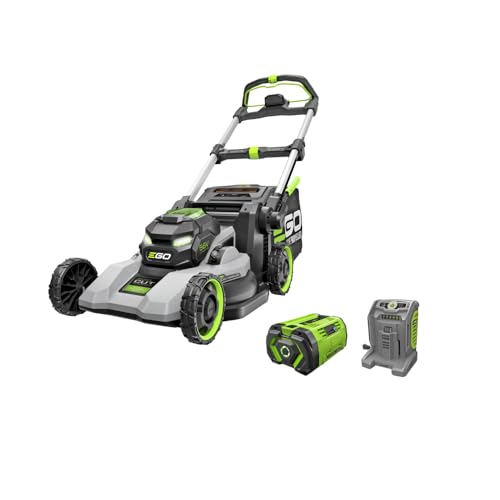
Neither of these fixes the calendar. A lawn that needs mowing every five days in May still needs mowing every five days in May regardless of what is cutting it. What changes is whether each mow takes fifteen minutes or forty five, and whether you finish with a clean cut or a lawn full of clumps that forces you back out two days later. For a side-by-side look at how these compare against other battery mowers on power, runtime, and price, our EGO Power+ mower comparison and our roundup of the best battery lawn mowers cover the full field.
Renters, Small Yards, and Tight Budgets
None of this requires a premium mower to get right. A lawn under a quarter acre does not need the runtime or torque of a flagship model, and the schedule advice above works the same regardless of what is cutting the grass. If a mower is not already sitting in the garage, an entry-level self-propelled model with a full set of adjustable height positions, such as the EGO LM2135SP, covers the same 1 to 4 inch range as the pricier models for less money, which matters more for a rental or a starter home than runtime you will not use on a small lot.
Renters who do not want to store a mower at all have a simpler option worth considering on small, flat lots. A manual reel mower needs no battery, no gas, and no storage beyond a hook on the garage wall, and it forces the little-and-often habit that keeps grass healthiest in the first place, since a reel mower struggles once grass gets much past three inches. It will not work on a lawn that regularly gets away from you, but on a small yard mowed on a strict weekly schedule it is close to maintenance free.
How Tall Is Too Tall for HOA and Neighbor Rules
Most HOA covenants and city ordinances set a maximum grass height somewhere between six and twelve inches before a lawn counts as a violation, well beyond the one-third rule threshold that should already have triggered a mow. In practice, if the grass has grown enough to raise an HOA or neighbor concern, it has already grown past the point where a single mow back to normal height is safe. Use the gradual step-down approach above rather than cutting straight to compliance height in one pass, and note the date of the first catch-up mow if a notice has already been issued. Most associations only ask for visible progress, not an instant fix.
The one-third rule is the only number worth memorizing here. Mow by how much the grass has grown since the last cut, not by a fixed day of the week, and adjust the frequency up in spring, down in summer heat, and off entirely once the lawn goes dormant. Everything else, including which mower makes that schedule easier to keep, follows from that one rule.
Last update on 2026-11-10 / Affiliate links / Images from Amazon Product Advertising API
This post contains affiliate links, which means I may receive a small commission, at no extra cost to you, if you make a purchase using these links.


