

The steak is on the counter, the grill is heating up, and you have about ten minutes before you need a real answer, not a debate about doneness levels. The honest problem with almost every steak timing chart online is that it assumes one fire. Your gas grill, your charcoal kettle, and a cold night in the driveway all cook that same one inch strip steak at different speeds, and a generic chart cannot know which one you are standing in front of.
Why a Steak Grilling Chart Only Gets You Partway There
Charcoal burns hotter and less evenly than gas, so a steak that takes 5 minutes a side over live coals might need 7 or 8 over a gas burner at the same dial setting. Most pellet grills cap out around 400 to 450°F and cannot sear the way an open flame can, so a steak that reads “medium rare in 5 minutes” on a gas or charcoal chart can take twice as long, with a softer crust, on a pellet grill. Wind, a cold steak straight from the fridge, and outdoor temperature in the 30s instead of the 70s all push real cook time past whatever a chart promises.
That is why every time listed below is a starting point, not a stopping point. The number that actually matters is internal temperature, and the fastest way to know it without guessing is a thermometer, not a stopwatch.
Steak Doneness Temperatures and Carryover
Pull the steak 5°F before your target. Carryover cooking, the temperature rise that keeps happening after the meat leaves the heat, will close the gap while it rests.
| Doneness | Pull Temperature | Final Resting Temperature |
|---|---|---|
| Rare | 115 to 120°F | 120 to 125°F |
| Medium Rare | 125 to 130°F | 130 to 135°F |
| Medium | 135 to 140°F | 140 to 145°F |
| Medium Well | 145 to 150°F | 150 to 155°F |
| Well Done | 155°F and up | 160°F and up |

Steak Grilling Times by Cut and Thickness
These times assume direct, high heat (450 to 550°F grate temperature) and a steak that has sat out for 30 minutes, not one straight from the fridge. Use them to plan your cook, then confirm with a thermometer before you pull.
Ribeye and strip steak, 1 to 1.5 inches thick. Medium rare runs 5 to 6 minutes per side. Medium runs 7 to 8 minutes per side. Ribeye’s fat cap can cause flare-ups, so keep a cooler zone on the grill to move it to if flames spike.
Sirloin, 1 inch thick. Medium rare runs 4 to 5 minutes per side. Medium runs 5 to 6 minutes per side. Sirloin is leaner than ribeye, so it overcooks and toughens faster once it passes medium.
Filet mignon, 2 to 3 inches thick. Medium rare runs 5 to 6 minutes per side, medium runs 6 to 8 minutes per side, and thick filets often need to finish over indirect heat with the lid closed for a few extra minutes so the center catches up without burning the outside. See our full filet mignon grilling guide for the reverse sear version of this cut.
| Thickness | Rare (110 to 120°F) | Medium Rare (120 to 130°F) | Medium (130 to 140°F) |
| 1.5″ | 3 min each side | 3.5 min each side | 4 min each side |
| 1.75″ | 3.5 min each side | 4 min each side | 4.5 min each side |
| 2″ | 4 min each side | 4.5 min each side | 5 min each side |
| Thickness | Rare (110 to 120°F) | Medium Rare (120 to 130°F) | Medium (130 to 140°F) |
| 1″ | 4.5 min each side | 4.5 min each side | 5 min each side |
| 1.5″ | 5 min each side | 6 min each side | 7 min each side |
| 2″ | 6 min each side | 7 min each side | 8 min each side |
The Tool That Actually Fixes the Guesswork
Time charts fail for one reason: they cannot see your fire, your steak’s starting temperature, or your grill’s hot spots. An instant read thermometer does. The specific feature that matters for steak, more than for almost any other cut, is read speed. You are standing over 500°F grates with your face and hands close to the heat, and a slow thermometer either makes you rush the reading or costs you the sear while you wait. We put together a full breakdown of the best digital meat thermometers, but for steak specifically, three from that list stand out for different situations.
For most home grillers

The ThermoWorks ThermoPop 2 reads in 2 to 3 seconds, is fully waterproof, and costs around $35. That speed is fast enough to check a steak without losing significant heat when you open the lid or step away from the grate, and the auto-rotating display is easy to read one-handed while you are holding tongs in the other.
For grilling several steaks at once

The Typhur InstaProbe reads in 0.5 seconds, which matters most when you have four or five steaks on the grate at different distances from the hottest zone and need to spot check each one without any of them sitting past their target while you wait on a slower thermometer.
For a tight budget
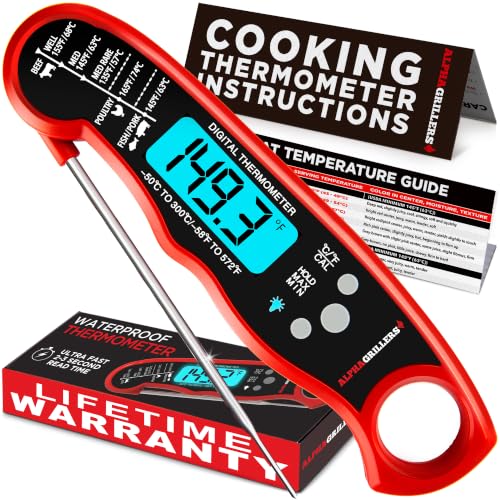
The Alpha Grillers instant read thermometer costs a fraction of the options above, carries a lifetime warranty, and has a bright backlight that is genuinely useful if you tend to grill after work when the sun is already going down. It reads in 2 to 4 seconds, a bit slower than the premium options above, but is still far more reliable than cutting into the steak to check.
Grilling Steak in Specific Situations
Grilling from frozen. It works better than most people expect for thin cuts under an inch, since a hard sear on a frozen exterior actually limits the overcooked gray band around the edges. Add roughly 50 percent to your grilling time and confirm doneness with a thermometer rather than the clock, since frozen steaks are the situation where time estimates are least reliable. For anything over an inch thick, thaw in the fridge overnight or in a sealed bag in cold water for more even cooking.
Grilling on an apartment balcony or with a small electric or tabletop grill. These units often run 100 to 150°F cooler at the grate than a full-size gas or charcoal grill, even with the dial on high. If your steak is browning slowly and never developing a real crust no matter how long you leave it, that is a heat ceiling problem, not a technique problem. Getting the pan or grate as hot as the unit allows and patting the steak fully dry before it hits the heat helps more than extra time does. If your current grill genuinely cannot get hot enough to sear a steak, our Weber grill buying guide breaks down which models, including compact and electric options built for small patios, actually reach searing temperatures.
Grilling a thick cut, 2 inches or more. A direct hot sear the whole way through will burn the outside before the center catches up. Sear both sides hard for 90 seconds to 2 minutes each over direct heat, then move the steak to indirect heat, close the lid, and let it finish more gently until it hits your pull temperature. This is the reverse sear approach and it is the difference between an even medium rare edge to edge and a steak with a thick gray band around a small pink center.
No thermometer on hand. The hand test, where you compare the firmness of the steak to the muscle at the base of your thumb as you touch different fingers to it, can get you in the right range once you have calibrated it against a thermometer a few times. It is not reliable the first time you try it, particularly on a cut you have not grilled before, so treat it as a backup skill rather than your primary method. A basic instant read thermometer costs less than a single steak dinner and removes the guesswork entirely.

Step by Step, From Fridge to Rest
- Temper the steak. Let it sit at room temperature for 30 to 40 minutes before grilling. A cold center is the main reason a steak looks perfectly seared outside and is still cool and underdone in the middle.
- Season generously. Kosher salt and coarse black pepper on both sides, applied right before it hits the grill.
- Preheat fully. Charcoal needs the coals ashed over gray. Gas needs a full 10 to 15 minutes with the lid closed. A grill that has not fully preheated is the most common reason a steak sticks to the grates.
- Sear, then flip once. Constant flipping and poking releases juice and slows the crust from forming. One flip per side is enough for most cuts.
- Check temperature early. Start checking with your instant read thermometer a minute or two before your estimated finish time, and pull at 5°F below your target doneness.
- Rest before cutting. Five to ten minutes, loosely tented with foil. Cutting immediately lets the juice run out onto the cutting board instead of staying in the meat.
Frequently Asked Questions
Why does my steak look done outside but raw in the middle?
Usually a cold center, a cut that is thicker than the chart you followed accounted for, or heat that is too high for the thickness of the steak. Thick cuts need a lower, longer approach like the reverse sear described above, not just more time at full blast.
Should I oil the steak or the grates?
Oil the steak lightly rather than the grates, which reduces flare-ups and sticking without leaving oil to smoke off on the grate surface. For which oil actually holds up at grill temperatures, see our guide on cooking steak with vegetable oil.
Do thicker steaks always need more total time?
Yes, but not proportionally. A 2 inch filet does not take twice as long as a 1 inch strip steak. It needs a gentler, more indirect finish so the center reaches temperature before the outside overcooks, which is a technique change, not just added minutes on the same direct heat.
Last update on 2026-11-10 / Affiliate links / Images from Amazon Product Advertising API
This post contains affiliate links, which means I may receive a small commission, at no extra cost to you, if you make a purchase using these links.


