


The wonders of the night sky could be even more appealing to kids than they are to us. Equipped with the right telescope, they can see many facts they read on the pages of their textbooks regarding the cosmos.
Using the best telescope for kids, children can develop a fascination for astronomy and science that could lead to a lifelong passion.
Today, I will discuss telescopes manufactured for young, aspiring astronomers. I have identified the most suitable scopes for three different age groups.
If you are looking to buy a telescope for your kid or younger sibling, this article will serve as the perfect guideline for you.
Alongside enlisting the best telescope models for junior users, I have also chewed over a few other important facts.
Before we get into all that, I must tell you to exercise caution before letting your kid have his or her first astronomical gear.
NB: Younger children should only operate the scope under strict parental supervision to avoid severe ocular injuries.
Table of Contents
Best Telescope for Kids Aged Under 6: A Chartwise Comparison
| Telescope | Features |
| Educational Insights Nancy B’s Science Club MoonScope | 60mm aperture, 360mm focal length, Suitable for viewing the moon and some nearby planets, Compatible with STEM curriculum |
| Black Twinstar 60mm | 60mm aperture, 300mm focal length, Alt-Azimuth mount, Suitable for watching the moon, planets and some bright star clusters |
| Educational Insights GeoSafari Jr. Talking Telescope | Slide shows with exciting commentary in four languages, Contains 24 high-resolution photos provided by NASA and has a Convenient double eyepiece design. |
Best Telescope for Kids Aged 6 and Above: A Chartwise Comparison
| Telescope | Aperture | Focal length | Focal ratio | Magnification | Mount type | Weight |
| Celestron 80mm Travel Scope | 80mm | 400mm | F/5 | 40x | Alt-Azimuth | 4.5lbs |
| Celestron PowerSeeker 127EQ | 127mm | 1000mm | F/7.87 | 250x | Equatorial | 21.38lbs |
| Meade Instruments 209003 Infinity 70mm Refractor Telescope | 70mm | 700 | F/10 | 78x | Alt-Azimuth | 7lbs |
Best Telescope for Kids Aged 10 and Above: A Chartwise Comparison
| Telescope | Aperture | Focal length | Focal ratio | Magnification | Mount type | Weight |
| Orion Starblast 10015 Astro Reflector | 70mm | 400mm | F/5.7 | 75x | Alt-Azimuth | 13lbs |
| Celestron NexStar 130SLT Computerized Telescope | 130mm | 650mm | F/5 | 72x | Alt-Azimuth | 18lbs |
| Meade Instruments 209006 Infinity 102mm AZ Refractor Telescope | 102mm | 600mm | F/5.9 | 95x | Alt-Azimuth | 12.2lbs |
| Orion StarBlast II 4.5 Equatorial Reflector Telescope | 114mm | 450mm | F/4 | 45x | Equatorial | 20.7lbs |
Best Telescopes for Kids: My Picks
A telescope that caters to the needs of an 8-year-old might not be good enough for a teenager. That’s why I have categorized these telescopes into three different age groups. We will start with children aged 6 or below-
Best Telescopes for Age 6 and Under
1. Educational Insights Nancy B’s Science Club MoonScope
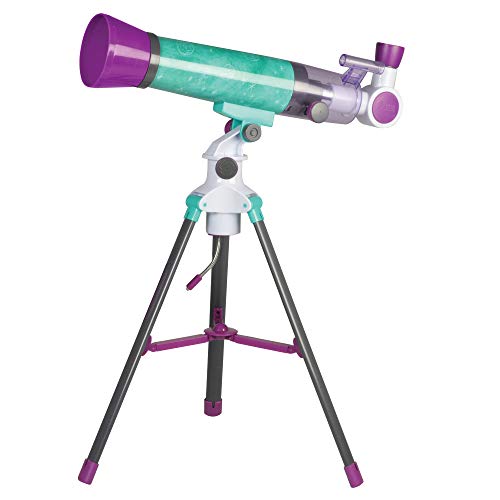
Moon is the brightest and largest thing visible to the naked eye in the night sky. So, it is understandable that most of us develop our fascination for the nocturnal sky, looking at the shiny silvery surface of the moon.
Your kids could feel the same way if they get to take a closer look at it, and Educational Insights Nancy B’s Science Club MoonScope could be the perfect equipment for his first moongazing session.
This telescope comes with STEM support so that your child can have a valuable self-learning experience. There’s also a moon filter for excellent lunar viewing.
Specifications
- Aperture: 50mm
- Focal length: 360mm
- Focal ratio: F/5.2
- Magnification: 90x
- Weight: 1 lb
Features
- STEM Support: Specifically designed as a tool to be used for STEM (Science, Technology, Engineering, and Math) education. Using this scope enables children to have a practical learning experience about the wonders of space while they are playing.
- Illustrated Activity Guide: The scope comes with a 22-page activity guide that entices the children with its colorful presentation of the cosmos and the scope’s use.
- Accessories: The package contains a MoonScope, as the name suggests. It also has two glass-made eyepieces (4mm and 20mm), a moon filter, a tripod, and a finder scope.
Pros
- Designed on a play and learn the principle. It could be used as a teaching tool for STEM curriculum.
- Features fun and informative learning guide.
- Comes along with two 18x and 90x magnifiers for lunar viewing. Also accompanied by a moon-specific filter to boost your moon-watching experience.
- It can be used by children belonging to a broader age group.
Cons
- The tripod that comes with the scope isn’t long enough. Moreover, it is non-adjustable, leaving you with minimal options if you want to realign your scope.
- There is no accessory tray to hold the lenses.
2. Black Twinstar 60mm
If simplicity tops your list of priorities while you are buying a children’s telescope, you will have a hard time finding a better candidate than Black Twinstar 60mm.
It is fairly straightforward to assemble and use, and even if you have problems putting it together, the accompanying instruction guide has detailed directions for you.
Regarding specs, I would say the 60mm objective lens and the 300mm focal length makes Black Twinstar 60mm a stand-out piece.
You will have superb value for your investment buying this scope, considering the technical prowess it has to offer.
You can view the moon, the planets, and nearby constellations with fantastic detail with Black Twinstar 60mm. The clarity is so good that you might forget you are using a scope made for children.
Specifications
- Aperture: 60mm
- Focal length: 300mm
- Focal ratio: F/5
- Magnification: 50x
- Mount type: Alt-Azimuth
- Weight: 4.1 lbs
Features
- 300mm Focal Length: The 300mm focal length of the scope allows it to vary its magnification range from 15x to 50x. This will prove to be a handy attribute when you try to view objects located at various distances.
- Easy to Assemble: Very few people would find it difficult to put together this scope. Attach the scope on its mount, then place the finder scope on the finder scope holder, and finally enter the eyepieces to complete the setup.
- Kid’s Lunar Bundle: To sweeten the pot, Twin Star throws in a Kid’s Lunar Bundle package, which includes a lunar map, a space book, and 12 glow in the dark stickers.
Pros
- The setup process is easy to figure out.
- You can buy it in two different bundle offers.
- The Alt-Azimuth mount is easy to use and adjust.
Cons
- No auto-tracking options. You need to configure the mount manually.
3. Educational Insights GeoSafari Jr. Talking Telescope
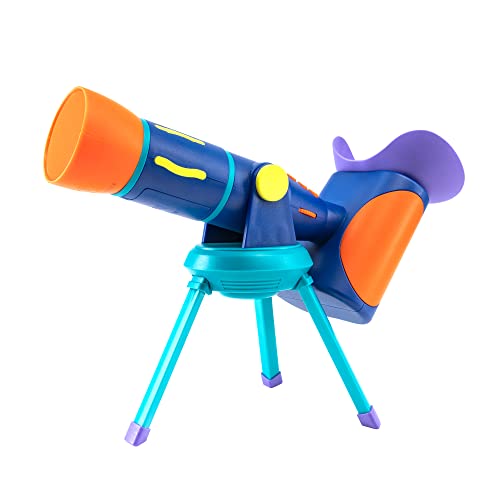
Educational Insights GeoSafari Jr. Talking Telescope is more of a toy rather than a telescope, but it does have some exciting features that make it the perfect astronomy tool for children aged five or below.
If you want to embed the love of space into a child’s mind at a very early age, there is hardly a better alternative than Educational Insights GeoSafari Jr. Talking Telescope.
Toddlers love toys that can utter a few words, which makes this talking telescope a brilliant selection for introducing space to your children.
The recorded voice of Xploration Outer Space host Emily Dawn Calandrelli describes the images that pop up in the eyepieces in a playful manner and makes your kids familiar with the planets and stars.
Specifications
- Design: Double eyepiece design
- Batteries: 3 AAA batteries (not included)
- Audio: English, German, French, and Spanish
Features
- Space Pictures and Trivia: The telescope has 24 NASA-provided images of space, planets, and the stars. The commentary includes trivial facts on each of these objects.
- Double eyepiece design: The scope incorporates a double eyepiece design, which is easier to look at.
- Voiced by Emily Dawn Calandrelli: Voiced by none other than Emily Dawn Calandrelli, the host of the popular space show Xploration Outer Space. Her captivating voice performance is the obvious highlight of this item.
Pros
- Images of space objects with fun trivia and facts.
- You can choose between Fact and Quiz modes.
- Emily Dawn Calandrelli shares her space insights in an engaging style.
- An effective tool to create a spark for astronomy in pre-school kids.
Cons
- Flimsy build. Gets damaged quite easily.
Age 6 and up
1. Celestron – 80mm Travel Scope
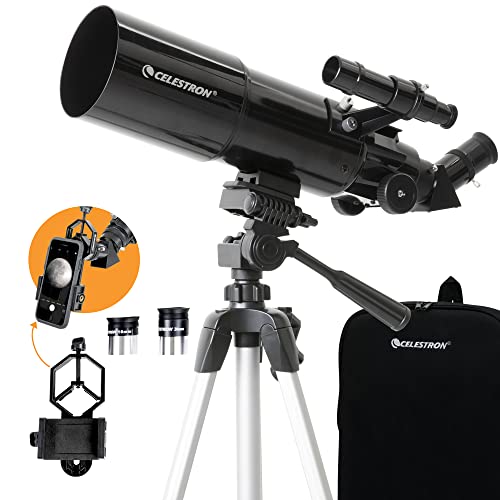
For kids aged 6 and above, Celestron’s 80mm Travel Scope could be an excellent pick to get their astronomy adventure off and running.
This is one of Celestron’s best sellers because of its affordability and riches of options.
This scope comes equipped with an impressive 80mm aperture and a focal length of 400mm, which gives it an outstanding focal ratio of 5.
If you do not know why you would care about that number, you should know a focal ratio of f/5 is optimal for wide-field viewing, meaning you will get to have a better look at deep sky objects, which appear faint in many low-budget telescopes.
Specifications
- Aperture: 80mm
- Focal length: 400mm
- Focal ratio: F/5
- Magnification: 40x
- Mount type: Alt-Azimuth
- Weight: 4.5 lbs
Features
- Brilliant Optics: The glass-based optics of this scope tics all the boxes you would look for in a top-shelf refractor telescope. The 800mm objective lens, combined with the 20mm and 10mm eyepieces, is capable of creating vivid imagery of a handful of celestial objects.
- Accessories: The accessories coming alongside this scope make it an irresistible deal to turn down. Upon purchasing a Celestron 80mm Travel Scope, you will get a stylish backpack carrier, a full-length tripod, a smartphone adapter, and a free download option of Celestron’s Starry Night software.
Pros
- Offers free accessories, including a rugged travel backpack and a smartphone adapter.
- Weighs considerably less than other similar telescopes.
- Easy to assemble.
- The ideal focal ratio for wide-field observation.
Cons
- The tripod is not stable enough.
- The plastic materials made the telescope lightweight but also compromised its endurance. Definitely not the sturdiest telescope you would find within this price range.
2. Celestron – PowerSeeker 127EQ
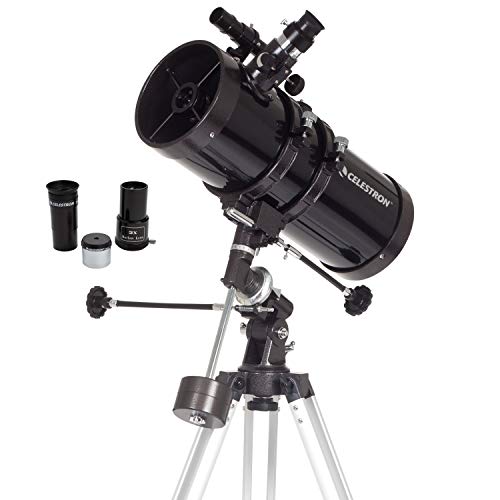
Even though it’s marketed as an entry-level telescope, Celestron PowerSeeker 127EQ is well admired by astronomy fans who have been in the field for a while.
With quality features and reasonable pricing, this scope has everything you would want in your first telescope.
The optics of the scope are satisfactory. The eyepieces that are packed with the scope (10mm and 20mm) can be used to view many planets and constellations without any extra help.
If you need some bonus magnification, the 3x Barlow lens has covered you. It yields a threefold enhancement of magnification for each of the eyepieces, meaning you can derive as much as 750x magnification from this unit.
Specifications
- Aperture: 127mm
- Focal length: 1000mm
- Focal ratio: F/7.87
- Magnification: 250x
- Mount Type: Equatorial
- Weight: 21.38lbs
Features
- Equatorial mount: Celestron Powerseeker 127EQ boasts a handy equatorial mount with slow-motion control cables that gives you the opportunity to track a moving object across the night sky precisely.
- Barlow lens: The 3x Barlow lens that comes with the scope can triple the magnification power of each of the eyepieces.
- Versatile: Celestron Powerseeker 127EQ is a telescope that has something to offer to all kinds of astronomers. Yes, it’s a beginner-friendly telescope, but with great focal length and aperture backed up by top-notch optics, this telescope also has a lot to offer to advanced users.
Pros
- Astonishing magnification range that lies between 50x-250x. You can further bolster this with the 3x Barlow lens that is included in the package.
- The EQ mount is complemented with great altitude and motion controls.
- It can be used by advanced users.
Cons
- The mount takes a bit of time to get used to.
3. Meade Instruments 209003 Infinity 70mm Refractor Telescope

The Meade Infinity 70mm Alt-Azimuth Refractor Telescope is another alternative to consider as we continue our search for the best telescope for kids.
Being a refractor telescope, you can also use this scope for terrestrial viewing during the daytime.
This model has been designed keeping budding astronomers in mind. You will see some criticisms online about the optics of this model, most of them blaming noticeable chromatic aberrations at high magnification phases.
This is a problem that haunts most telescopes at this price range. For a kid who is just getting started, this will make no significant impact on his learning curve.
Rather, its highly effective laser finder, responsive controls, and fully coated eyepieces make this a superb choice for planetary exploration.
Specifications
- Aperture: 70mm
- Focal length: 700mm
- Focal ratio: F/10
- Magnification: 78x
- Mount type: Alt-Azimuth
- Weight: 7lbs
Features
- Slow Motion Control Rods: The slow-motion control rods smoothly adjust the Alt-Azimuth mount to pinpoint the location of your target object.
- Terrestrial Viewing: You can use this under daylight to conduct landscape observation.
- 90 Degree Erect-Prism Diagonal: Whether you are looking at Jupiter or a flock of flying birds over the horizon, the 90 Degree Erect-Prism Diagonal will ensure you see it as it is instead of being content with images flipped upside down, which is a common nuisance in refractors.
Pros
- Includes a 2x Barlow lens capable of doubling the magnification power of the eyepieces.
- The 90 Degree Erect-Prism Diagonal eliminates the possibility of upside-down images.
- The red dot viewfinder is easy to point and locate a target.
Cons
- Suffers chromatic aberrations when highly magnified.
- The tripod mount is unsteady.
Age 10 and Up
1. Orion 10015 StarBlast 4.5 Astro Reflector Telescope

If you don’t want to go through the trouble of assembling a telescope after buying, Orion Starblast 10015 Astro Reflector is a godsend for you.
The telescope comes pre-assembled and ready to go. So, all you need to do is just unbox it.
For the price, you will not get premium magnification from this scope, which is obviously a frustrating point. But within its viewing range, it can treat you with crisp, high-definition imagery.
You can observe the moon and some of our neighboring planets in great detail. Galaxies and nebulae are not out of the equation as well.
Specifications
- Aperture: 70mm
- Focal length: 400mm
- Focal ratio: F/5.7
- Magnification: 75x
- Mount type: Alt-Az
- Weight: 13lbs
Features
- Grab and Go Design: Comes pre-assembled. So, it’s ready for use as soon as you take it out of the box.
- Stable Tabletop Base: The tabletop base gives the scope exceptional stability and allows the Alt-Az mount to move smoothly.
- Starry Night Software: You will receive a free version of Orion’s Starry Night software upon buying this telescope. The app is a fantastic tool to refer to for honing your stargazing skills.
Pros
- Generates high-resolution images.
- Ships pre-assembled. You will just have to unbox it.
- Compact and lightweight design.
- Collimation cap to help you collimate the scope.
Cons
- Not suitable for deep sky observations.
- The instruction manual is difficult to understand.
2. Celestron – NexStar 130SLT Computerized Telescope
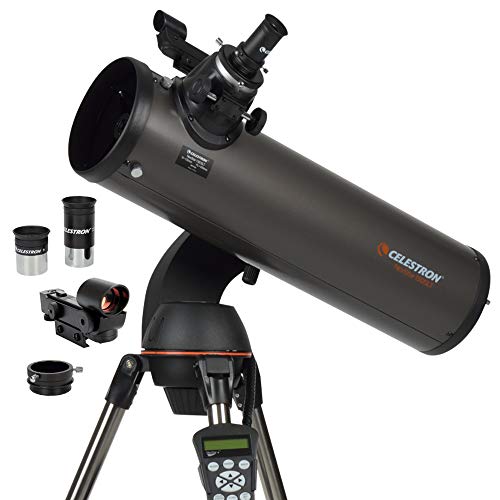
The Celestron NexStar 130SLT Computerized Telescope is one of my personal favorites because of the myriad of utilities it has to offer at a justifiable price.
Due to its user-friendly design, this scope can be easily operated by a rookie astronomer even though some of its functions are targeted toward more experienced users.
The Celestron NexStar is the modern iteration of Newtonian reflectors and uses the principles of Newton’s classic mirror-based telescope to view objects.
The aluminized glass mirrors collect photons and create a reflection of the object at a focal point.
You don’t need to do anything on your own to find a space body in the sky. The SkyAlign software will find your target for you and point the StarPointer finderscope right at it.
All you need to do is type in what you intend to see, and the rest will be taken care of.
Specifications
- Aperture: 130mm
- Focal length: 650mm
- Focal ratio: F/5
- Magnification: 72x
- Mount type: Alt-Azimuth
- Weight: 18lbs
Features
- Computerized Auto Location: The Celestron NexStar 130SLTis programmed to automatically detect the location of 40,000+ celestial objects.
- SkyAlign: The SkyAlign feature prepares your scope for space observation within minutes under the night sky. Simply place three bright objects in the finder scope, and the scope will be auto-aligned.
- Newtonian Reflector Design: The Celestron NexStar 130SLT incorporates a Newtonian reflector design to accumulate more light and create brighter pictures.
Pros
- Perfectly executed Newtonian reflector design.
- Computerized Alt-Azimuth mount can automatically follow the location of more than 40,000 space objects.
- SkyAlign feature for simple alignment of the scope.
Cons
- Batteries wear out fast.
- The mount is shaky.
3. Meade Instruments 209006 Infinity 102mm AZ Refractor Telescope
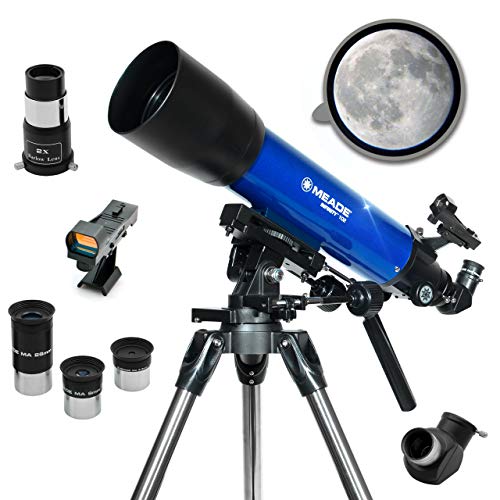
Meade Instruments 209006 Infinity 102mm telescopes have a larger aperture than any other telescopes in the company’s Infinity series.
Equipped with superior optical components and features, this telescope outperforms other Infinity entries in many aspects.
As the name suggests, this scope has a 102mm aperture, which pairs up with a focal length of 600mm to create a decent optical unit. You will get the best out of this scope at low magnification levels while viewing wide-field objects.
Despite having many upgraded features, Meade Instruments 209006 Infinity 102mm telescopes are not any better at viewing far-off objects.
You can have some excellent views of the moon and our solar system planets, and in suitable conditions, you could lay your eyes on some deep-lying sky objects.
Specifications
- Aperture: 102mm
- Focal length: 600mm
- Focal ratio: F/5.9
- Magnification: 95x
- Mount type: Alt-Azimuth
- Weight: 12.2lbs
Features
- Three Eyepieces: Meade Instruments 209006 Infinity 102mm ships with a 26mm (23x), a 9mm (67x), and a 6.3mm (95x) eyepiece for low, mid, and high magnification.
- 90 Degree Erect-Prism Diagonal: The 90 Degree Erect-Prism Diagonal system correctly orients the image of the object and facilitates a more comfortable angle for watching.
- Barlow lens: You can increase the magnification power by two times the original capacity of each of the lenses using the 2x Barlow lens that the manufacturers provide with the telescope.
Pros
- Comes with three eyepieces for three different levels of magnification.
- Provides correct image orientation.
- Easy to put together.
- 2x Barlow lens for superior magnification.
Cons
- The mount is not well balanced.
- Immune to chromatic aberrations during high magnification.
4. Orion StarBlast II 4.5 Equatorial Reflector Telescope
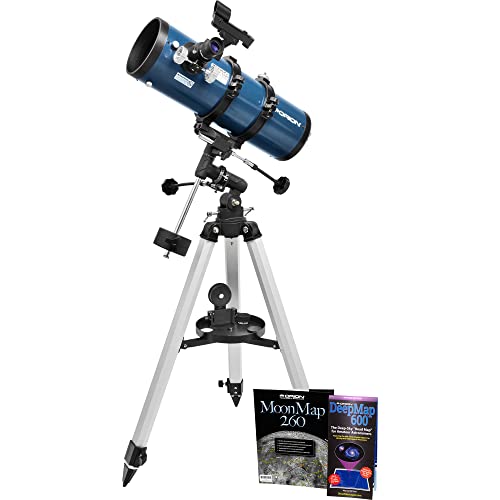
The final entry in my best telescopes for kids list is Orion StarBlast II 4.5 Equatorial Reflector Telescope, which has two default Sirius Plossls eyepieces.
These eyepieces are definitely of higher quality than the Kellners or plastic-made Plossls we notice in other similarly priced scopes as these produce crispier images and a wider field of view.
The equatorial mount in this scope also deserves a shout-out. One common complaint about equatorial mounts is that they are a nightmare to handle, but the ones used in Orion StarBlast are more compact and more comfortable to deal with.
The 114mm aperture is generous for a beginner-level scope and coupled with the flexibility of an equatorial mount. This is surely a nice piece of equipment to consider your first telescope.
Specifications
- Aperture: 114mm
- Focal length: 450mm
- Focal ratio: F/4
- Magnification: 45x
- Mount Type: Equatorial mount
- Weight: 20.7lbs
Features
- Superior Wide Field View: The F/4 focal ratio delivers a fantastic wide-field view experience, making the scope perfect for viewing objects within and beyond our solar system.
- Orion EQ-1 Equatorial Mount: The equatorial mount is relatively easier to handle and comes with a sleek design.
- Sirius Plossl Eyepieces: The package contains two Sirius Plossl eyepieces-a 25mm (18x) one and a 10mm (45x) one. These pieces enable a brighter, sharper, and clearer view of objects compared to default eyepieces used in other telescopes belonging to the same price margin.
Pros
- Easy to collimate.
- Excellent optics.
- User-friendly design.
- The equatorial mount is relatively easy to handle.
- High-quality Sirius Plossl eyepieces.
Cons
- The amount is subject to subtle vibrations once installed.
Telescope for Kids Buying Guide
Reflectors or Refractors?
Both reflector and refractor telescopes have their own pros and cons. As they use mirrors instead of lenses, reflectors are cheaper than refractors and are ideal for deep sky observation.
These telescopes also have a sturdier build, which makes them a practical pick for children. Moreover, reflectors are easier to operate and learn than other types of telescopes.
On the other hand, refractors are more expensive, but they do come with some unique perks. A refractor can be used both day and night, thanks to its all–lens design.
Also, they are more suitable for viewing the moon and planets than other reflectors.
Based on your preferences, you can opt for any one of these telescopes while buying a children’s telescope.
Alt-Az or EQ mount?
You also need to decide on what type of mount you want for the telescope you are buying for your kids. A mount serves two purposes-
1. It holds the telescope.
2. It helps to direct the scope towards a particular object.
There are two kinds of mounts- alt-azimuth (Alt-Az) and equatorial (EQ) mounts. Alt-Az mounts are cheaper, but they need to be manually repositioned when you are trying to keep track of a moving object in the sky.
EQ mounts do not have this hassle as it facilitates an effortless movement of the scope along its axis. They are, obviously, highly priced and also problematic to use while viewing objects on land.
Since your priority would be sky watching, I would advise you to buy an EQ mount if you have the budget.
Compare Aperture and Focal Lengths
When comparing telescopes, go for the ones with ideal focal length and aperture. If you have been reading from the start of this article, you know by now what aperture is and why it matters.
Besides aperture, there is one more feature you need to be looking at while purchasing a scope- its focal length.
Focal length is a metric that shows the strength of a lens’s capacity to converge/diverge light beams. In simpler words, focal length determines the magnification power of your scope. So, it helps if you can get a high focal length as well.
When Should I Buy A Telescope?
So, you want your kids to be interested in astronomy, or maybe their friends love astronomy, and they want it too. What should you do in such cases? Do you buy them a telescope right away?
Well, no one is stopping you from buying them one, but it’s better if you do some groundwork before getting them a scope. After all, it’s not a toy you are buying.
First, you need to find out whether they want to pursue astronomy as a hobby. And if they do, how serious are they? Is this a phase or like getting into supporting a sports club that sticks forever?
Take them to your local observatories and nearby astrology club events. If you sense they are enjoying the experience and want to learn more about the universe, then, by all means, buy them a telescope.
Ahead of buying a telescope, familiarize your kids with major celestial bodies and constellations. Introduce them to sky charts, and teach them how to locate an object using one.
Make sure they are prepared to take responsibility for a piece of delicate equipment. Once you feel convinced they are ready to use a telescope, buy them one.
How to Become an Expert Stargazer
The sky is a canvas of infinite proportions. Even with the aid of a powerful telescope, we can only view a minute fraction of the great outer space.
That said, there is still a myriad of objects you can lay your eyes upon using an entry-level telescope. Here is an introductory guide to stargazing for astronomy newcomers.
The first and foremost thing you need to be doing is to identify a perfect sky-watching spot. You would be up for disappointment if you plan on watching from an urban area.
The density of dust and other particles in the air is much higher in such locations, so you would be getting a hard time trying to locate your desired objects in the sky.
It would be ideal if you could drive out of the city and head towards a location that has less commotion and lower light pollution. You can take the help of this website to find out the nearest dark site where you can go and set up your telescope for a satisfying space observation session.
As I said before, there is no scarcity of things you can see in the sky with a beginner’s level telescope. Constellations, for instance, are easily viewable with these scopes.
You can see most of them with your naked eye, but using a telescope will enable you to view them in finer detail. You can use a star chart or a smartphone application like Star Guide to point out all 88 constellations in the sky.
If you direct your scope towards the northern sky, you can see the Ursa Major, aka ‘’the Great Bear’’. You can see this group of stars all year long.
Seven of the stars belonging to Ursa Major are the most luminescent ones, and they form a saucepan-shaped alignment. Astronomers call these stars “the Big Dipper.”
Draw an imaginary straight line from the two rightmost members of the Big Dipper, and you will find Polaris or the North Star.
Befitting to its name, the North Star lies in the northern direction, and for centuries sailors have used it as a natural compass for navigation.
Ursa Major is not the only constellation that adorns our northern sky the whole year-round. You can always see Ursa Minor, Draco, Cepheus, and Cassiopeia shining bright in the north.
Cygnus, Aquila, Lyra, Hercules, Scorpius, Sagittarius, and Ophiuchus can also be seen during the summer.
It’s indisputable that constellations are a treat to the eye, but nothing comes in comparison to the elegance of nature’s very own light show-meteor showers. The Perseids is the first name that comes to mind when discussing meteor showers.
It is a regular phenomenon between July 17 and August 24, when you can hope to see as many as 100 meteors per hour in the form of sparkling white streaks across the night sky.
While you are taking in the mindboggling view of the Perseids leaving their marks on the sky, keep your eye out for the Comet Swift-Tuttle. This is the comet that gives birth to Perseids as the debris fall off its body.
Comet Swift-Tuttle is one of the celestial objects that regularly fly past our planet.
It is common to mistake a human-made extra-terrestrial object for a star or other space bodies. Artificial satellites and space stations orbiting the earth often reflect sunbeams in our direction with their iridium panels. This incident is known as iridium flare.
In the event of an iridium flare, the satellite will appear as a moving object to an observer stationed on the ground. In such circumstances, novice astronomers frequently make the blunder of identifying them as celestial bodies.
You can use sites like Heaven Above to find out if any space stations or satellites are hovering over your observation spot to avoid such errors.
Types of Telescopes
Telescopes are basically of two types-refractors and reflectors. The key difference between these two types of telescopes lies in the components used for collecting light from the target object and the mechanism of passing light to our eyes from the target.
- Refractor Telescopes: Refractor telescopes are telescopes that use lenses to refract the light coming from the target and pass it to the eye of the observer.
- Reflector Telescopes: Reflector telescopes are telescopes that use mirrors to reflect the light coming from the target and pass it to the eye of the observer.
There is also a third kind of telescope, known as a catadioptric telescope. These scopes are sort of a refractor-reflector hybrid that uses both lenses and glasses to construct an image.
These scopes offer better accuracy and accommodate a wider aberration-free field of view.
Refractor vs. Reflector vs. Catadioptric Telescopes

| Refractor Telescope | Reflector Telescope | Catadioptric Telescope |
| 1. Uses lenses to construct images. | 1. Uses glasses to construct images. | 1. Uses both glasses and lenses to construct images. |
| 2. High chromatic aberration | 2. Low chromatic aberration | 2. Low chromatic aberration. |
| 3. Ideal for viewing planets and the moon. | 3. Ideal for viewing deep sky objects. | 3. Ideal for viewing both near and deep sky objects. |
| 4. More expensive. | 4. Cheaper than refractors. | 4. Costs more than both refractors and reflectors. |
What is Aperture, and Why is it so Important?
In the words of a dictionary, aperture refers to a hole or an opening. But in telescope talk, it is used to indicate the size of a scope’s primary optic component, which could be a glass or a lens, depending on the telescope’s nature.
If you ask me, I would say it is the most crucial attribute of a telescope as it defines the scope’s light capturing ability.
Telescopes are utterly reliant on their aperture to make us see distant objects hovering around space. Why is aperture so important? What makes it the ultimate benchmark for evaluating the competence of a scope?
Let’s assume you want to get some soda from a soda fountain. If you have a larger glass, you can get more soda.
The same principle works for telescopes and apertures-the larger the aperture is, the more light the scope can obtain from the viewing object. More light allows a clearer view.
This is the reason why telescopes are characterized by their aperture size. Assuming a bona fide design and up-to-the-mark material, a telescope with a larger aperture can give you higher magnification and sharper images.
Recommended Accessories: Making the Most out of Your Telescope
- Additional eyepieces: You will always find a use for additional eyepieces when you become a serious stargazer. Some objects look good on lower magnification, some appear better on higher magnification, and of course, each eyepiece has its set of limitations in different atmospheric and viewing conditions. So, it is helpful to have some extra eyepieces.
- Barlow Lens: A Barlow Lens is an accessory lens that can boost the original magnification power of your eyepieces. A 3x Barlow, for example, will magnify your eyepiece magnification by three times. It’s a cheaper option to consider if you need more magnification instead of buying additional eyepieces.
- Filters: Filters are like sunglasses for your eyepieces. They tone down the brightness of the light coming from the target object so that it becomes more visible. Moon filters are the most popular filters bought by telescope users as they make it easier to watch the moon during its brighter phases. Using the right filter, you can unearth more detail and reduce visual obstruction.
- Laser pointers: Laser pointers are quite convenient for night watching. The mini pen-shaped pointers are affordable and can easily fit into your finder scope holder. You can use it to pinpoint the location of a target. Point the laser towards the object and align your telescope with the beam. By doing so, you can view the target on the scope.
Best Telescope Brands
- Celestron: Celestron, formerly known as Valor Electronics, has been a pioneer in the field of optics since its inception in the mid-’50s. In 1970 the company revolutionized the telescope industry by releasing the famous “C8” model, which was the first Schmidt–Cassegrain catadioptric telescope produced at an unbelievably low cost.
- Orion: Since 1975, Orion has been serving its customers with high-quality telescopes. From beginner level to pro models, the company has a wide range of options at their disposal at very reasonable prices. Besides scopes, they also offer a vast collection of accessories that will make your journey into the cosmos even more special.
- Meade Instruments: Launching in 2008, Meade Instruments is relatively a newcomer to the telescope scene compared to the likes of Celestron and Orion. But they have already made a mark in the market with their innovative designs and posh features. Within a decade, the company has earned the trust of telescope enthusiasts worldwide.
Frequently Asked Questions
Should I buy a refractor or a reflector if the aperture is the same?
In case of similar apertures, a reflector will be a better choice because it offers lower color aberrations compared to their refractor counterparts.
They are also cheaper as they use mirrors instead of lenses. However, refractors are perfect for viewing the moon and other objects relatively closer to earth. Reflectors are best for viewing far-off objects.
What can I expect to see with my telescope?
Of course, you can’t see everything in the universe, given its infinite nature. But still, you can enjoy the site of a plethora of extra-terrestrial objects like the moon, the planets in our solar system, galaxies, nebulae, and constellations with an entry or intermediate-level telescope.
Sometimes, you will have to use appropriate filters with your telescope eyepieces to expect accurate imaging.
Can I look at the sun using a telescope?
It would be best if you do not look at the sun directly with your scope. The sun’s rays are intense and can cause critical damage to your eye.
However, you can have a good look at the sun using a solar filter, which minimizes the light transmission and ensures the safety of your eyes.
Final Verdict
The idea behind discussing the scopes in three different age categories was to make you realize which scopes fit your child’s profile the best.
I hope my best telescope for kids article has given you a better understanding of the telescope you would deem ideal for your kids.
Last update on 2024-04-05 / Affiliate links / Images from Amazon Product Advertising API
This post contains affiliate links, which means I may receive a small commission, at no extra cost to you, if you make a purchase using these links.
